How Credit Scores Are Calculated and What Affects Them
Understanding credit score calculation can help you see why your score changes and what matters most to lenders. From payment history to credit utilization, a few key habits can make a big difference over time.
By: Mary Smith on July 25, 2026
A credit score can shape everything from the interest rate on your car loan to whether a landlord takes your rental application seriously. Yet many people still wonder how credit scores are calculated and what can affect them in the first place. The answer is more straightforward than it seems, but the details matter.
At a high level, credit scores are built from the information in your credit reports. Lenders, credit card issuers, and scoring models look at how you borrow, how consistently you pay, and how much of your available credit you use. The result is a number that helps predict how likely you are to repay borrowed money on time.
Understanding how credit scores are calculated can help you make smarter financial decisions, avoid common mistakes, and improve your credit over time. Let’s break it down in a clear, practical way.
How Credit Scores Are Calculated
Credit scores are not random. They are created using mathematical models that analyze your credit history and assign points based on patterns that suggest risk or reliability. The most commonly used scoring model is FICO, though VantageScore is also widely used.
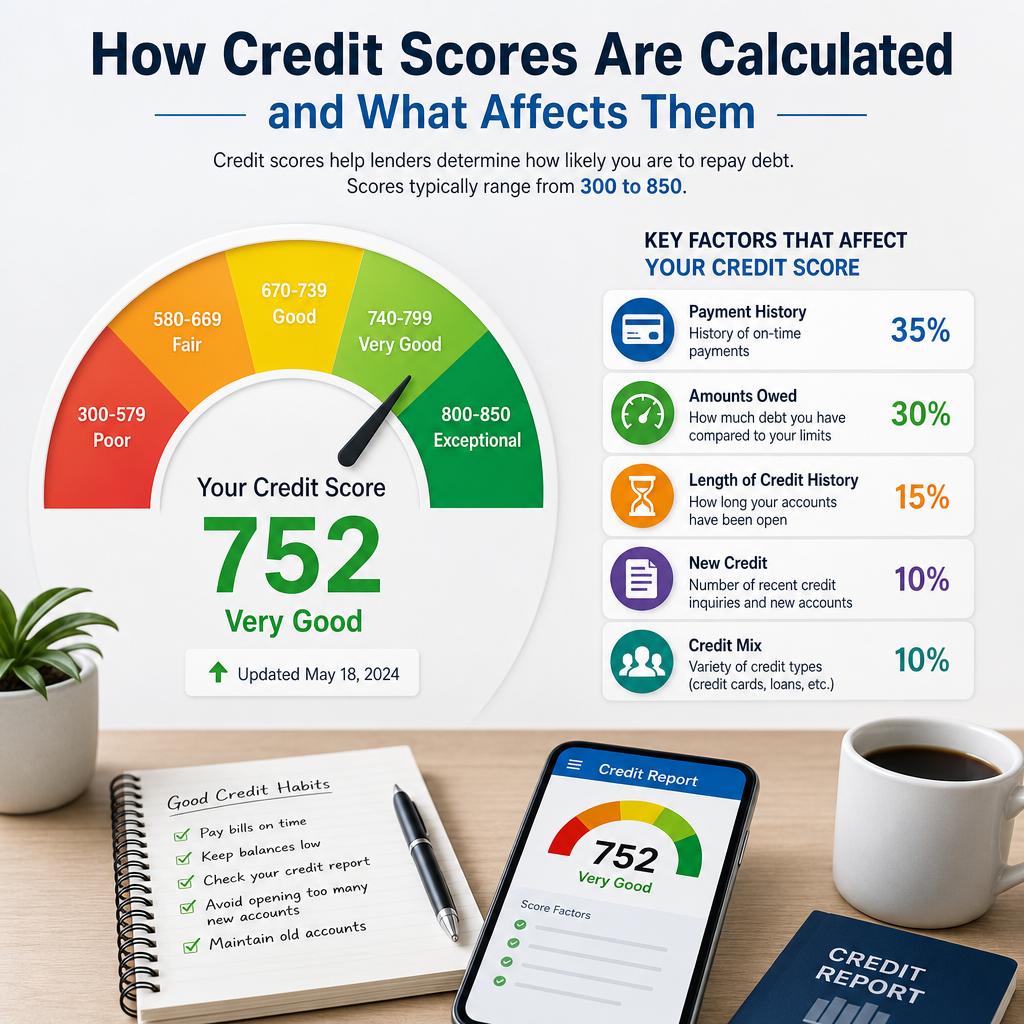
While each model uses its own formula, the main factors are similar. In general, your score is influenced by:
Payment history
Credit utilization
Length of credit history
New credit inquiries
Credit mix
Other information in your credit report
These factors do not all count equally. Some have a much bigger impact than others.
1. Payment History
Payment history is usually the most important factor in credit scoring. It shows whether you pay your bills on time.
Late payments, accounts sent to collections, charge-offs, and bankruptcies can hurt your score significantly. Even one missed payment may matter, especially if it is reported as 30 days late or more.
On the positive side, a long record of on-time payments builds trust with lenders and helps strengthen your score.
2. Credit Utilization
Credit utilization refers to how much of your available revolving credit you are using. This is most often measured on credit cards.
For example, if you have a card with a $10,000 limit and carry a $2,000 balance, your utilization on that card is 20%.
In general:
Lower utilization is better
High balances can signal risk
Paying down revolving debt can help your score
Many people aim to keep utilization below 30%, but lower is often better if you can manage it responsibly.
3. Length of Credit History
The longer your credit history, the more data lenders and scoring models have to evaluate.
This factor looks at things like:
Age of your oldest account
Age of your newest account
Average age of all accounts
Older accounts can support a stronger score because they show a longer track record of responsible borrowing. That is one reason it can help to keep older credit cards open, even if you use them only occasionally.
4. New Credit and Inquiries
When you apply for new credit, lenders often check your report with a hard inquiry. A few inquiries are normal, but too many in a short time can make you look like a higher-risk borrower.
Opening several accounts quickly can also lower your average account age, which may affect your score.
That said, not every inquiry has the same impact. For example, rate shopping for a mortgage or auto loan within a limited window is usually treated more favorably by scoring models.
5. Credit Mix
Credit mix refers to the different types of credit accounts you have. These may include:
Credit cards
Auto loans
Mortgages
Personal loans
Student loans
A healthy mix can help, but this factor usually matters less than payment history or utilization. You should never open unnecessary accounts just to diversify your credit mix. Responsible borrowing matters more than quantity.
6. Information in Your Credit Reports
Credit scores are based on the data in your credit reports, so any errors or outdated information can affect your score. Inaccurate late payments, accounts that do not belong to you, or incorrect balances can lead to an unfairly low number.
Reviewing your reports regularly is one of the best ways to protect your credit.
What Can Affect Your Credit Score
Now that you know how credit scores are calculated, it helps to look at the real-life behaviors and events that can move your score up or down.
Payment Habits Matter Most
Your day-to-day payment habits have a major effect on credit health. Even if you have a strong score today, one setback can cause problems if it turns into a pattern.
Things that can hurt your score include:
Missing due dates
Paying only the minimum on high balances for a long time
Letting accounts go to collections
Ignoring old debts that resurface
To stay on track, consider:
Setting up payment reminders
Enrolling in autopay for at least the minimum due
Using due-date calendars or budgeting apps
Contacting lenders early if you expect trouble
Example: A Missed Payment
Suppose you forget a credit card payment and it is reported as 30 days late. That one missed payment can lower your score, especially if your credit file is otherwise clean. If you continue paying late, the damage can grow. But if you quickly bring the account current and keep up with future payments, your score can recover over time.
Credit Card Balances Can Move Your Score Quickly
High credit card balances often affect scores faster than many people expect. That is because revolving debt is closely tied to utilization.
For example, if you charge a large vacation, medical expense, or home repair to a card and carry the balance through the statement closing date, your utilization may rise sharply. Even if you plan to pay it off later, the reported balance can still affect your score for that billing cycle.
A few smart habits can help:
Pay down balances before statement dates
Spread spending across cards if needed
Ask for a credit limit increase only if it won’t trigger overspending
Avoid maxing out any single card
Opening and Closing Accounts Can Have Side Effects
Opening a new account can help in some situations, especially if it adds a positive payment history over time. But in the short term, it may cause a temporary dip because of the hard inquiry and reduced average age of accounts.
Closing an account can also affect your score, particularly if it reduces your total available credit and raises utilization. It may be worth keeping an older no-fee card open, even if you use it only for a small recurring purchase.
Practical Tip
If you want to keep a card active without relying on it heavily, try putting a small subscription on it and paying it off each month. That can help preserve the account history while keeping the balance low.
Derogatory Marks Can Hurt for Years
Some negative items carry more weight than others, but all can affect your score.
Common derogatory marks include:
Late payments
Collections
Repossessions
Foreclosures
Bankruptcy
These events can remain on credit reports for several years depending on the type of item. While they do not define your credit forever, they can make borrowing more expensive or harder for a while.
The best response is to focus on rebuilding with consistent on-time payments, low utilization, and patience.
What Does Not Affect Your Credit Score
A lot of people worry about things that do not directly affect credit scores. Clearing up the myths can reduce stress and help you focus on what actually matters.
Usually, these do not affect your score:
Checking your own credit report or score
Your income
Your job title
Your bank account balance
Your age
Your marital status
Your race, religion, or other protected characteristics
Landlords, employers, or lenders may review some of this information for their own reasons, but it is not part of your credit score calculation.
How to Improve Your Credit Score Over Time
Improving credit is not about quick tricks. It is about building a reliable history that scoring models can recognize.
Here are some of the most effective steps:
Pay every bill on time.
Even one late payment can hurt, so consistency is key.
Keep credit card balances low.
Lower utilization usually supports a better score.
Avoid unnecessary applications.
Only apply for credit when you truly need it.
Keep older accounts open when possible.
A longer credit history can work in your favor.
Check your credit reports for errors.
Dispute inaccurate information promptly.
Use credit responsibly.
A mix of healthy habits matters more than trying to game the system.
Example: Building Credit After a Setback
If your score dropped because of high balances and a missed payment, you can begin rebuilding by paying down debt, setting automatic payments, and avoiding new applications for a while. Over time, the negative impact of old mistakes may fade as newer positive activity takes center stage.
How Often Do Credit Scores Change?
Credit scores can change frequently. In many cases, they update whenever a lender reports new account activity to the credit bureaus. That might happen monthly, though timing varies.
A score may change because you:
Paid down a balance
Missed a payment
Opened a new account
Closed a card
Had an inquiry added
Had an error corrected on your report
Because of this, it is smart to monitor your credit regularly, especially if you are preparing to apply for a mortgage, auto loan, or major lease.
When you understand how credit scores are calculated, you can make better choices with real payoff. Instead of guessing, you can focus on the actions that matter most.
That knowledge can help you:
Qualify for better loan terms
Lower borrowing costs
Reduce stress before applying for credit
Catch mistakes before they cause damage
Build a stronger financial foundation
Credit scores are not just numbers. They are summaries of your borrowing behavior, and they respond to habits over time.
Frequently Asked Questions
What is the most important factor in credit score calculation?
Payment history is generally the most important factor. Lenders want to see that you pay on time, and scoring models reward a consistent record of on-time payments. Late payments and collections can have a serious negative effect.
How much does credit card utilization affect credit scores?
Credit utilization can have a major impact, especially on revolving accounts like credit cards. High balances relative to your credit limit may lower your score, while lower utilization often helps. Keeping balances manageable is one of the simplest ways to support better credit.
Does checking my own credit score hurt it?
No. Checking your own credit is usually considered a soft inquiry and does not affect your score. In fact, reviewing your reports regularly is a good habit because it helps you spot errors and monitor changes.
How long do late payments stay on a credit report?
Late payments can remain on your credit report for several years, depending on the reporting rules and the type of account involved. Even though the impact often lessens over time, the best approach is to avoid future late payments and rebuild positive history.
Can I improve my credit score quickly?
Some changes can help relatively fast, such as paying down credit card balances or correcting reporting errors. Other improvements, like rebuilding after missed payments, take longer. The fastest progress usually comes from lowering utilization and maintaining perfect payment habits.
Understanding how credit scores are calculated gives you real control over your financial life. Instead of treating credit as a mystery, you can focus on the habits that matter most: paying on time, keeping balances low, avoiding too many new applications, and checking your reports for accuracy. These are not flashy strategies, but they are the ones that tend to make the biggest difference over time.
If your credit score is already strong, these habits can help you protect it. If it needs work, the good news is that credit can improve with steady effort and patience. The key is consistency. Small decisions, repeated month after month, can lead to meaningful progress.
Start with the basics: review your credit reports, pay every bill on time, and keep your credit card usage in check. From there, you can build a healthier credit profile and open the door to better borrowing opportunities in the future.
Mary S, CFP®, is a Certified Financial Planner with over 12 years of experience in personal finance, retirement planning, and wealth management. She writes educational content that helps readers understand financial concepts and make informed decisions based on reliable information.