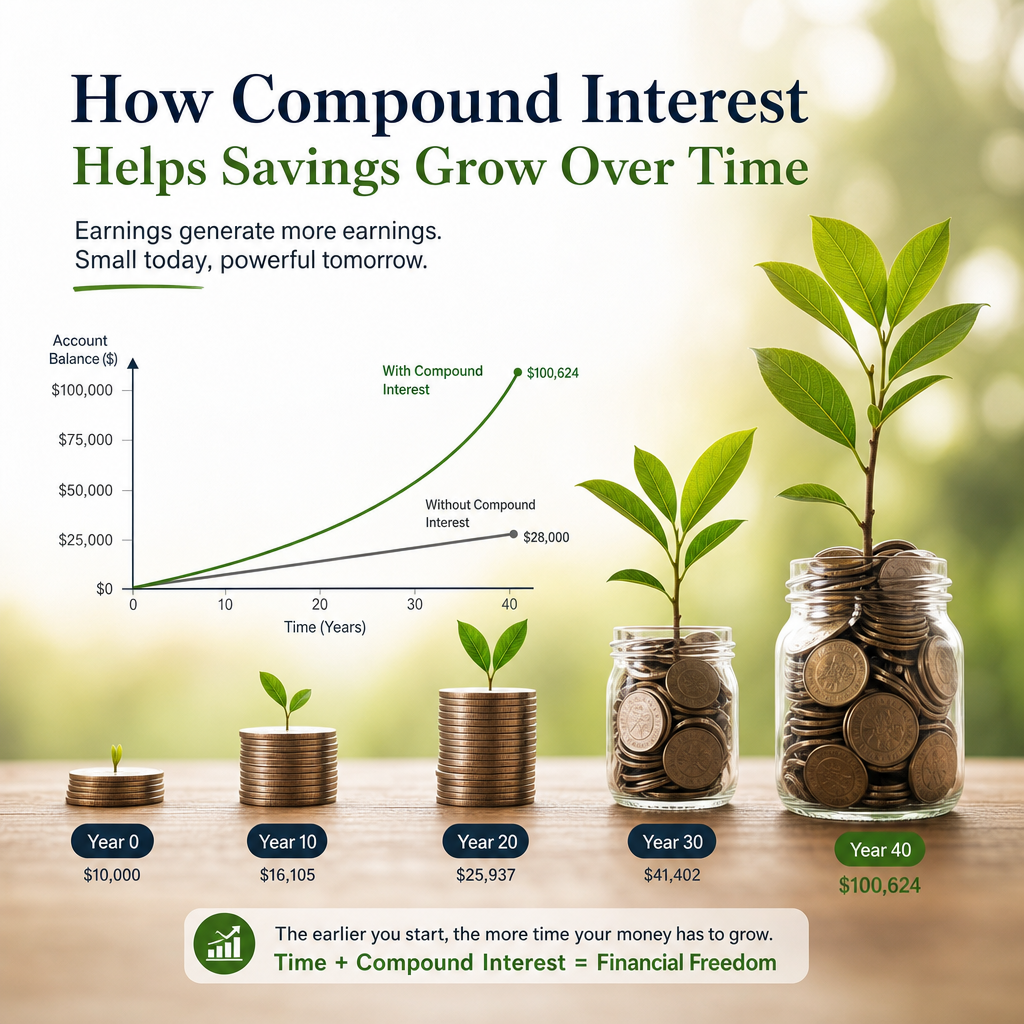
How Compound Interest Helps Savings Grow Over Time
Compound interest helps your savings grow faster by earning interest on both your original deposit and the interest it has already made. The earlier you start, the more time your money has to build momentum and grow over time.
By: Mary Smith on July 25, 2026
Saving money is easier when you can see a clear payoff for your effort. That’s where compound interest comes in. Instead of earning interest only on your original deposit, compound interest helps your savings grow on both the money you put in and the interest your account has already earned. Over time, that simple idea can make a meaningful difference.
If you’ve ever wondered why financial experts encourage people to start saving early, the answer often comes down to compound interest. It rewards patience, consistency, and time. Whether you’re building an emergency fund, saving for a home, or putting money aside for retirement, understanding how compound interest works can help you make smarter decisions with your money.
What Is Compound Interest?
Compound interest is interest earned on both your principal—the amount you originally save—and the interest that accumulates over time. In contrast, simple interest is calculated only on the original amount.
Here’s the basic idea:
You deposit money into a savings account.
The bank pays interest on that deposit.
In the next period, you earn interest on the original deposit plus the interest already added.
This cycle continues, allowing your balance to grow faster over time.
That’s why compound interest is often called “interest on interest.” It can work in your favor when you save and against you when you borrow.
A Simple Example
Suppose you put $1,000 into a savings account earning 5% annual interest, compounded yearly.
After year 1, you earn $50 in interest.
Your balance becomes $1,050.
In year 2, you earn 5% on $1,050, not just $1,000.
That means you earn $52.50 in year 2.
The difference may seem small at first, but over many years, the growth becomes more noticeable.
How Compound Interest Helps Savings Grow Over Time
The biggest advantage of compound interest is time. The longer your money stays in an account, the more chances it has to generate additional interest. This creates a snowball effect that can steadily increase your savings.
Why Time Matters So Much
When you save regularly and leave your money alone, compound interest has more opportunities to work. Even small deposits can grow significantly if given enough time.
For example:
A saver who starts at age 25 and contributes consistently may end up with more total growth than someone who starts at age 35 and contributes more each month.
The early saver benefits from more years of compounding.
The later saver has to make up for lost time with larger contributions.
This is one reason financial planners emphasize starting early, even if you can only save a little at first.
Frequency of Compounding Makes a Difference
Compound interest can be applied:
Annually
Quarterly
Monthly
Daily
The more frequently interest compounds, the faster your balance can grow, assuming the same interest rate. This happens because interest gets added to the account more often, giving future interest more to build on.
For savers, that means two accounts with the same rate may not grow at the same pace if they compound on different schedules.
The Key Factors That Affect Compound Interest
Compound interest doesn’t work the same way in every account. Several factors influence how fast savings grow.
1. The Interest Rate
A higher interest rate generally means faster growth. But the rate is only one part of the equation. A lower rate can still produce solid results if you save consistently and give the account enough time to grow.
2. The Starting Balance
The more money you begin with, the more interest you can earn right away. Still, compound interest is valuable even for small balances because growth builds over time.
3. Regular Contributions
Adding money on a regular schedule can greatly improve results. Even modest automatic transfers into savings can make a noticeable difference.
For example:
Saving $25 a week may not seem dramatic.
But over a year, that adds up to $1,300 before interest.
With compounding, the total grows even more.
4. Time Horizon
Time is one of the most powerful parts of compound interest. A savings goal that lasts 10 or 20 years gives interest many more chances to accumulate than a short-term goal.
5. Compounding Frequency
As mentioned earlier, monthly or daily compounding can lead to more growth than annual compounding at the same rate. It’s always worth checking the account terms.
Why Compound Interest Is Especially Useful for Savers
Many people think of compound interest in relation to loans or credit cards, but it’s just as important for savings. When used in a savings account, it becomes a tool for building financial stability.
It Rewards Consistent Habits
You don’t need to be wealthy to benefit from compound interest. What matters most is consistency. Small deposits made regularly can grow into a meaningful balance over time.
It Encourages Long-Term Thinking
Compound interest naturally supports goals that take time to reach, such as:
Building an emergency fund
Saving for a down payment
Creating a vacation fund
Preparing for retirement
Setting aside money for education
When you understand how growth builds gradually, it becomes easier to stay committed.
It Can Help Offset Inflation
While interest rates and inflation move differently, earning interest is still better than letting money sit idle. A savings account with compound interest may help your money retain more of its value than cash kept at home.
Practical Ways to Make Compound Interest Work for You
Understanding compound interest is helpful, but using it effectively matters even more. A few simple strategies can improve your savings outcomes.
Open the Right Account
Look for accounts that offer:
Competitive interest rates
No or low fees
FDIC or NCUA insurance, if applicable
Easy access to your funds
Automatic transfer options
High-yield savings accounts often provide better rates than standard savings accounts, though terms and rates can change over time.
Save Automatically
Automatic transfers remove the guesswork. If money moves into savings right after payday, you’re less likely to spend it elsewhere.
A simple system might look like this:
Set up an automatic transfer.
Choose a realistic amount.
Increase it whenever your income rises.
Leave the money untouched unless you truly need it.
Avoid Unnecessary Withdrawals
Compound interest works best when the balance keeps growing. Frequent withdrawals interrupt the compounding process and can slow progress toward your goal.
If possible, keep emergency savings separate from everyday spending so you’re less tempted to dip into long-term savings.
Reinvest Interest When Possible
Some accounts automatically add interest back into the balance. That’s ideal for compounding. If you’re using an investment or dividend-paying account, reinvesting earnings can also help your money grow over time.
Compound Interest in Real Life: A Savings Mindset
Compound interest is not just a math concept. It’s a reminder that small financial choices can add up.
Example: Building an Emergency Fund
Let’s say you want to build a three-month emergency fund. You start with $500 and add $100 each month to a savings account with compound interest.
Over time:
Your balance grows from deposits
Interest adds to the total
The next round of interest applies to a larger amount
This may not create dramatic growth overnight, but it can steadily move you toward a more secure financial position.
Example: Saving for a Big Purchase
If you’re planning to buy a car or take a major trip in two years, compound interest can help your savings work harder while you wait. Instead of letting the money sit in a low-interest account or checking account, placing it in an interest-bearing savings account can create some extra growth with little effort.
Example: Preparing for Retirement
Compound interest becomes even more powerful over long periods. That’s why retirement accounts such as IRAs and 401(k)s are often discussed in terms of long-term compounding. The earlier you begin, the more time your contributions have to grow.
Common Mistakes That Reduce the Power of Compound Interest
It’s easy to miss out on the full benefit of compound interest if you overlook a few details.
Waiting Too Long to Start
Delaying your savings plan means giving up valuable time. Even if you can only begin with a small amount, starting now is usually better than waiting until later.
Chasing Interest Without Looking at Fees
A high rate doesn’t help much if fees cancel out the gain. Always compare account costs, minimum balance requirements, and withdrawal limits.
Ignoring Account Terms
Not every savings product compounds the same way. Read the fine print so you know:
How often interest is credited
Whether the rate is variable
If balances must meet a minimum
Whether promotional rates expire
Treating Savings Like Spending Money
Compound interest works best when money stays in the account. If you regularly withdraw funds for nonessential purchases, your balance won’t have as much time to grow.
Compound Interest vs. Simple Interest
The difference between compound and simple interest is important.
Simple Interest
Simple interest is earned only on the original principal. It doesn’t account for previous interest earnings.
Compound Interest
Compound interest is earned on both the principal and accumulated interest.
For savers, compound interest is usually the better choice because it creates more growth over time. For borrowers, however, compounding can increase the cost of debt if balances aren’t paid down.
How to Use Compound Interest to Build Better Saving Habits
The best way to take advantage of compound interest is to pair it with good habits.
Here are a few practical habits to build:
Start saving as early as possible
Contribute on a regular schedule
Choose accounts with competitive rates
Let interest stay in the account
Review your savings goals every few months
Increase deposits when possible
These habits don’t require complicated financial strategies. They simply make it easier for time and consistency to do their work.
Frequently Asked Questions
1. What is compound interest in simple terms?
Compound interest is interest earned on both your original savings and the interest those savings have already earned. It helps money grow faster over time than simple interest.
2. Why is compound interest important for savings?
Compound interest matters because it increases the growth potential of your savings without requiring much extra effort. The longer your money stays in the account, the more it can grow.
3. How often should compound interest be paid to help savings grow?
In general, more frequent compounding can help savings grow faster, all else being equal. Monthly or daily compounding usually results in slightly more growth than annual compounding.
4. Does compound interest work on small savings amounts?
Yes. Even small savings can benefit from compound interest. The key is to save consistently and give the account enough time to grow.
5. What type of account is best for compound interest?
A savings account, high-yield savings account, certificate of deposit, or certain retirement accounts may all use compound interest. The best choice depends on your savings goal, timeline, and access needs.
Compound interest helps savings grow over time by building interest on top of interest. That’s what makes it such a powerful tool for anyone working toward financial stability or a long-term goal. The earlier you start, the more time your money has to grow. The more consistently you save, the more compounding can work in your favor.
You don’t need a perfect financial plan to benefit from compound interest. You just need a place to save, a habit of adding money regularly, and the patience to let time do its job. Choosing the right account, minimizing withdrawals, and keeping fees in check can all strengthen the effect.
Whether you’re setting aside money for emergencies, a major purchase, or retirement, compound interest can help turn small steps into meaningful progress. The key is to begin now and stay consistent. Over time, your savings can become more than a stash of cash—they can become a growing financial resource that supports your future.
Mary S, CFP®, is a Certified Financial Planner with over 12 years of experience in personal finance, retirement planning, and wealth management. She writes educational content that helps readers understand financial concepts and make informed decisions based on reliable information.