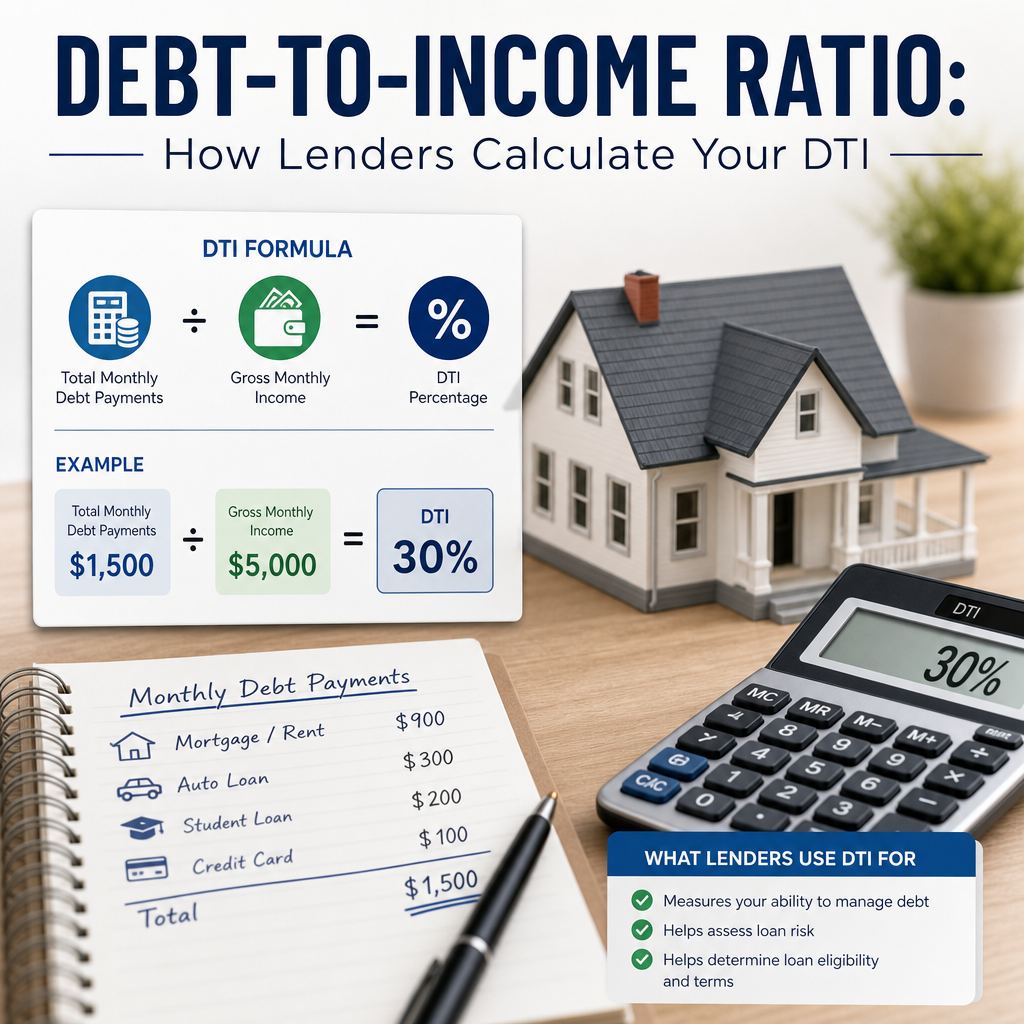
Debt-to-Income Ratio: How Lenders Calculate Your DTI
Your debt-to-income ratio is one of the first numbers lenders look at when deciding if you can afford a loan. Learn how DTI is calculated, what counts toward it, and how to improve yours before you apply.
By: Mary Smith on July 25, 2026
If you’re planning to apply for a mortgage, auto loan, or personal loan, understanding your debt-to-income ratio can make a big difference. Lenders use this number to gauge whether you can handle new monthly payments without overextending your budget. In simple terms, your debt-to-income ratio compares how much you owe each month to how much you earn.
That one calculation can influence whether you’re approved, how much you can borrow, and what interest rate you receive. The good news is that DTI is straightforward once you know what goes into it. In this guide, you’ll learn how lenders calculate your debt-to-income ratio, what counts as debt, how to improve your number, and why it matters for your financial health.
What Is Debt-to-Income Ratio?
The debt-to-income ratio is a percentage that shows how much of your gross monthly income goes toward debt payments. Lenders use it to evaluate risk. A lower DTI generally suggests you have more room in your budget to take on additional debt, while a higher DTI may signal strain.
There are two common types of DTI:
Front-End DTI
Front-end DTI is used mainly in mortgage lending. It measures housing costs only, including:
Principal
Interest
Property taxes
Homeowners insurance
HOA dues, if applicable
This ratio helps lenders see how affordable a home payment will be relative to your income.
Back-End DTI
Back-end DTI is more common across all loan types. It includes your housing payment plus all other recurring debt obligations, such as:
Car loans
Student loans
Credit card minimum payments
Personal loans
Child support or alimony, in some cases
When people refer to debt-to-income ratio, they usually mean back-end DTI.
How Lenders Calculate Your DTI
The formula for debt-to-income ratio is simple:
Monthly debt payments ÷ Gross monthly income = DTI
To convert it into a percentage, multiply the result by 100.
Step-by-Step Example
Let’s say you earn $6,000 per month before taxes. Your monthly debts include:
Rent or mortgage: $1,500
Car payment: $350
Student loan: $250
Credit card minimums: $150
Your total monthly debt payments are $2,250.
Now divide:
$2,250 ÷ $6,000 = 0.375
Multiply by 100:
0.375 x 100 = 37.5%
Your debt-to-income ratio is 37.5%.
That means 37.5% of your gross monthly income goes toward debt obligations.
What Counts as Debt in DTI?
Lenders only include certain recurring monthly obligations. Not every bill counts. Knowing what is and isn’t included can help you estimate your debt-to-income ratio more accurately.
Usually Included in DTI
Common debts lenders count include:
Mortgage or rent
Car loans
Student loans
Personal loans
Credit card minimum payments
Home equity loan payments
Child support or alimony
Any other installment debt with a fixed monthly payment
Usually Not Included in DTI
These expenses typically do not count:
Groceries
Utilities
Cell phone bills
Streaming subscriptions
Gas
Insurance premiums that are not part of housing costs
Savings contributions
Entertainment expenses
Lenders focus on debt obligations because they directly affect your ability to make new loan payments.
Gross Income vs. Net Income
One common mistake is using take-home pay instead of gross income. For debt-to-income ratio calculations, lenders usually use gross monthly income, which is your income before taxes and other deductions.
Gross income may include:
Salary or hourly wages
Overtime, if consistently earned and documented
Bonuses, if likely to continue
Commissions
Self-employment income
Rental income
Alimony or child support, if it meets lender requirements
Disability or retirement income
Net income, or take-home pay, is lower because it subtracts taxes, retirement contributions, health insurance, and other deductions. While net income is helpful for personal budgeting, lenders rely on gross income because it provides a standard way to evaluate borrowers.
Why Debt-to-Income Ratio Matters
Your debt-to-income ratio is more than just a lender metric. It’s a snapshot of how much financial flexibility you have.
For Lenders
A lower DTI often means:
Lower perceived risk
Higher chance of approval
Better loan terms
More borrowing capacity
A higher DTI can lead to:
Loan denial
Lower approved loan amounts
Higher interest rates
Requests for a co-signer or additional documentation
For You
Your DTI can help you answer an important question: Are you borrowing within your means?
If too much of your income already goes toward debt, adding another payment could make your budget vulnerable to emergencies, income changes, or unexpected expenses.
What Is a Good Debt-to-Income Ratio?
The ideal debt-to-income ratio depends on the loan type and the lender. Still, general guidelines can help you understand where you stand.
Common DTI Benchmarks
Below 36%: Often considered strong
36% to 43%: Usually manageable, depending on the rest of your financial profile
43% to 50%: May still qualify for some loans, especially mortgages, but options may narrow
Above 50%: Often signals elevated risk and can limit approval chances
These ranges are not universal rules. Some lenders are more flexible, especially if you have strong credit, savings, or stable income. Others use stricter underwriting standards.
How Lenders Use DTI in Real Life
A lender doesn’t look at debt-to-income ratio in isolation. It’s one piece of a larger financial picture that includes:
Credit score
Employment history
Income stability
Savings and cash reserves
Loan amount requested
Down payment size
For example, a borrower with a slightly higher DTI but excellent credit and a solid emergency fund may still qualify for a loan. On the other hand, someone with a low DTI but poor credit could still face challenges.
Mortgage Example
Suppose you want to buy a home. The lender will compare your proposed mortgage payment plus existing debts to your gross monthly income. If your DTI is too high, the lender may approve a smaller mortgage or ask you to reduce other debts first.
Auto Loan Example
For an auto loan, the lender may include your existing car payment, student loan, rent, and credit card minimums. If your debt-to-income ratio is already high, you may be approved for a shorter term, a smaller loan, or a higher rate.
How to Improve Your Debt-to-Income Ratio
If your DTI is higher than you’d like, you may be able to improve it before applying for a loan. The most effective strategies usually fall into two categories: reduce debt or increase income.
1. Pay Down Existing Debt
Targeting high-interest or high-balance debt can lower your monthly obligations.
Options include:
Paying extra on credit cards
Using the debt avalanche method
Consolidating debts if it lowers your monthly payment
Refinancing a loan for a lower monthly installment, if it makes sense
Even one less payment can improve your debt-to-income ratio.
2. Avoid Taking on New Debt
Before applying for a loan, try not to add new monthly obligations. A new car lease, furniture financing, or a large credit card balance can quickly raise your DTI.
3. Increase Your Income
A higher income lowers your ratio, assuming your debt stays the same. Depending on your situation, you might:
Pick up additional work
Ask for more hours
Pursue a raise
Build side income
Document all eligible income sources for the lender
4. Rework the Timing of Your Application
Sometimes, waiting a few months can help. If you know a loan payment will soon be eliminated or a balance will be paid off, delaying your application may improve your profile.
5. Refinance or Consolidate Carefully
Debt consolidation can lower monthly payments, but it is not automatically the best move. A lower payment may improve your debt-to-income ratio, but you should also consider:
Total interest paid
Fees
Loan term
Long-term affordability
DTI vs. Credit Score: What’s the Difference?
People often confuse debt-to-income ratio with credit score, but they measure different things.
Debt-to-Income Ratio
DTI shows how much of your monthly income goes to debt payments.
Credit Score
Credit score reflects how you have managed debt in the past, based on factors like:
Payment history
Credit utilization
Length of credit history
Types of credit
New credit inquiries
A person can have a strong credit score and a high DTI, or a lower credit score and a low DTI. Lenders often review both because together they help explain your financial behavior and repayment ability.
How to Estimate Your Own DTI
You can calculate your debt-to-income ratio before applying for a loan.
Use This Simple Process
Add up all recurring monthly debt payments.
Determine your gross monthly income.
Divide total monthly debt by gross monthly income.
Multiply by 100 to get a percentage.
Example Worksheet
Suppose your monthly debts are:
Mortgage: $1,400
Student loan: $275
Car payment: $325
Credit cards: $100
Total debts = $2,100
Your gross monthly income = $5,500
Calculation:
$2,100 ÷ $5,500 = 0.3818
0.3818 x 100 = 38.2%
Your DTI is 38.2%.
Common Mistakes to Avoid
When reviewing your debt-to-income ratio, a few errors can lead to surprises during the lending process.
Forgetting Annual to Monthly Conversions
If you know your annual salary, divide by 12 to get gross monthly income.
Leaving Out Minimum Credit Card Payments
Lenders usually count the required minimum payment, not the amount you plan to pay.
Including Non-Debt Expenses
Utilities, groceries, and streaming services generally do not count toward DTI.
Using Take-Home Pay
Always use gross income unless the lender provides a different calculation method.
Ignoring Co-Signed Debts
If you co-signed a loan and you are legally responsible for the payment, the lender may include it in your DTI.
When DTI Becomes a Red Flag
A higher debt-to-income ratio is not automatically disqualifying, but it can become a concern when your budget has little room for flexibility. That’s especially true if:
You rely on credit cards to cover everyday expenses
You have little or no emergency savings
Your income varies from month to month
You expect upcoming expenses, like childcare or medical costs
You are applying for a large mortgage or long-term loan
In those situations, a lender may worry that you could struggle if your financial circumstances change.
Final Thoughts on Debt-to-Income Ratio
Understanding your debt-to-income ratio gives you a clearer picture of how lenders see your finances. It also helps you make smarter borrowing decisions. By knowing what counts as debt, using gross income correctly, and calculating your DTI before you apply, you can avoid surprises and plan ahead with more confidence.
If your ratio is too high, small changes can make a meaningful difference. Paying down balances, increasing income, or waiting until an existing debt is gone can improve your chances of approval and help you borrow more responsibly.
Frequently Asked Questions
1. What is the debt-to-income ratio in simple terms?
The debt-to-income ratio is the percentage of your gross monthly income that goes toward debt payments. Lenders use it to determine whether you can afford a new loan.
2. Do lenders include rent in debt-to-income ratio calculations?
Yes, many lenders include rent if you are currently renting and applying for a loan. For mortgage applications, the proposed housing payment is typically used instead of rent.
3. Is a lower debt-to-income ratio always better?
Generally, yes. A lower DTI suggests you have more income available after debt payments, which can make you a less risky borrower. However, lenders also look at credit score, income stability, and savings.
4. Can student loans affect my debt-to-income ratio?
Yes. Student loan payments are usually included in DTI calculations. If your loan is in deferment or forbearance, the lender may use a specific payment amount based on its underwriting rules.
5. How can I lower my debt-to-income ratio quickly?
The fastest ways are usually to pay down debt, eliminate a recurring payment, refinance a loan for a lower monthly amount, or increase your income. Even small reductions in monthly obligations can improve your DTI.
Your debt-to-income ratio is one of the most important numbers lenders review because it shows how comfortably you can handle monthly debt payments. By understanding how it’s calculated, what expenses count, and how lenders interpret the result, you can approach borrowing with more confidence and fewer surprises.
A healthy DTI can improve your odds of approval, open the door to better loan terms, and give you a clearer view of your financial capacity. If your ratio is higher than you’d like, don’t panic. Focus on practical steps such as paying down balances, avoiding new debt, and increasing income where possible. Even modest changes can improve your position over time.
Whether you’re preparing for a mortgage, auto loan, or personal loan, knowing your DTI helps you make smarter decisions before you apply. Use it as a planning tool, not just an approval hurdle, and you’ll be better equipped to borrow responsibly and protect your long-term financial health.
Mary S, CFP®, is a Certified Financial Planner with over 12 years of experience in personal finance, retirement planning, and wealth management. She writes educational content that helps readers understand financial concepts and make informed decisions based on reliable information.