Federal Tax Brackets and Standard Deduction 2026 Explained
Federal tax brackets and standard deduction 2026 rules can have a big impact on your bottom line, but they’re easier to understand than they seem. Here’s a simple breakdown of how the brackets work, how the standard deduction lowers taxable income, and what it could mean for your tax planning.
By: Mary Smith on July 25, 2026
Understanding federal tax brackets and standard deduction 2026 rules is one of the smartest ways to plan your taxes, estimate your refund, and avoid surprises when filing. Even if you don’t consider yourself “tax savvy,” knowing how the IRS structures income tax can help you make better decisions throughout the year—especially if your income changes, you’re married, or you’re approaching retirement.
The big idea is simple: the U.S. federal income tax system is progressive, which means different portions of your income are taxed at different rates. At the same time, the standard deduction reduces the amount of income that is subject to tax. Together, these two pieces largely determine what you owe.
In this guide, we’ll break down how federal tax brackets and standard deduction 2026 are expected to work, how they affect different filers, and how to use them in practical tax planning. While final IRS inflation-adjusted numbers can still be subject to official release timing and updates, the framework below will help you understand the system clearly and prepare with confidence.
What federal tax brackets and standard deduction 2026 mean
The federal income tax system uses tax brackets to apply different tax rates to different ranges of taxable income. Importantly, crossing into a higher bracket does not mean all of your income is taxed at that higher rate. Only the portion of income within that bracket is taxed at that rate.
The standard deduction is a fixed amount that lowers your taxable income. Most taxpayers choose it instead of itemizing because it is simpler and often more valuable.
Why these two numbers matter
If you understand your bracket and deduction, you can:
Estimate your tax bill more accurately
Compare the standard deduction with itemizing
Plan retirement withdrawals and bonus income
Adjust paycheck withholding
Make smarter year-end tax moves
How federal tax brackets work
The IRS applies tax rates to income in layers. Think of it like filling buckets:
The first part of your taxable income is taxed at the lowest rate.
The next portion is taxed at the next rate.
This continues until all taxable income is assigned a bracket.
Example of bracket taxation
Suppose a taxpayer has taxable income that reaches into a higher bracket. Only the amount above the lower threshold gets taxed at that higher rate. This is a key concept because many people mistakenly think moving up a bracket raises tax on all income. It does not.
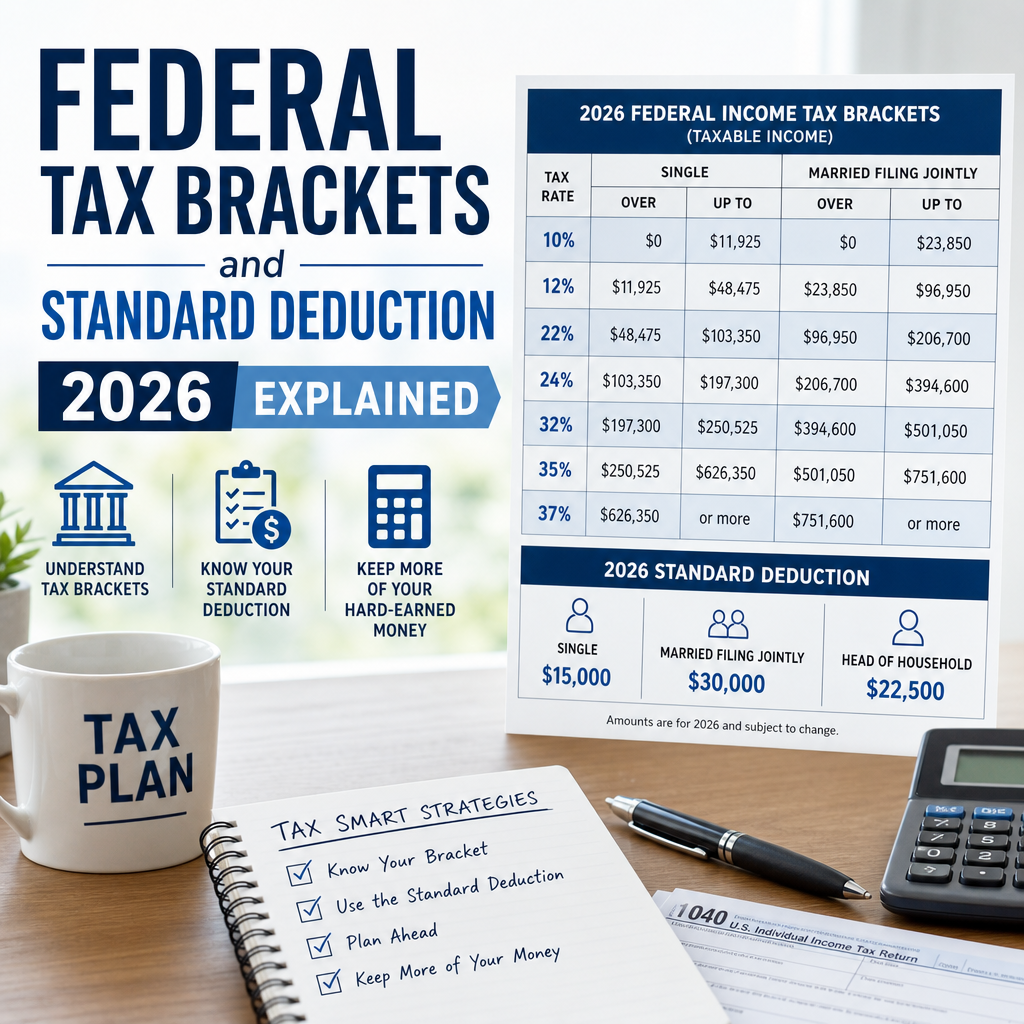
Common federal tax rate structure
For individual income taxes, the federal system typically includes these marginal tax rates:
10%
12%
22%
24%
32%
35%
37%
The exact dollar thresholds for federal tax brackets and standard deduction 2026 are based on IRS inflation adjustments and filing status. The rates themselves generally remain the same unless Congress changes the law.
Standard deduction 2026: what it does
The standard deduction is one of the most useful tax benefits available to individuals and families. It reduces the amount of income that is taxed at federal rates.
For many taxpayers, the standard deduction is the easiest and most beneficial choice because it requires no receipts or detailed expense tracking.
Who should consider the standard deduction?
The standard deduction often makes sense for people who:
Don’t have enough deductible expenses to exceed the itemizing threshold
Prefer simple tax filing
Have typical wage income with limited mortgage interest, charitable giving, or medical expenses
Are retirees with a straightforward tax situation
Who might itemize instead?
Some taxpayers may benefit more from itemizing deductions if they have significant deductible expenses, such as:
Mortgage interest
State and local taxes, within federal limits
Charitable donations
Large medical expenses that qualify under IRS rules
Federal tax brackets and standard deduction 2026 by filing status
The IRS sets both brackets and the standard deduction by filing status. These include:
Single
Married Filing Jointly
Married Filing Separately
Head of Household
Qualifying Widow(er)
Because inflation adjustments can shift values, the specific 2026 numbers should always be confirmed with official IRS guidance when released. Still, the structure below shows how the system works and how to think about it.
Single filers
Single filers generally have the lowest standard deduction of the main filing categories. Their taxable income starts after the standard deduction is subtracted, and then the bracket system applies to the remainder.
Single filers often benefit from:
Careful withholding review
Retirement contributions to lower taxable income
Timing bonus income when possible
Using tax credits where eligible
Married filing jointly
Married couples filing jointly usually receive a larger standard deduction and wider tax bracket ranges than single filers. This can create meaningful tax savings, especially when one spouse earns much more than the other.
Joint filers should pay attention to:
Combined income levels
Capital gains and retirement distributions
Whether itemizing beats the standard deduction
Possible marriage penalty or marriage bonus effects
Head of household
Head of household status often provides a larger standard deduction and more favorable bracket thresholds than single filing. It is available to qualifying taxpayers who pay more than half the cost of keeping up a home for a qualifying person.
This filing status can be especially valuable for:
Single parents
Caregivers supporting dependents
Separated taxpayers who meet IRS rules
Married filing separately
This status usually comes with less favorable tax treatment than filing jointly. It can matter in specific situations, such as when spouses want to keep tax liabilities separate or when one spouse is dealing with certain repayment or legal issues.
However, it often results in:
Lower standard deduction than joint filers
Less favorable bracket thresholds
Reduced access to some tax benefits
How to estimate your taxable income for 2026
To understand where you may land in federal tax brackets and standard deduction 2026, start with gross income and work toward taxable income.
Step-by-step approach
Add up all income sources
Include wages, self-employment income, interest, dividends, retirement distributions, and other taxable income.
Subtract above-the-line adjustments
These may include certain retirement contributions, student loan interest, or health savings account contributions, depending on eligibility.
Apply the standard deduction or itemized deductions
This creates your taxable income.
Apply the tax brackets
Tax each layer of income at the appropriate rate.
Simple example
Imagine a taxpayer has $75,000 of gross income and takes the standard deduction. After subtracting the deduction, the remaining amount is taxable income. That taxable income is then divided across the relevant tax brackets.
This method is easier than it sounds, and tax software does it automatically. Still, knowing the process helps you understand your return and make better decisions before filing season.
Why inflation adjustments matter in 2026
The IRS adjusts many tax figures each year for inflation. That includes tax bracket thresholds and the standard deduction. These adjustments help prevent taxpayers from being pushed into higher brackets simply because of rising prices and wage growth.
What inflation adjustments can affect
Bracket thresholds
Standard deduction amounts
Certain tax credits
Contribution limits for some retirement and health accounts
Phaseouts for deductions and credits
For taxpayers, this means the 2026 tax landscape may feel slightly different even if the tax rates themselves stay the same.
Practical tax planning tips for 2026
Knowing the rules is useful, but putting them to work is where the real value appears. Here are some practical ways to use federal tax brackets and standard deduction 2026 information in everyday planning.
1. Review withholding early
If you had a refund that was too large or owed money at filing time, check your W-4 and withholding settings. A small adjustment can improve cash flow throughout the year.
2. Time income and deductions carefully
If you’re near a bracket threshold, timing can matter.
Examples:
Deferring a bonus to the next year
Accelerating deductible expenses into the current year
Bunching charitable donations into one year if itemizing
3. Maximize pre-tax contributions
Contributions to traditional retirement accounts, HSAs, and similar accounts can reduce taxable income, which may help you stay in a lower bracket.
4. Compare itemizing vs. standard deduction
Even if you usually claim the standard deduction, it is worth checking each year. Major life events can change the math quickly.
5. Watch for tax credit opportunities
Tax credits reduce tax directly, which can be more powerful than deductions. Depending on your situation, look for credits related to education, children, dependent care, or energy-efficient improvements.
Common mistakes taxpayers make
A lot of filing-season stress comes from simple misunderstandings. Avoid these common mistakes:
Assuming all income is taxed at the highest bracket reached
Forgetting that deductions lower taxable income, not tax dollar-for-dollar
Ignoring filing status differences
Overlooking the standard deduction when itemizing
Failing to update withholding after marriage, divorce, or a new child
A quick note on tax planning vs. tax filing
Tax filing is about reporting what already happened. Tax planning is about making informed choices before year-end.
That distinction matters because federal tax brackets and standard deduction 2026 rules can affect decisions such as:
How much to contribute to retirement accounts
Whether to realize capital gains
Whether to make charitable contributions now or later
How much extra tax to set aside if you’re self-employed
Planning ahead usually produces better results than scrambling in March or April.
Frequently Asked Questions
What are federal tax brackets and standard deduction 2026?
They are the IRS income tax rate ranges and the deduction amount that reduce taxable income for the 2026 tax year. Tax brackets determine which rate applies to each portion of income, while the standard deduction lowers the amount of income subject to tax.
Do higher tax brackets mean all my income is taxed at a higher rate?
No. The U.S. uses a marginal tax system. Only the income that falls within a higher bracket is taxed at that rate. Your lower portions of income remain taxed at the lower rates.
Should I take the standard deduction or itemize?
It depends on which gives you a larger deduction. If your mortgage interest, charitable giving, state and local taxes, and other qualifying expenses are not large enough to exceed the standard deduction, the standard deduction is usually the better choice.
Does the standard deduction change every year?
Often, yes. The IRS frequently adjusts the standard deduction for inflation. That’s why it’s important to check the official figures for the exact tax year before filing.
How can I estimate my tax liability for 2026?
Start with gross income, subtract allowable adjustments, then subtract the standard deduction or itemized deductions to find taxable income. After that, apply the bracket rates to each layer of taxable income. Tax software or a qualified tax professional can help you calculate it accurately.
Understanding federal tax brackets and standard deduction 2026 gives you a clearer picture of how the tax system affects your paycheck, your refund, and your year-end planning. The key takeaway is that brackets apply progressively, not all at once, and the standard deduction can significantly reduce taxable income for many households. Once you know your filing status, estimated income, and likely deduction strategy, you can make much better decisions about withholding, retirement contributions, charitable giving, and other tax moves.
As 2026 approaches, take time to review your situation instead of waiting until tax season. A quick check now can help you avoid surprises later and possibly keep more of your money working for you throughout the year. Whether you file on your own or work with a professional, a basic understanding of how tax brackets and deductions operate will make the entire process easier and more effective.
Mary S, CFP®, is a Certified Financial Planner with over 12 years of experience in personal finance, retirement planning, and wealth management. She writes educational content that helps readers understand financial concepts and make informed decisions based on reliable information.