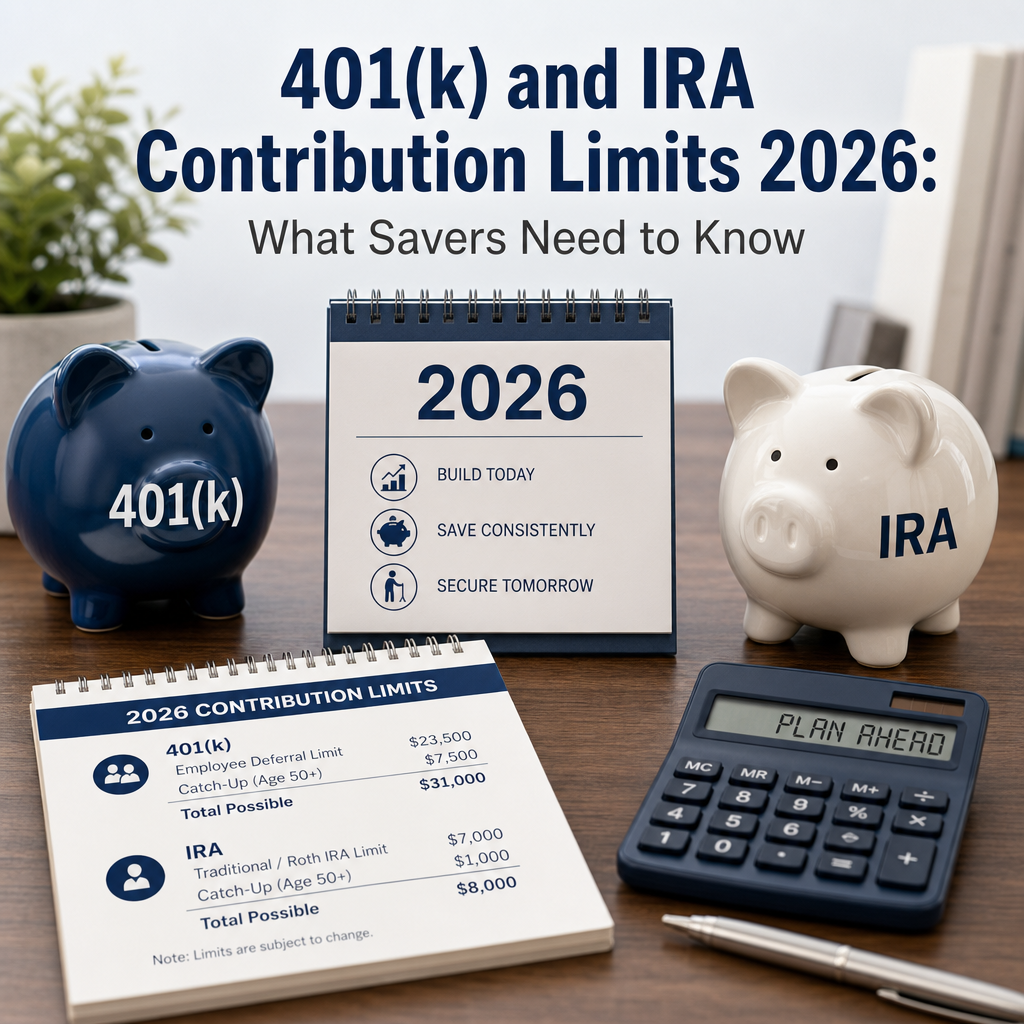
401(k) and IRA Contribution Limits 2026: What Savers Need to Know
The 401(k) and IRA contribution limits 2026 can have a big impact on how much you save, how much you may deduct, and how effectively you plan for retirement. Here’s what savers should know so they can make the most of their tax-advantaged accounts before the year gets underway.
By: Mary Smith on July 25, 2026
Planning for retirement works best when you know the rules before the year starts. That’s especially true for 401(k) and IRA contribution limits 2026, since these limits shape how much you can save, how much you may be able to deduct, and how close you can get to your long-term goals.
Whether you’re a seasoned investor or just starting to build a retirement nest egg, understanding these limits can help you make smarter decisions. The details matter: contribution caps, catch-up contributions, income rules, and employer match strategies all affect your bottom line. In this guide, we’ll walk through what savers should know, how the rules typically work, and how to plan ahead without getting tripped up by IRS details.
401(k) and IRA Contribution Limits 2026: The Basics
Retirement contribution limits are adjusted periodically by the IRS to keep up with inflation. While the exact figures for 2026 are released by the IRS as part of its annual cost-of-living update, the overall framework stays the same:
401(k) plans let employees contribute pre-tax or Roth dollars, depending on the plan.
Traditional IRAs and Roth IRAs each have annual contribution limits that apply across all your IRA accounts combined.
Catch-up contributions may allow older savers to save more if they meet age requirements.
Income and plan participation rules can affect whether contributions are deductible or whether you’re eligible to contribute to a Roth IRA.
If you’re trying to maximize tax-advantaged retirement savings, knowing the current and upcoming limits is essential. Even a small change in contribution amounts can have a meaningful effect over time.
Why Contribution Limits Matter
Many people think of retirement saving as a simple “set it and forget it” task. In reality, contribution limits influence your entire strategy.
They help you maximize tax advantages
Traditional 401(k) and IRA contributions may reduce taxable income now, while Roth contributions offer tax-free withdrawals later if rules are met. The limit determines how much of either advantage you can use each year.
They guide your savings target
If you want to retire comfortably, your annual contribution goal should align with the IRS cap whenever possible. Hitting the limit can be a practical benchmark, especially for higher earners.
They help avoid penalties
Exceeding IRA limits can trigger excess contribution penalties unless corrected promptly. Staying aware of the rules helps you avoid unnecessary taxes and paperwork.
401(k) Contribution Limits in 2026
A 401(k) is often the cornerstone of workplace retirement saving. For many employees, it’s the easiest way to invest consistently because contributions are deducted automatically from each paycheck.
What to expect from the 2026 limit
The IRS announces the official 401(k) contribution limit each year. For 2026, savers should watch for:
The employee elective deferral limit
The catch-up contribution amount for eligible participants age 50 and older
Potential special rules for higher earners under certain plan types
Whether the plan allows Roth 401(k) contributions in addition to traditional contributions
If you’re not sure of the exact number yet, check the IRS announcement or your employer’s benefits portal, since plan administrators usually update payroll systems after the official release.
Traditional 401(k) vs. Roth 401(k)
Both versions count toward the same annual employee contribution cap.
Traditional 401(k): Contributions are generally pre-tax, which lowers current taxable income.
Roth 401(k): Contributions are made after tax, but qualified withdrawals may be tax-free in retirement.
A simple way to think about it: the IRS limit controls how much you can put in, but your tax choice determines when you pay the bill.
Employer matching doesn’t reduce your limit
Employer match is one of the biggest benefits of a 401(k), but it does not count against your employee contribution limit. In other words, if your employer matches part of your salary deferral, that match is extra retirement money.
That said, total plan contributions are subject to separate annual limits that may include both employee and employer contributions.
IRA Contribution Limits in 2026
IRAs give savers flexibility and can work alongside a workplace plan. The annual IRA contribution limit applies across all traditional and Roth IRA accounts combined.
Traditional IRA contribution rules
A traditional IRA may allow tax-deductible contributions, but deductibility depends on:
Your income
Whether you or your spouse are covered by a workplace retirement plan
Filing status
Even if a contribution is not deductible, it may still be allowed. That makes traditional IRAs useful for some savers who want tax-deferred growth.
Roth IRA contribution rules
Roth IRAs are popular because they can provide tax-free withdrawals in retirement if requirements are met. However, eligibility is restricted by income.
Key points to remember:
You must have earned income to contribute.
Your ability to contribute may phase out at higher income levels.
The annual limit is shared with traditional IRA contributions.
If your income is too high for a direct Roth IRA contribution, some savers use a backdoor Roth strategy. That approach has tax implications and can be complex, so it’s wise to review it carefully before acting.
Catch-Up Contributions for 2026
Catch-up contributions are a valuable option for older savers who want to accelerate retirement savings.
Age 50 and older
If you’re age 50 or older by the end of the year, you may be allowed to contribute extra to:
401(k) plans
Traditional IRAs
Roth IRAs
These additional amounts are designed to help people who may have started saving later or who want to close the gap before retirement.
Why catch-up contributions matter
Catch-up contributions can make a real difference because they increase your annual savings capacity during your peak earning years. For example:
A worker who already contributes regularly can use the catch-up amount to increase retirement savings without changing their overall financial plan dramatically.
Someone nearing retirement can use the extra space to strengthen long-term security.
If you’re eligible, this is often one of the easiest ways to boost your retirement readiness.
How to Plan Around 401(k) and IRA Contribution Limits 2026
The best retirement strategy usually combines discipline with flexibility. Here are practical ways to make the most of the 401(k) and IRA contribution limits 2026.
1. Start with your employer match
If your employer offers a match, contribute enough to capture the full amount first. That’s often the highest-return move available because it’s immediate compensation you don’t want to miss.
2. Increase contributions gradually
If maxing out feels unrealistic, use smaller increases:
Raise your 401(k) contribution by 1% to 2%
Increase again after a raise or bonus
Set annual reminders to review your savings rate
These small steps can add up without straining your monthly budget.
3. Use an IRA for additional tax-advantaged saving
If you’ve already reached your 401(k) savings target, an IRA can be a useful next step. It can provide:
More investment choices
Potential tax benefits
An additional layer of retirement diversification
4. Coordinate traditional and Roth savings
You do not need to choose the same tax treatment for every account. Some people prefer:
Traditional 401(k) contributions now
Roth IRA contributions for future tax-free income
This mix can create flexibility in retirement, especially if your tax situation changes later.
5. Watch income thresholds
IRA deductibility and Roth eligibility can change based on income. If you’re near a phaseout range, a year-end bonus, side income, or capital gains could affect your options. Review your tax picture before making final contributions.
Practical Examples of Retirement Contribution Planning
A few real-world scenarios can make the rules easier to understand.
Example 1: The early-career saver
Maria is in her early 30s and just started a new job with a 401(k) match. She contributes enough to get the full employer match, then opens a Roth IRA to save a little more each month. This gives her both workplace savings and tax-free growth potential later.
Example 2: The mid-career professional
Derek, age 45, wants to catch up on retirement. He increases his 401(k) deferral rate after receiving a raise and uses his tax refund to fund an IRA. He also checks whether he’s close to any income-based IRA restrictions.
Example 3: The late-career saver
Lisa, age 58, wants to maximize savings before retirement. She uses catch-up contributions in her 401(k) and continues making IRA contributions if eligible. Since she’s closer to retirement, she focuses on consistency and keeping her asset allocation aligned with her timeline.
Common Mistakes to Avoid
Even experienced savers can make mistakes when contribution limits change. Keep an eye on these common issues:
Missing the employer match
Contributing to an IRA without checking income eligibility
Forgetting that IRA limits apply across all IRA accounts combined
Overcontributing and creating an excess contribution problem
Ignoring catch-up contribution eligibility
Assuming last year’s numbers still apply
A quick review during the first quarter of the year can prevent many of these problems.
How to Stay Updated on the Final 2026 Limits
The IRS typically announces retirement plan limits before the new year. To stay on top of the latest updates:
Check the IRS website for the annual cost-of-living announcement
Review your employer’s plan documents
Confirm payroll deduction changes before January
Talk with a tax professional if you have a complicated income situation
Even if you set a contribution plan early, it’s worth revisiting once the final numbers are released.
Frequently Asked Questions
1. What are the 401(k) and IRA contribution limits for 2026?
The IRS sets the official 401(k) and IRA contribution limits each year and may adjust them for inflation. Savers should verify the final 2026 numbers through the IRS or their plan administrator before making year-end decisions.
2. Can I contribute to both a 401(k) and an IRA in the same year?
Yes, in many cases you can contribute to both. A workplace 401(k) does not prevent you from contributing to an IRA, though your income may affect whether a traditional IRA contribution is deductible or whether you can contribute directly to a Roth IRA.
3. Does my employer match count toward my 401(k) contribution limit?
No. Your employer match does not count toward your employee elective deferral limit. However, total contributions to the plan are subject to separate overall limits.
4. What happens if I contribute too much to an IRA?
Excess IRA contributions can lead to tax penalties if they are not corrected in time. If you think you overcontributed, contact your custodian or tax professional as soon as possible to fix the issue properly.
5. Should I choose a traditional or Roth account?
That depends on your current tax rate, expected future tax rate, and overall financial plan. Traditional accounts may help if you want a deduction now, while Roth accounts may be attractive if you prefer tax-free withdrawals later. Many savers use both for flexibility.
Understanding the 401(k) and IRA contribution limits 2026 is one of the simplest ways to make your retirement plan stronger. These limits affect how much you can save, how you can balance tax advantages, and whether you’re taking full advantage of your employer-sponsored plan and personal retirement accounts. The key is not just knowing the numbers, but using them intentionally.
Start by checking your workplace plan, confirming whether you qualify for catch-up contributions, and reviewing your IRA eligibility based on income. If you can’t max out right away, that’s okay. Consistent contributions, employer matching, and gradual increases still move you in the right direction. A smart retirement strategy is built over time, and the earlier you align your savings with the annual limits, the more flexibility you’ll have later.
As the final 2026 figures are released, revisit your plan and make any needed adjustments. A small update today can lead to a stronger, more confident retirement tomorrow.
Mary S, CFP®, is a Certified Financial Planner with over 12 years of experience in personal finance, retirement planning, and wealth management. She writes educational content that helps readers understand financial concepts and make informed decisions based on reliable information.