HSA Contribution Limits 2026 for Individual and Family Coverage
Planning ahead for HSA contribution limits can help you save more for healthcare while staying within IRS rules. Whether you have individual or family coverage, knowing the 2026 cap makes it easier to maximize your tax advantages and avoid surprises.
By: Mary Smith on July 25, 2026
Health savings accounts, or HSAs, remain one of the most tax-advantaged ways to set money aside for medical expenses. If you’re trying to plan ahead for the HSA contribution limits 2026, understanding the rules for individual and family coverage can help you maximize tax savings and avoid costly mistakes.
For people enrolled in a qualifying high-deductible health plan (HDHP), an HSA can be a powerful tool. You can contribute pre-tax dollars, let the balance grow tax-free, and withdraw funds tax-free for eligible medical expenses. But the annual contribution cap changes over time, and the amount you can save depends on whether you have self-only or family coverage.
This guide explains the HSA contribution limits 2026, how eligibility works, what catch-up contributions are, and how to make the most of your account.
What Is an HSA and Why Does It Matter?
An HSA is a tax-advantaged savings account designed for people covered by an HDHP. Unlike a flexible spending account (FSA), HSA funds roll over from year to year, so you don’t lose unused money at the end of the year.
Key HSA benefits
An HSA can offer three major tax advantages:
Tax-deductible contributions if you fund the account yourself
Tax-free growth on investments inside the account
Tax-free withdrawals for qualified medical expenses
That combination makes an HSA more flexible than many other health-related accounts. Some people use it to pay current medical bills, while others treat it as a long-term healthcare savings vehicle.
HSA Contribution Limits 2026: What to Know
The IRS sets HSA contribution limits each year. These limits are tied to inflation and may change before 2026 based on federal guidance. When planning your budget, always confirm the final numbers with the IRS once they are released.
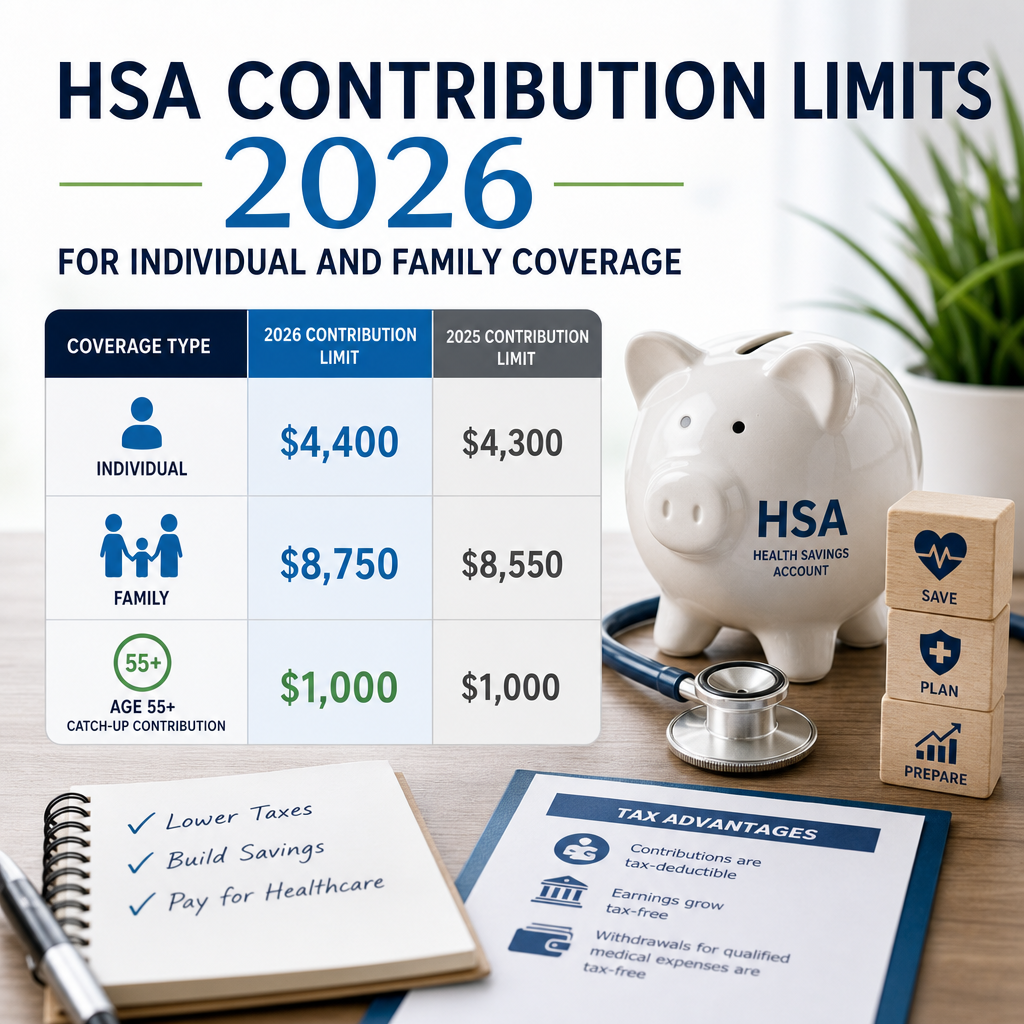
HSA contribution limits 2026 for individual coverage
If you have self-only coverage under a qualifying HDHP, your maximum annual HSA contribution will be the IRS-approved limit for individual coverage in 2026.
HSA contribution limits 2026 for family coverage
If you have family coverage under a qualifying HDHP, your contribution limit will be higher. Family coverage allows for a larger maximum contribution because the plan covers more than one person.
Catch-up contributions for age 55 and older
If you’re age 55 or older by the end of the tax year, you may be eligible to make an additional catch-up contribution to your HSA. This extra amount is available on top of the standard limit.
A few important notes:
The catch-up contribution is available only if you are HSA-eligible
Each spouse must make a separate catch-up contribution to their own HSA
If only one spouse is covered under an HSA-eligible plan, the rules still require contributions to be kept separate
HSA Eligibility Rules You Shouldn’t Overlook
You can’t contribute to an HSA unless you meet specific eligibility requirements. The most important requirement is being enrolled in a qualifying HDHP.
To be HSA-eligible, you generally must:
Be covered by a qualified HDHP
Have no other disqualifying health coverage
Not be enrolled in Medicare
Not be claimed as a dependent on someone else’s tax return
What counts as a qualifying HDHP?
A high-deductible health plan must meet federal requirements for:
Minimum annual deductible
Maximum out-of-pocket limit
These thresholds are also adjusted periodically. If your plan doesn’t meet the IRS standards, you cannot contribute to an HSA, even if the plan has a high deductible in everyday terms.
Other coverage that can affect eligibility
Some types of insurance can interfere with HSA eligibility, including:
A general-purpose FSA
A non-HDHP medical plan
Certain health reimbursement arrangements (HRAs)
Before contributing, review your benefits carefully or check with your plan administrator.
How Individual and Family Coverage Affect Your Contribution
The biggest factor in HSA contribution planning is whether your HDHP covers just you or your entire family.
Self-only coverage
Self-only coverage applies when the HDHP covers only one person. This usually means:
One individual enrolled in the HDHP
The lower of the two annual HSA limits
A simpler contribution calculation
Family coverage
Family coverage applies when the HDHP covers at least one additional person. This can include:
A spouse
Children
Other dependents, depending on the plan
Family coverage raises the contribution limit, but it does not require every covered person to use the HSA. The account still belongs to the HSA holder.
Switching between coverage types during the year
If your coverage changes during the year, your HSA contribution limit may need to be prorated. For example:
You start the year with self-only coverage
Later, you move to family coverage
Your annual maximum may be adjusted based on the months under each type of coverage
This is one of the most common areas where people overcontribute unintentionally.
How to Estimate Your 2026 HSA Contribution
Once the official HSA contribution limits 2026 are released, you can use a simple process to estimate how much you can contribute.
Step 1: Confirm your coverage type
Ask yourself:
Do I have self-only or family HDHP coverage?
Was I HSA-eligible for all 12 months?
Did my coverage change during the year?
Step 2: Check your age
If you are 55 or older, add the catch-up amount, assuming you’re eligible.
Step 3: Consider employer contributions
Employer contributions count toward your annual HSA limit. If your employer deposits money into your account, subtract that amount from the total you’re allowed to contribute.
Step 4: Watch for prorated limits
If you were not HSA-eligible for the full year, your contribution limit may be prorated based on the number of eligible months.
Practical example
Suppose you have family coverage for most of 2026 and your employer contributes to your HSA each month. To figure out your personal contribution room, you would:
Start with the IRS family coverage limit
Add any catch-up contribution if eligible
Subtract employer deposits
Adjust for any months you were not eligible
That gives you the amount you can contribute without going over the limit.
Common HSA Mistakes to Avoid
Even experienced savers can make HSA errors. These mistakes can reduce tax benefits or trigger penalties.
1. Contributing too much
Overcontributing can happen when:
You switch jobs or health plans midyear
Your spouse also contributes
Your employer deposits more than expected
If you exceed the limit, you may need to withdraw the excess and any earnings on it.
2. Forgetting employer contributions count
Your total limit includes:
Your payroll deductions
Direct contributions you make yourself
Employer contributions
Many people forget to count the employer share and accidentally go over the cap.
3. Using HSA funds for nonqualified expenses
If you take money out for something that doesn’t qualify, you may owe:
Income tax on the distribution
An additional penalty if you’re under age 65
Keep good records for all withdrawals.
4. Contributing while ineligible
You can’t contribute to an HSA if you have disqualifying coverage, even if your HDHP looks otherwise eligible. Medicare enrollment is another common reason people lose eligibility.
Best Ways to Maximize Your HSA
If you want to make the most of your HSA contribution limits 2026, a little planning goes a long way.
Use payroll deductions when possible
Contributing through payroll often provides the cleanest tax treatment, especially for employees. It may also save you from paying payroll taxes on those dollars.
Invest long-term funds
If you can afford to pay current medical expenses out of pocket, you may choose to leave HSA money invested for future healthcare costs.
Save receipts
You do not have to reimburse yourself immediately for qualified medical expenses. Some people keep detailed records and reimburse themselves years later, as long as the expense was eligible and incurred after the HSA was established.
Coordinate with your spouse
If both spouses are HSA-eligible, make sure contributions are allocated correctly. The IRS treats HSA limits carefully, especially when catch-up contributions are involved.
Who Should Pay Close Attention to the 2026 Limits?
The HSA contribution limits 2026 matter most for people in these situations:
Employees with HDHP coverage through work
Self-employed individuals with qualifying plans
Married couples trying to coordinate family coverage
People age 55 and older planning catch-up contributions
Anyone switching insurance plans during the year
If any of these describe you, it’s worth checking your HSA status before the tax year begins.
Frequently Asked Questions
What are the HSA contribution limits 2026?
The official HSA contribution limits 2026 are set by the IRS and depend on whether you have self-only or family HDHP coverage. The final numbers are typically announced later and can change from year to year. If you’re planning ahead, monitor IRS updates so you can confirm the correct cap before contributing.
Does employer HSA funding count toward my limit?
Yes. Employer contributions count toward your total annual HSA contribution limit. That includes money your employer puts in directly as well as pre-tax contributions made through payroll. If you receive employer funding, subtract it from your personal contribution room to avoid going over the limit.
Can I contribute to an HSA if I have family coverage but only one person uses the plan?
Yes. HSA eligibility depends on the type of HDHP coverage, not on how often family members use it. If your plan qualifies as family coverage, you can generally contribute up to the family limit as long as you meet the other HSA eligibility rules.
What happens if I contribute more than the limit?
If you contribute more than allowed, you should correct the excess as soon as possible. In many cases, you can withdraw the extra contribution and any earnings before the tax filing deadline. If you leave the excess in the account, you may face tax consequences and possible penalties.
Can I make HSA contributions if I’m on Medicare?
No. Once you enroll in Medicare, you can no longer contribute to an HSA. However, you can still use the funds already in your account for qualified medical expenses. If you plan to delay Medicare enrollment, make sure you understand how that affects your HSA eligibility.
Understanding the HSA contribution limits 2026 can help you make smarter decisions about your healthcare budget and long-term savings strategy. Whether you have self-only or family coverage, the key is to know your eligibility, track employer contributions, and stay alert to coverage changes that can affect your limit. If you’re age 55 or older, the catch-up contribution can provide even more room to save.
An HSA is more than just a place to park money for doctor visits. It can serve as a flexible, tax-advantaged savings tool that supports both current medical needs and future planning. The most effective approach is to review your plan details early, confirm the IRS limit once it’s published, and keep accurate records throughout the year. Small steps now can help you avoid overcontributing and make the most of every tax benefit available.
Mary S, CFP®, is a Certified Financial Planner with over 12 years of experience in personal finance, retirement planning, and wealth management. She writes educational content that helps readers understand financial concepts and make informed decisions based on reliable information.