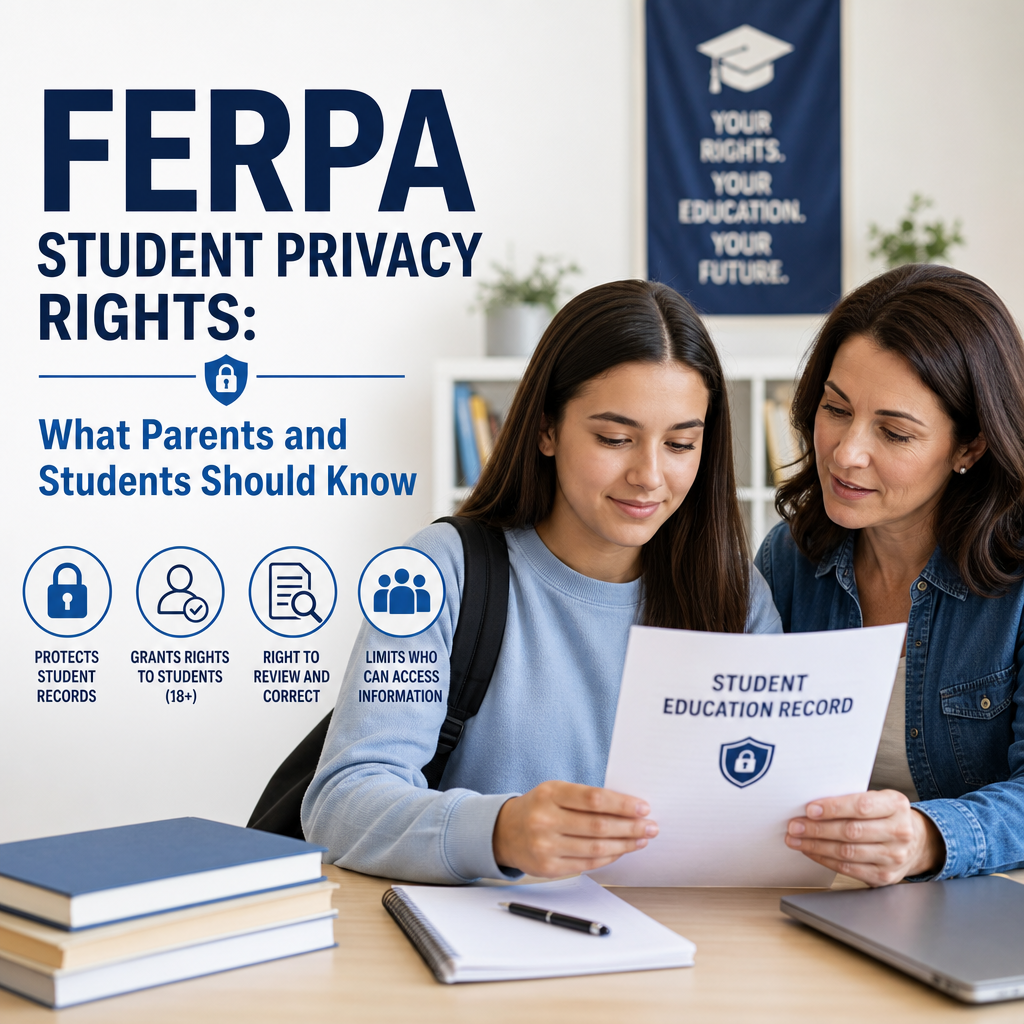
FERPA Student Privacy Rights: What Parents and Students Should Know
FERPA student privacy rights help protect the confidentiality of education records, giving parents and students important control over who can access, correct, or share that information. In this guide, you’ll learn the basics of FERPA in clear, practical terms so you can navigate school requests with confidence.
By: Jennifer on July 25, 2026
If you’re trying to understand FERPA student privacy rights, you’re not alone. Many parents, guardians, and students hear about FERPA when a school asks for a signature, when a transcript is requested, or when family members want access to records. The rules can feel confusing at first, but the core idea is simple: FERPA protects the privacy of student education records and gives families important rights.
Whether you’re a parent of a younger student or a college student managing your own records, knowing how FERPA works can help you make informed decisions, avoid surprises, and communicate more effectively with schools. This guide breaks down the essentials in clear, practical terms.
What Is FERPA?
FERPA stands for the Family Educational Rights and Privacy Act. It is a federal law that gives parents certain rights regarding their children’s education records and later transfers those rights to the student when the student reaches adulthood or attends college.
At a high level, FERPA covers:
Access to education records
Requests to correct inaccurate records
Control over disclosure of personally identifiable information
Limits on who can see student records without permission
FERPA applies to schools that receive funding from the U.S. Department of Education. That includes most public K–12 schools, school districts, colleges, and universities.
Why FERPA Student Privacy Rights Matter
School records can include much more than grades. They may contain disciplinary notes, attendance records, disability-related documentation, health information held by the school, and contact details. In the wrong hands, that information can create privacy concerns or even safety issues.
Understanding FERPA student privacy rights helps families:
Know when schools can share information
Request copies of records when needed
Protect sensitive academic or personal information
Challenge mistakes in official records
Support a student’s transition to college or adulthood
In practice, FERPA is about balancing privacy with legitimate school operations. Schools still need to communicate with teachers, counselors, administrators, and sometimes outside agencies. FERPA simply sets the rules for how that information is handled.
Who Has FERPA Rights?
FERPA rights belong to different people at different stages of a student’s life.
Parents of Elementary and Secondary Students
For students in K–12 schools, parents generally hold FERPA rights while the student is a minor. That means parents can usually:
Review education records
Request corrections
Decide whether certain information can be shared
In many cases, legal guardians have the same rights as parents, depending on custody orders and state law.
Students at Age 18 or in Postsecondary Education
Once a student turns 18 or attends a college or university, FERPA rights usually transfer from the parent to the student. At that point, the student controls access to their education records, even if the parent is paying tuition.
This is one of the biggest surprises for families. A parent may assume they can call the registrar or dean’s office and get details about grades or conduct, but FERPA often prevents that unless the student gives permission.
Exceptions and Special Circumstances
There are situations where schools may still share information without the student’s consent, such as:
Health or safety emergencies
Certain disciplinary matters involving crime of violence or nonforcible sex offenses at the postsecondary level
Compliance with a lawful subpoena or court order
Information classified as “directory information,” if the school follows proper notice procedures
What Counts as an Education Record?
Not every note, email, or file at school is automatically an education record, but many are.
Examples of education records include:
Report cards and transcripts
Attendance records
Schedules
Disciplinary records
Special education files
Assessment results
Counselor notes stored in the official record
Admissions documents at the college level
What Is Not Usually Covered?
Some records are excluded from FERPA, including:
Personal memory aids kept by a teacher and not shared
Law enforcement unit records maintained separately
Employment records when the employment is unrelated to student status
Medical records made and maintained by a healthcare provider for treatment purposes
Alumni records after a student leaves the institution
These distinctions matter because they determine whether the student or parent can access the information under FERPA.
What Rights Does FERPA Give Students and Parents?
FERPA student privacy rights usually fall into four main categories.
1. The Right to Inspect and Review Records
Parents of K–12 students, and eligible students in college, can request to see education records. Schools must provide access within a reasonable period, typically no more than 45 days.
This right helps families:
Verify grades
Check attendance history
Review disciplinary decisions
Understand what information the school has on file
2. The Right to Request Corrections
If a record is inaccurate, misleading, or violates privacy rights, the parent or student can ask the school to amend it.
For example, a family might request a correction if:
A transcript lists the wrong course grade
A name is misspelled in an official record
A disciplinary entry contains factual errors
If the school refuses, FERPA gives the requester the right to a hearing to challenge the record.
3. The Right to Control Disclosure
Schools generally need written consent before sharing personally identifiable information from education records with third parties.
That means schools typically cannot share details with:
Employers
Neighbors
Most relatives
Outside organizations
College admissions offices, unless allowed by law or policy
4. The Right to File a Complaint
If a school is not following FERPA, students or parents can file a complaint with the U.S. Department of Education. This step matters when a school repeatedly mishandles records or ignores privacy rules.
What Is Directory Information?
FERPA allows schools to designate some information as directory information. This is information that is not usually considered harmful or private if disclosed.
Examples may include:
Student name
Address
Telephone number
Email address
Date and place of birth
Photographs
Grade level
Dates of attendance
Honors and awards
Participation in sports or activities
Schools can release directory information without consent, but they must notify families and give them a chance to opt out.
Why Directory Information Can Be Tricky
Families sometimes assume all student information is protected equally. That is not always true. A school may legally share a student’s name in a program booklet or athletics roster unless the family has objected in advance.
If privacy is important, check the school’s annual FERPA notice and ask how to restrict directory information.
Common FERPA Mistakes Families Make
Even well-informed families can misunderstand how FERPA works. Here are a few common mistakes.
Assuming Parents Always Have Access
Once a student turns 18 or enters college, the parent no longer automatically has access to records. The student must usually provide written consent.
Confusing FERPA With HIPAA
FERPA and HIPAA are different laws. Most school health records maintained by a school are covered by FERPA, not HIPAA. That includes records held by a school nurse or counseling office if they are part of the education record.
Thinking Verbal Permission Is Always Enough
Some schools may accept a signed release form, and certain exceptions allow disclosure without consent. But in general, written consent is the safest and most common way to authorize sharing.
Overlooking Directory Information Opt-Outs
If a family wants to limit exposure of basic information, they need to act early. Waiting until after information has already been shared may be too late.
Not Reading the School’s Annual Notice
Schools are required to notify parents and eligible students about FERPA rights. This notice often explains local procedures, deadlines, and how to file a request.
How Parents Can Protect Student Privacy
Parents play a key role in helping younger students understand privacy and records. A few practical steps can make a big difference.
Review the School’s FERPA Notice
Look for:
Who to contact with questions
How to request records
Whether the school uses directory information
Opt-out deadlines
Consent forms for disclosure
Keep Records of Your Requests
If you ask to see records or request a correction, put it in writing and keep a copy. Written documentation helps if you need to follow up later.
Ask About Online Portals and Third-Party Apps
Schools increasingly use digital platforms for grades, attendance, and communication. Ask:
Who can access the portal
How passwords are managed
Whether third-party vendors store student data
What protections are in place for records shared digitally
Teach Students to Guard Their Own Information
For older students, privacy habits matter. Encourage them to:
Use strong passwords
Avoid sharing login credentials
Be careful with screenshots of grades or schedules
Know when to grant access to a parent or guardian
FERPA at the College Level
College students often face a major shift in privacy control. Even if a parent is funding tuition or housing, the student usually becomes the sole holder of FERPA rights at age 18 or when enrolled in postsecondary education.
What This Means in Real Life
A parent may not be able to:
Call the registrar for grades
Ask about disciplinary actions
Receive billing or academic details without permission
However, students can often choose to grant access through:
FERPA release forms
Authorized user accounts
Education records consent forms
It’s smart for college students to complete these forms thoughtfully. They can allow a parent, spouse, or other trusted person to help if needed while still protecting privacy.
A Practical Example
Imagine a college student struggles academically and wants a parent to help coordinate tutoring. Without student consent, the school may not be able to share grades or course performance. With a signed FERPA release, the school can discuss the records the student has authorized.
Special Situations: Emergencies, Divorce, and Custody
Some family situations raise extra questions about FERPA student privacy rights.
Emergencies
Schools may disclose information without consent if they believe there is a significant health or safety emergency. That exception is narrow and intended for urgent situations.
Divorced or Separated Parents
In many cases, both parents retain FERPA rights unless a court order, custody agreement, or state law says otherwise. Schools may ask for legal documents to confirm who can access records.
Students with Disabilities
FERPA still applies to special education and related records. Parents and eligible students have the right to inspect those records and request amendments when appropriate. At the same time, separate laws like IDEA may also affect educational services and procedures.
Practical Steps to Take If You Need Records or Have a Privacy Concern
If you’re dealing with a school record issue, follow a simple process.
Identify the exact record you need.
Be specific. Ask for the transcript, attendance file, discipline report, or special education record.
Submit a written request.
Email or letter is usually best. Include the student’s name, school, and the records requested.
Review the school’s timeline.
Ask how long access or correction will take and who is responsible.
Check whether consent is needed.
If the student is in college, make sure the student authorizes any third-party disclosure.
Escalate if necessary.
If the school refuses access or does not respond, ask for the FERPA complaint process or hearing procedure.
Frequently Asked Questions
Can parents see their child’s grades under FERPA?
Yes, for most K–12 students, parents can generally see grades and other education records. Once a student turns 18 or attends college, those rights typically transfer to the student unless the student gives consent for the parent to access the information.
Does FERPA cover emails between teachers and parents?
Sometimes, but not always. If an email is part of the student’s education record and maintained by the school, FERPA may apply. Casual communication that is not stored as an official record may not be covered in the same way.
Can a school share student information with law enforcement?
In some cases, yes. FERPA allows disclosure under certain legal circumstances, including compliance with a subpoena, court order, or health and safety emergency. Schools may also have separate law enforcement unit records that are not treated as education records under FERPA.
What should I do if I find a mistake in my child’s record?
Request a correction in writing and explain the error clearly. If the school denies the request, ask about the FERPA hearing process. Keep copies of all correspondence and supporting documents.
How do college students let parents access records?
College students can usually complete a FERPA release form or use the school’s authorization process. The exact steps vary by institution, so students should check the registrar’s office or student portal for the official method.
FERPA student privacy rights give parents and students meaningful control over education records, but the rules depend on the student’s age, school level, and the type of information involved. For younger students, parents usually have access to records and the ability to request corrections. For college students and adults, those rights generally shift to the student, which is why families should plan ahead for record access and consent forms.
The most important takeaway is that FERPA is not just a legal acronym. It is a practical privacy framework that affects grades, transcripts, disciplinary files, directory information, and the way schools share student data. By reading your school’s annual notice, asking questions early, and keeping written records of requests, you can avoid confusion and protect sensitive information more effectively. If you’re a parent, student, or caregiver, now is a good time to review your school’s FERPA policy and make sure you understand what access you have and what steps to take when you need it.
Jennifer, M.Ed., holds a degree in Higher Education Administration, with
a focus on U.S. college financial aid, admissions policy, and student
support systems. She researches and writes about scholarships, federal
aid programs, and the college planning process to help students and
families make informed, well-supported decisions.