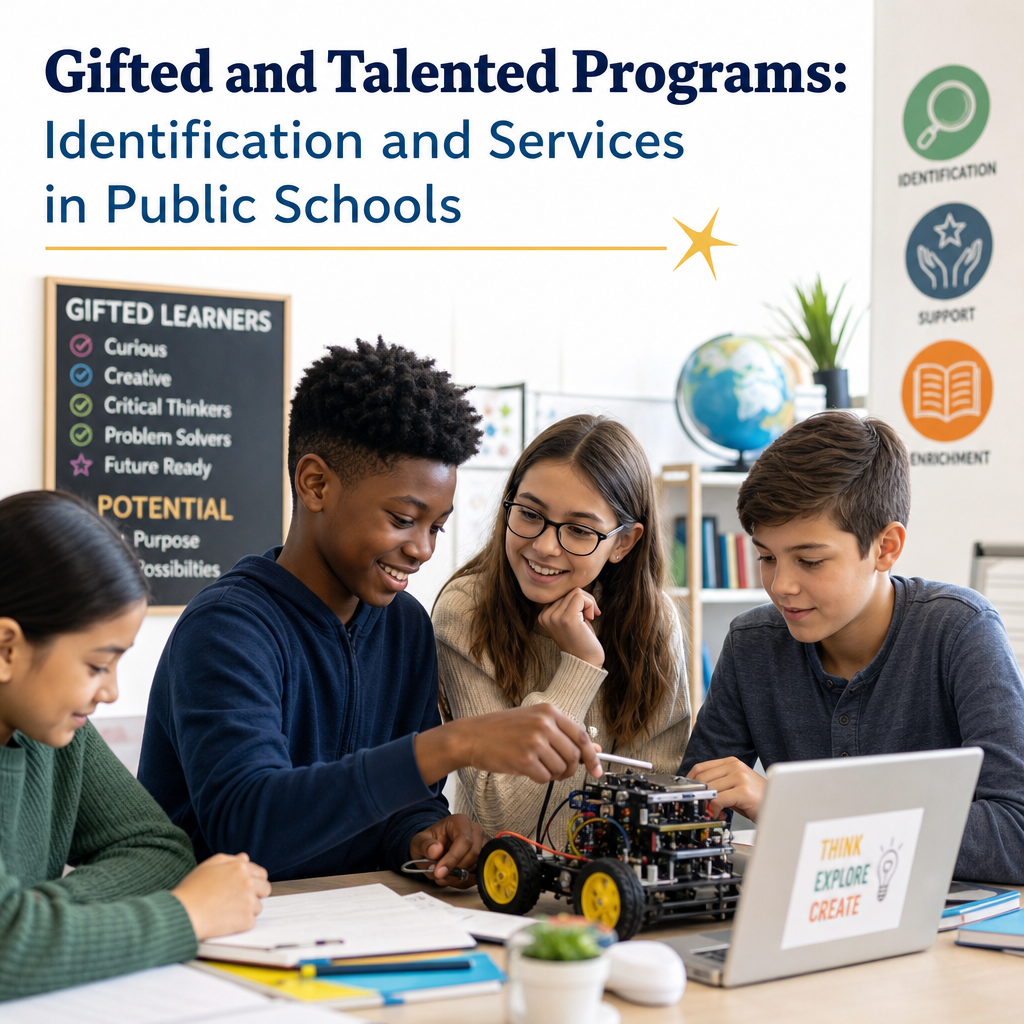
Gifted and Talented Programs: Identification and Services in Public Schools
Gifted and talented programs help public schools identify students who need learning opportunities beyond the regular classroom, using tools like test scores, teacher input, and performance data. When these programs are done well, they can provide the right mix of challenge, enrichment, and support to keep advanced learners engaged and growing.
By: Jennifer on July 25, 2026
Gifted and talented programs play an important role in helping public schools meet the needs of students who learn, think, and create at an advanced level. For families, understanding how gifted and talented programs work can make the difference between a child’s abilities being recognized—or overlooked. These programs are not just about placing high-achieving students in harder classes. They are designed to identify learners who need deeper, faster, or more complex instruction than the standard classroom provides.
Because every school district sets its own procedures, the path to services can look different from one community to the next. Some schools use test scores, teacher recommendations, and performance data. Others also look at creativity, leadership, or motivation. Once identified, students may receive services such as enrichment, acceleration, cluster grouping, or pull-out instruction. Knowing how identification and services work helps parents advocate effectively and helps educators build stronger, more equitable programs.
What Are Gifted and Talented Programs?
Gifted and talented programs are public school services designed to support students who show exceptional potential or achievement in one or more areas. Those areas may include:
General intellectual ability
Specific academic aptitude in reading, math, or science
Creativity or problem-solving ability
Leadership skills
Artistic talent
Other advanced learning needs
These programs are not meant to give students “more work.” Instead, they provide instruction at a level that matches the student’s readiness, pace, and depth of understanding. When schools do this well, students stay engaged, challenged, and better supported.
Why These Programs Matter
Gifted learners can become bored, frustrated, or disconnected if classroom work moves too slowly. Some may coast through school without being challenged, while others may underperform because the work does not match their abilities.
Strong gifted and talented programs can:
Prevent boredom and underachievement
Encourage creativity and critical thinking
Support advanced academic growth
Build confidence and motivation
Help students develop long-term learning habits
How Schools Identify Gifted and Talented Students
Identification is one of the most important parts of gifted education. Schools often use a combination of measures rather than relying on one test score alone. This helps create a more complete picture of a child’s strengths.
Common Identification Methods
Districts may use one or more of the following:
Standardized ability or achievement tests
These may assess verbal reasoning, nonverbal reasoning, math, reading, or overall academic performance.
Classroom performance data
Grades, work samples, and classroom observations can show how a student performs over time.
Teacher and parent nominations
Adults who know the child well may notice advanced reasoning, curiosity, or unusual talent.
Behavior rating scales
These tools measure traits such as persistence, leadership, creativity, or rapid learning.
Portfolio reviews
Work samples, projects, performances, and other evidence can support identification, especially in the arts or other specialized areas.
Why Multiple Measures Matter
A single test can miss students who are gifted but not standardized-test savvy, students learning English, students with disabilities, or students whose potential has gone unnoticed because of limited access to enrichment. Multiple measures help schools make better decisions and reduce bias.
This matters especially for:
Students from historically underrepresented groups
English learners
Twice-exceptional students, also called 2e students
Students who are quiet, perfectionistic, or underconfident
Students whose advanced ability appears in only one subject area
Eligibility Rules Can Vary by District and State
There is no one national model for gifted education in public schools. State laws and district policies determine who qualifies, what evidence is used, and what services are available. Some districts identify students in kindergarten or first grade. Others wait until later grades. Some open nominations only once a year, while others allow them continuously.
Questions to Ask Your School
If you are trying to understand local policies, ask:
What screening tools do you use?
Are all students screened, or only students referred by adults?
What score or criteria is needed for qualification?
Are services available in all grades?
How often are students reviewed for placement?
Can students qualify for services in one subject but not another?
These questions can help families understand both the process and the opportunities available.
Services Commonly Offered in Gifted and Talented Programs
Identification is only the first step. The real value of gifted and talented programs comes from the services students receive after they qualify. Services should match the student’s level of readiness and learning profile.
1. Enrichment
Enrichment adds depth, complexity, or variety to standard instruction. It might include:
Research projects
Problem-based learning
Creative writing
STEM challenges
Debates or Socratic discussions
Independent inquiry
Enrichment is useful for students who need more challenge without necessarily moving ahead in grade level.
2. Acceleration
Acceleration moves students through the curriculum at a faster pace. This can happen in several ways:
Skipping a grade
Advancing in one subject area
Compacting curriculum to eliminate repeated material
Allowing early access to higher-level courses
Acceleration is often effective when a student has already mastered grade-level content and is ready for more advanced work.
3. Cluster Grouping
In cluster grouping, several gifted students are placed in the same classroom with a teacher trained to meet their needs. This approach can make differentiation easier and reduce the isolation some gifted students feel.
4. Pull-Out Programs
Some schools remove students from regular class for part of the day or week to work with a gifted education specialist. During this time, students may do advanced reading, math, inquiry projects, or creative problem-solving.
5. Self-Contained Classes
In some districts, gifted students are placed together in a classroom for most or all of the day. This setting can allow for more targeted instruction, but it works best when the teacher has strong training in gifted education.
What Effective Gifted Services Look Like
A strong gifted and talented program should do more than provide busywork or occasional enrichment. It should be intentional, challenging, and responsive.
Signs of a High-Quality Program
Look for services that include:
Ongoing progress monitoring
Differentiated instruction
Opportunities for independent thinking
Curriculum that goes deeper, not just faster
Social and emotional support
Trained teachers who understand gifted learners
Students should not be asked to repeat already-mastered content. Instead, instruction should build on strengths and stretch thinking.
The Role of Social and Emotional Support
Gifted students often face unique social and emotional challenges. Some feel pressure to be perfect. Others struggle with asynchronous development, where cognitive abilities are advanced but emotional or social skills are still age-typical. Some may mask their abilities to fit in.
Good programs recognize these needs by helping students:
Handle frustration
Take academic risks
Develop resilience
Work with peers
Understand perfectionism and self-expectations
Challenges Families May Encounter
Even when gifted and talented programs exist, families may run into barriers. Some of the most common include limited seats, inconsistent screening, and unclear communication.
Underidentification
Many gifted students are never identified, especially when schools rely heavily on teacher referrals or a single test score. Students from low-income families, students with disabilities, and multilingual learners may be particularly vulnerable to being missed.
Uneven Access
Some schools offer strong services, while others offer little more than enrichment packets. That means a child’s experience may depend more on zip code than ability.
Confusion About Labels
Some families worry that “gifted” is a permanent label or that it creates pressure. Others assume it guarantees elite opportunities. In reality, identification is simply a tool for matching instruction to need.
How Parents Can Advocate for Their Child
Parents do not need to be experts in gifted education to advocate effectively. A focused, respectful approach often works best.
Steps to Take
Learn your district’s policy
Review the school handbook or district website for gifted education information.
Gather examples of advanced work or behavior
Save writing samples, projects, test results, and teacher comments that show your child’s strengths.
Talk with the classroom teacher
Ask how your child performs in class, what challenges they notice, and whether they see signs of advanced learning.
Request screening or evaluation in writing
If you believe your child may qualify, submit a formal request according to district procedures.
Follow up regularly
Keep records of emails, meetings, and decisions.
Sample Signs Your Child May Need More Challenge
A child may benefit from gifted services if they:
Finish work unusually quickly and accurately
Ask complex questions
Learn new material after very little repetition
Show strong memory or reasoning
Become disengaged or bored in class
Create original ideas or solutions
Read, write, or compute well beyond grade level
These signs do not automatically mean a child should be identified, but they are worth discussing with the school.
Supporting Twice-Exceptional and Diverse Learners
Gifted education should recognize that advanced ability does not always look the same. Some students are both gifted and disabled, while others may have talents that appear in nontraditional ways.
Twice-Exceptional Students
Twice-exceptional students may be gifted and also have:
ADHD
Dyslexia
Autism
Anxiety
Speech or language differences
Other learning or developmental needs
These students are often misread because one strength may hide a challenge, or one challenge may hide a strength. Schools should consider both sides of the student’s profile when planning services.
Equity and Representation
A fair gifted program should aim to identify talent in all student groups. That means schools should use culturally responsive practices, universal screening when possible, and a variety of evidence sources. Talent is not limited to one background, language, or personality type.
Tips for Working With the School
Whether your child is newly identified or still under consideration, communication matters.
Helpful Questions for Parent-Teacher Conferences
What strengths do you see in my child?
Is my child being challenged enough?
How does my child respond to advanced tasks?
What services or supports are available?
How will we know whether the placement is working?
Tips for a Productive Partnership
Stay collaborative rather than confrontational
Bring documentation
Focus on your child’s needs, not just the label
Ask how progress will be measured
Revisit the plan each year
Frequently Asked Questions
What is the difference between gifted and talented programs and advanced classes?
Gifted and talented programs are designed to identify students who need instruction beyond the regular curriculum because of advanced ability or potential. Advanced classes, such as honors or AP courses, are subject-based and often offered later in school. A student may participate in both, but they serve different purposes.
Can a student qualify for gifted services in only one subject?
Yes. Many districts identify students for specific academic areas, such as math or reading, rather than for general giftedness. A child may need advanced math work but standard support in other subjects.
Do all public schools offer gifted and talented programs?
No. Availability varies by state and district. Some schools provide robust services, while others offer limited enrichment or no formal gifted program at all. Families should check local policies to learn what is available.
What if my child was not identified but still seems advanced?
If you believe your child was overlooked, ask the school about retesting, portfolio review, or additional screening options. Share specific examples of advanced performance and ask what evidence the district considers during identification.
Are gifted students always high achievers?
Not necessarily. Some gifted students earn excellent grades, but others underachieve, struggle with motivation, or hide their abilities. Performance and potential do not always match, which is why schools should look at more than report cards.
Understanding gifted and talented programs gives families and educators a stronger foundation for supporting advanced learners in public schools. Identification should be thoughtful, inclusive, and based on more than one measure. Once a student is identified, the services should truly fit the child’s needs—whether that means enrichment, acceleration, pull-out support, or a more specialized classroom setting.
The best gifted education does more than reward high scores. It helps students grow, stay curious, and engage with learning at the right level of challenge. It also recognizes that giftedness can appear in many forms and that talented students may need both academic challenge and social-emotional support.
If you are a parent, start by learning your district’s process and documenting your child’s strengths. If you are an educator, look for ways to make identification more equitable and services more meaningful. In either case, the goal is the same: to make sure capable students are seen, challenged, and supported so they can reach their full potential.
Jennifer, M.Ed., holds a degree in Higher Education Administration, with
a focus on U.S. college financial aid, admissions policy, and student
support systems. She researches and writes about scholarships, federal
aid programs, and the college planning process to help students and
families make informed, well-supported decisions.