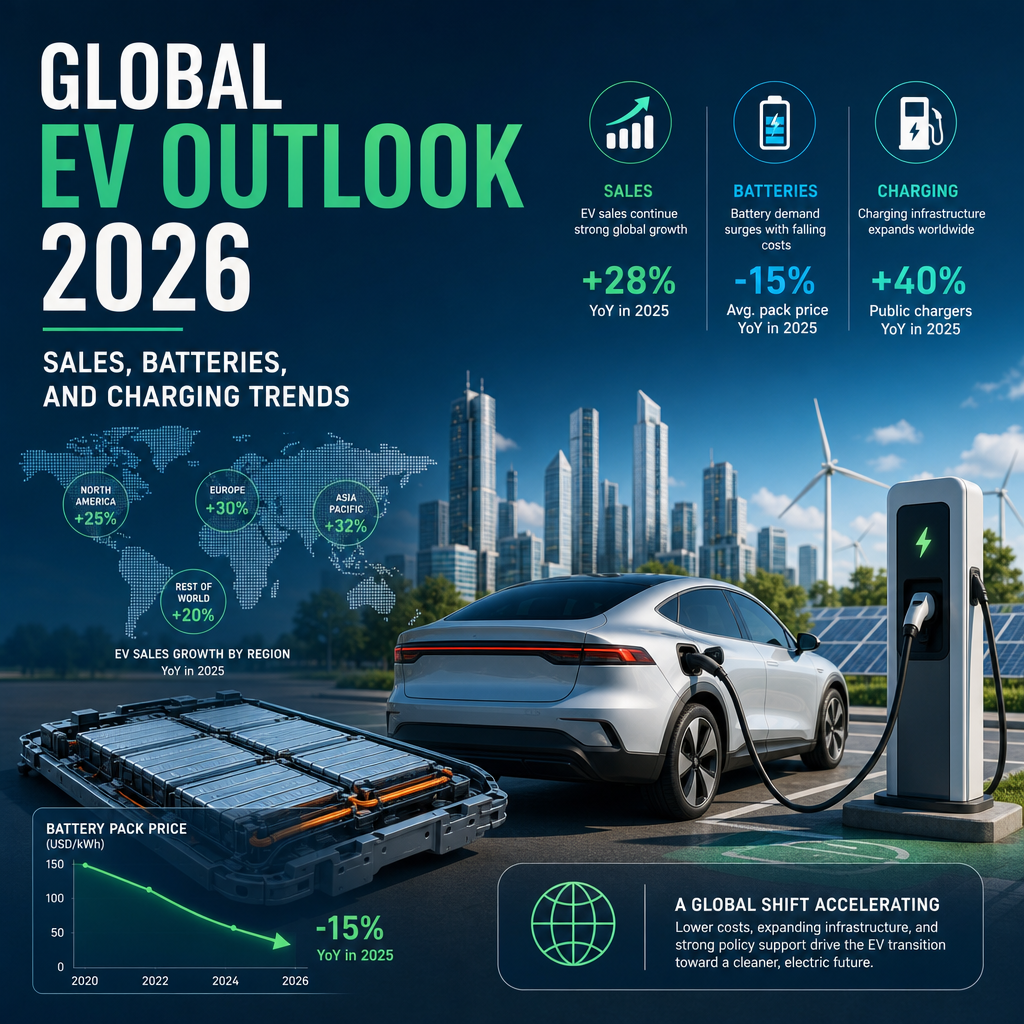
Global EV Outlook 2026: Sales, Batteries, and Charging Trends
Global EV Outlook 2026 points to a market moving beyond hype and into real-world scale, where sales growth, battery innovation, and charging access are all shaping the next phase of EV adoption. From lower costs to better infrastructure, the trends ahead will determine how quickly electric vehicles become the mainstream choice.
By: Peter B on July 24, 2026
Electric vehicles are no longer a niche category reserved for early adopters. As the market matures, the Global EV Outlook 2026 is shaping up to be a story about scale, infrastructure, and competition—not just innovation. Buyers want lower operating costs, governments are tightening emissions rules, automakers are balancing profit with volume, and charging networks are racing to keep up.
The result is a fast-changing landscape where EV sales, battery technology, and charging trends are increasingly connected. A stronger battery supply chain can lower vehicle costs. Better charging access can boost consumer confidence. And broader model availability can accelerate adoption across more markets.
In this article, we’ll break down the key themes behind the Global EV Outlook 2026, including what’s driving electric vehicle sales, where battery development is heading, and how charging infrastructure is evolving to support the next wave of adoption.
Global EV Outlook 2026: What’s Shaping the Market
The electric vehicle market in 2026 is expected to reflect several long-running forces that are now entering a more mature phase:
Policy support remains important, though incentives are becoming more targeted in many countries.
Consumer expectations have shifted toward practical ownership, not just environmental appeal.
Automaker strategy is moving from “announce and build” toward “scale efficiently and profitably.”
Battery supply chains are becoming more diversified as manufacturers reduce dependence on a few raw-material sources.
Charging reliability is becoming just as important as charging speed.
The phrase Global EV Outlook 2026 captures more than growth forecasts. It describes an ecosystem where electric mobility is increasingly integrated into mainstream transportation. That means the conversation has moved beyond whether EVs will succeed. The real question now is how quickly the market can scale while improving affordability, convenience, and trust.
EV Sales Trends in 2026
Broader adoption across vehicle segments
One of the clearest trends in EV sales is expansion beyond compact cars and premium sedans. By 2026, electric models are expected to appear more widely across:
Crossovers and SUVs
Fleet vehicles
Light commercial vans
Pickup trucks in select markets
Entry-level city cars in regions focused on affordability
This matters because buyers often choose based on utility, not technology. As more electric options fit real-world needs, the addressable market grows.
Price remains a key factor
Even as battery costs continue to improve over time, upfront price still influences purchasing decisions. Many shoppers compare EVs not only with other electric models but also with comparable gasoline vehicles. That comparison includes:
Purchase price
Incentives and rebates
Fuel and electricity costs
Maintenance savings
Insurance and financing terms
For many households, the value proposition gets stronger when total cost of ownership is clear. That’s why dealerships, automakers, and policymakers increasingly emphasize long-term savings rather than sticker price alone.
Fleet electrification keeps expanding
Commercial fleets are helping drive EV adoption in 2026. Delivery companies, municipal agencies, rideshare operators, and service fleets often have a strong reason to electrify because they can benefit from lower operating costs and predictable routes.
Fleet buyers also tend to be more data-driven. They look at:
Vehicle uptime
Charging logistics
Maintenance schedules
Battery degradation
Residual value
This practical focus often accelerates adoption, especially when charging can happen at depots overnight.
Regional differences still matter
The Global EV Outlook 2026 will not look the same everywhere. Markets vary based on:
Incentive structures
Grid readiness
Fuel prices
Vehicle availability
Local manufacturing capacity
Urban density and driving patterns
China, Europe, and North America are likely to remain major EV markets, but many emerging economies are also building momentum through two-wheelers, compact cars, buses, and commercial fleets. In these places, affordability and charging access often matter more than long-range battery specs.
Battery Technology: The Heart of the EV Shift
Battery chemistry is diversifying
Battery innovation remains one of the most important themes in the Global EV Outlook 2026. The market is no longer focused on a single chemistry or supply model. Instead, automakers are working with a wider mix of battery types to balance cost, performance, and supply chain resilience.
Common developments include:
LFP batteries for lower cost and improved durability
Nickel-rich chemistries for higher energy density
Sodium-ion batteries for certain cost-sensitive applications
Solid-state research aimed at improving safety and energy storage
Not every chemistry fits every vehicle. For example, a commuter EV may prioritize affordability and cycle life, while a long-range SUV may prioritize energy density. This segmentation allows manufacturers to match battery design with use case.
Supply chains are becoming a strategic issue
Battery materials such as lithium, nickel, cobalt, graphite, and manganese continue to attract attention because supply reliability affects pricing and production planning. Manufacturers are responding by:
Building more local refining and processing capacity
Signing long-term supply contracts
Expanding recycling initiatives
Designing batteries with fewer scarce materials
Exploring alternative chemistries
This is not just a manufacturing story. It affects consumer pricing, production timing, and the ability of automakers to meet demand.
Battery recycling and second-life use are growing
As EV adoption grows, battery end-of-life management becomes more important. In 2026, more companies are investing in recycling systems that recover valuable materials and reduce waste. Others are exploring second-life batteries for stationary storage applications such as:
Grid support
Solar energy storage
Backup power
Commercial peak shaving
These uses can extend the value of a battery after it leaves a vehicle, improving the sustainability case for electrification.
Faster charging and better thermal management
Battery technology is also advancing in terms of charging speed and durability. Better thermal management helps batteries maintain performance during rapid charging and in extreme weather. That matters because drivers expect EVs to work in everyday conditions, not only under ideal test scenarios.
Manufacturers are focusing on:
Better cell design
Improved cooling systems
More efficient battery management software
Reduced charging time without compromising lifespan
The goal is simple: make EV ownership feel normal, convenient, and dependable.
Charging Trends: Convenience Is the New Battleground
Public charging networks are getting denser
The charging experience is a major factor in EV adoption. In the Global EV Outlook 2026, public charging is expected to continue expanding, especially along highways, in urban centers, and near retail or workplace destinations.
Drivers want more than just charger availability. They want:
Easy-to-find stations
Clear pricing
Reliable uptime
Fast payment options
Compatible connectors
Safe, well-lit locations
A charger that exists but is broken, blocked, or confusing to use does little to build confidence.
Home charging remains the easiest solution
For many EV owners, home charging is still the most convenient option. Overnight charging lets drivers wake up to a full battery without changing daily routines. This is especially valuable in suburban and residential settings where off-street parking is common.
However, home charging access is not universal. Renters, apartment residents, and urban drivers may rely more heavily on workplace or public charging. That reality is pushing policymakers and property owners to rethink building codes, electrical upgrades, and shared charging access.
Workplace and destination charging are gaining value
Charging doesn’t have to happen only at home or on the highway. In 2026, workplace and destination charging are expected to play a larger role as employers, shopping centers, hotels, and public venues add chargers to attract and retain visitors.
This category is especially useful for:
Drivers without home charging
Fleet vehicles parked during the day
People who can top up while working, shopping, or dining
Long-duration parking locations
Destination charging may not be as fast as DC fast charging, but it can be highly practical.
Fast charging is improving, but reliability matters more
DC fast charging continues to evolve, especially for long-distance travel and high-utilization fleets. But speed alone does not solve the whole problem. Drivers also care about whether the charger works, whether the session starts smoothly, and whether the station is available when needed.
That’s why the charging conversation in the Global EV Outlook 2026 increasingly includes:
Network maintenance
Standardization
Roaming across charging providers
Uptime monitoring
User-friendly apps and payment systems
In many ways, the next phase of competition is not just about installing more chargers. It is about creating a better overall charging experience.
Policy, Grid Readiness, and Consumer Confidence
The success of EV adoption depends on more than vehicles and batteries. Governments and utilities play a major role in shaping how quickly the market develops.
Policy is shifting from subsidies to systems
Many countries are moving away from broad purchase incentives and toward policies that support infrastructure, manufacturing, and adoption in specific segments. This can include:
Charging buildout support
Grid modernization
Fleet electrification programs
Local battery manufacturing incentives
Low-emission zones and vehicle regulations
This shift reflects a more mature market. Instead of trying only to stimulate demand, policymakers are also trying to remove structural barriers.
Grid planning matters more than ever
As EV adoption increases, electricity demand patterns change. Utilities need to prepare for more charging load, especially in neighborhoods with high EV concentration or commercial fleet depots.
Smart charging can help by shifting energy use to off-peak hours. That reduces strain on the grid and may lower costs for drivers. Managed charging, dynamic pricing, and vehicle-to-grid trials are all part of the broader strategy to make electrification scalable.
Trust is essential for mainstream adoption
Many potential buyers still have practical questions:
How far can the car really go?
Where will I charge?
How much will maintenance cost?
What happens to the battery over time?
Is the resale value stable?
Addressing these concerns with clear information is essential. In that sense, the Global EV Outlook 2026 is not just about technology; it is about confidence. The faster the industry answers common questions with reliable solutions, the faster adoption can grow.
What Businesses and Buyers Should Watch in 2026
For automakers
Automakers should watch:
Battery sourcing and chemistry choices
Vehicle segment demand
Charging partnerships
Software integration
Profitability at scale
For fleet operators
Fleet managers should focus on:
Depot charging planning
Route fit and range
Maintenance costs
Driver training
Charging downtime risk
For consumers
Shoppers should compare:
Real-world range
Home charging options
Public charging availability
Warranty coverage
Total ownership cost
The EV market is becoming more competitive, which should benefit informed buyers. But it also means product differences matter more than ever.
Practical Example: How a Mid-Sized Business Can Prepare
Consider a regional delivery company evaluating electric vans in 2026. Instead of asking only whether the vans have enough range, the company should assess:
Daily route length
Depot electrical capacity
Driver shift schedules
Winter performance
Charging costs
Maintenance intervals
Replacement planning for aging batteries
This broader approach often reveals that the main challenge is not the vehicle itself but the charging and operations system around it. That insight applies equally to governments, households, and fleet buyers.
Frequently Asked Questions
1. What does the Global EV Outlook 2026 focus on?
The Global EV Outlook 2026 centers on the main forces shaping electric mobility: vehicle sales growth, battery development, charging infrastructure, policy support, and market maturity. It reflects how EV adoption is moving from early growth into a more system-wide transformation.
2. Will EV sales continue growing in 2026?
EV sales are expected to keep expanding in many regions, although growth rates may vary by market. Adoption depends on pricing, model availability, charging access, incentives, and consumer confidence. Broader vehicle choices and improved infrastructure are likely to support continued growth.
3. Which battery technologies matter most in 2026?
Several battery technologies are important in 2026, including lithium iron phosphate (LFP), nickel-rich chemistries, sodium-ion for certain applications, and ongoing solid-state research. Different chemistries serve different needs, from lower cost to higher energy density.
4. What is the biggest challenge for EV charging?
The biggest challenge is not only charger quantity but also reliability and convenience. Drivers need chargers that are easy to find, available when needed, compatible with their vehicles, and simple to use. Reliable maintenance and payment systems are just as important as fast charging speeds.
5. How can buyers evaluate whether an EV is right for them?
Buyers should look at their daily driving distance, charging access, climate conditions, vehicle type, and total cost of ownership. A good EV fit depends on how the car will be used in real life, not just on range numbers or promotional claims.
The Global EV Outlook 2026 points to a market that is becoming more practical, more competitive, and more dependent on infrastructure than ever before. EV sales are no longer driven only by novelty; they are being shaped by affordability, model variety, and real-world usability. Battery innovation continues to improve cost, performance, and supply chain resilience, while charging trends show that access, reliability, and convenience are now central to the consumer experience.
For automakers, the next stage is about scaling wisely. For fleet operators, it is about aligning vehicles with charging operations. For consumers, it is about choosing an EV that fits daily life and long-term ownership goals. Across all of these groups, the same lesson applies: the future of electric mobility will be built not just on better cars, but on better systems.
If you want to understand where the industry is headed, keep watching sales patterns, battery chemistry shifts, and charging network improvements. Those three areas will tell the story of EV adoption far better than headlines alone.
Peter B holds a degree in Journalism and has 5 years
of experience covering U.S. economic policy, labor markets, and
financial news. He writes data-driven news content on topics
like inflation, interest rates, and employment trends.