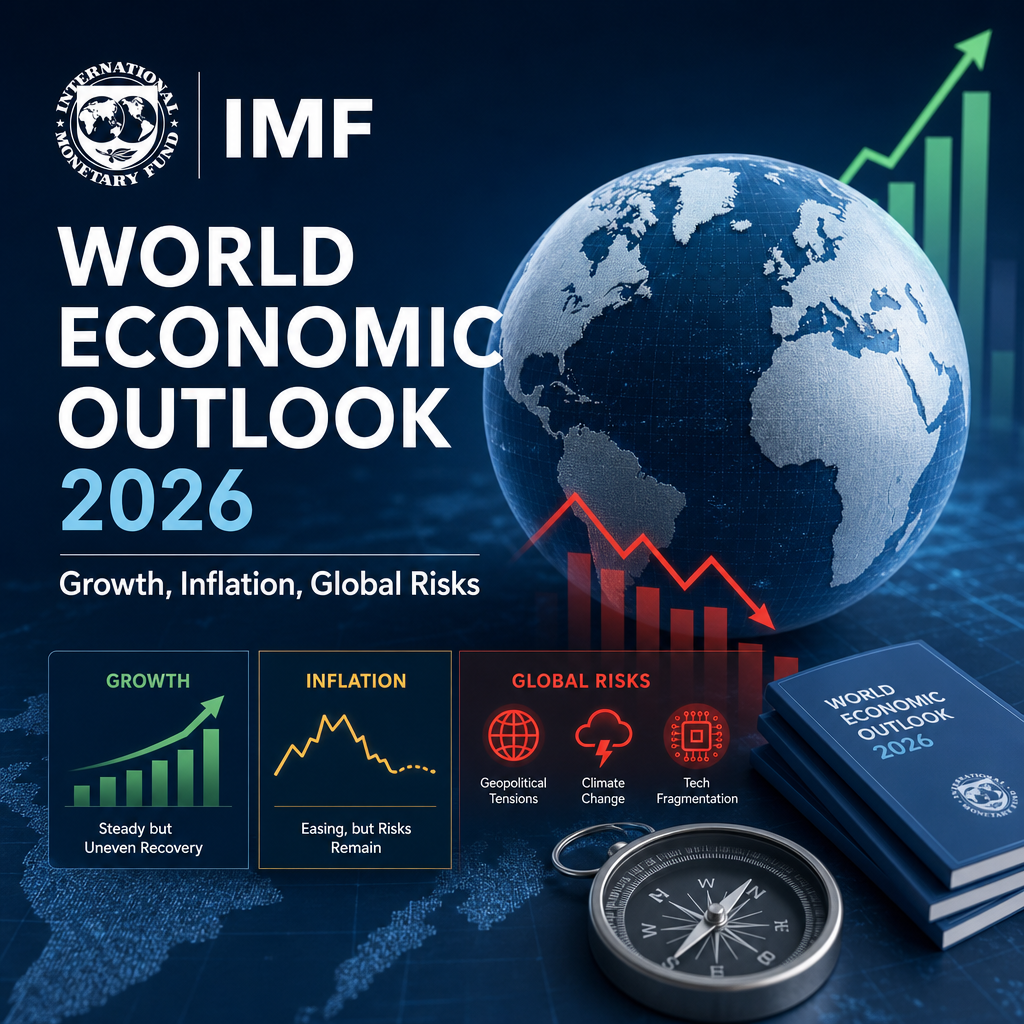
IMF World Economic Outlook 2026: Growth, Inflation, Global Risks
The World Economic Outlook is one of the clearest guides to what may shape the global economy in 2026, from growth and inflation to debt, trade, and financial stability. With uncertainty still high, the IMF World Economic Outlook 2026 will be essential reading for anyone trying to understand the risks and opportunities ahead.
By: Peter B on July 24, 2026
The IMF World Economic Outlook 2026 will be closely watched by investors, policymakers, business leaders, and anyone trying to understand where the global economy is headed. Each IMF outlook offers a detailed snapshot of growth trends, inflation pressures, labor market conditions, and the risks that could push the world economy off course. In a period shaped by higher borrowing costs, geopolitical uncertainty, and uneven recovery across regions, the 2026 outlook will matter more than ever.
While no forecast can capture every surprise, the IMF World Economic Outlook 2026 is expected to provide one of the clearest international assessments of how inflation is evolving, where growth is holding up, and which global risks deserve the most attention. For readers who want a practical understanding of the global economy, this report is not just for economists—it is a useful guide for businesses, policymakers, and households making decisions in a complex environment.
What the IMF World Economic Outlook 2026 Covers
The IMF World Economic Outlook 2026 will likely examine the major forces shaping the global economy across advanced economies, emerging markets, and developing countries. The report typically brings together forecasts and analysis on:
Global GDP growth
Inflation trends and disinflation progress
Monetary policy and interest rates
Fiscal policy and debt sustainability
Trade, investment, and productivity
Labor markets and wage dynamics
Financial stability and market risks
It is important to remember that the IMF does more than publish numbers. The World Economic Outlook explains why growth is slowing or accelerating, where inflation is persistent, and how policy choices affect future performance. That broader context makes the report especially valuable.
Why the IMF outlook matters
The IMF’s forecasts often influence how governments frame budgets, how central banks interpret inflation risks, and how companies plan for international demand. Even when local conditions differ, the report helps readers compare economies using a common framework.
For example:
A manufacturer may use IMF growth forecasts to plan export demand.
A lender may examine debt trends in emerging markets.
A portfolio manager may assess currency risk and global interest-rate pressure.
A policymaker may compare domestic inflation with global trends.
Global Growth in 2026: A Picture of Uneven Momentum
The headline question in any IMF report is simple: How fast is the world economy growing? For the IMF World Economic Outlook 2026, the answer will likely reflect a mixed picture rather than a single global trend.
Advanced economies may grow slowly but steadily
Many advanced economies are expected to continue facing sluggish growth due to:
Tight financial conditions
Aging populations
Weak productivity gains
Cautious household spending
Uneven industrial demand
Even when inflation falls, growth may not rebound quickly. Higher interest rates can continue to weigh on borrowing, housing markets, and business investment. Some economies may avoid recession, but that does not necessarily mean they will return to strong expansion.
Emerging markets may remain more dynamic
Emerging market economies could continue to show relatively stronger growth, especially where domestic demand is solid and inflation has eased enough to allow policy flexibility. Still, the picture is not uniform. Countries with high debt loads, heavy import dependence, or weak institutional buffers may remain vulnerable to shocks.
China, India, and other major economies
The IMF World Economic Outlook 2026 will likely pay close attention to the world’s largest economies:
China: growth may remain affected by property-sector stress, local government debt, and soft domestic demand.
India: likely to remain one of the faster-growing major economies, supported by investment, consumption, and digital expansion.
The United States: may continue to show resilience, but slower growth could emerge if labor markets cool and borrowing remains expensive.
The euro area: may struggle with weak industrial activity and uneven consumer demand.
The key theme is not whether the world is growing, but whether growth is broad-based enough to support durable expansion.
Inflation in 2026: Progress, Persistence, and Policy Trade-Offs
Inflation will remain one of the most important topics in the IMF World Economic Outlook 2026. Even if headline inflation has fallen from earlier peaks in many countries, the challenge is not always over. Some economies may still face sticky services inflation, wage pressure, or imported price shocks.
Why inflation may continue to matter
Inflation can remain politically and economically important even when it is no longer accelerating quickly. Households still feel the effects of higher prices on food, housing, and everyday essentials. Businesses still face uncertainty about labor costs, transportation, and financing.
The IMF is likely to examine several inflation-related questions:
Are central banks succeeding in restoring price stability?
Is core inflation declining at a sustainable pace?
Are wages rising faster than productivity in some economies?
Could renewed energy or supply shocks reverse progress?
Different inflation paths across countries
Inflation trends are rarely synchronized. Some countries may be near target, while others continue to fight elevated prices. Differences in exchange rates, fiscal policy, labor market conditions, and import exposure all matter.
For example:
Economies with stronger currencies may see lower imported inflation.
Countries with persistent fiscal deficits may struggle with demand-driven price pressure.
Nations dependent on food or energy imports may be more exposed to commodity swings.
The risk of “last mile” inflation
The final stage of disinflation is often the hardest. The IMF World Economic Outlook 2026 may highlight the “last mile” problem, where getting inflation from moderate levels back to central bank targets proves more difficult than the initial decline.
This matters because it affects:
The timing of interest-rate cuts
Real wage growth
Consumer confidence
Market expectations for long-term borrowing costs
The Global Risks the IMF Will Likely Highlight
No world economic forecast is complete without a serious discussion of risks. The IMF World Economic Outlook 2026 will likely emphasize that the baseline outlook is only one possible path. Several downside risks could disrupt growth or reignite inflation.
1. Geopolitical tensions
Conflict, sanctions, trade restrictions, and shipping disruptions can all spill into the global economy. Geopolitical shocks often affect energy prices, supply chains, and investor confidence quickly.
2. Financial market volatility
If investors expect faster rate cuts than central banks can deliver, financial markets may become unstable. Sudden changes in bond yields, credit spreads, or exchange rates can create stress for borrowers and governments.
3. Debt vulnerabilities
Public and private debt remain major concerns in many countries. Higher interest rates can make refinancing harder, especially for lower-income economies and firms with variable-rate obligations.
4. Climate-related shocks
The IMF increasingly recognizes that extreme weather, crop disruption, and infrastructure damage can harm growth and worsen inflation. Climate events can also strain government budgets and insurance systems.
5. Trade fragmentation
A less integrated global trading system can reduce efficiency and raise costs. If firms are forced to reorganize supply chains around geopolitical blocs, the result may be slower growth and higher prices.
6. Policy mistakes
Central banks and governments must balance inflation control, fiscal sustainability, and growth support. If policy becomes too loose, inflation may reaccelerate. If it becomes too tight, growth may weaken unnecessarily.
What the IMF Outlook Means for Businesses
The IMF World Economic Outlook 2026 is not just a macroeconomic report. It is a planning tool. Businesses can use it to think ahead about demand, pricing, hiring, and investment.
Key business takeaways
Exporters should monitor growth forecasts in major destination markets.
Importers should watch inflation and exchange-rate projections.
Employers should track labor market tightness and wage trends.
Borrowers should pay attention to rates, credit conditions, and refinancing risks.
Practical example
A U.S.-based consumer goods company selling into Europe may use the IMF outlook to assess whether European household demand is likely to improve. If growth remains weak and inflation is still elevated, the company might delay expansion plans or adjust pricing strategy.
Likewise, a logistics company serving Asia and Latin America may study trade and energy risks more carefully if the report signals fragmented supply chains or volatile commodity markets.
What the IMF Outlook Means for Policymakers
For governments and central banks, the IMF World Economic Outlook 2026 will likely serve as an external benchmark.
Central banks
Central bankers will look for clues on:
Inflation persistence
Wage growth
Economic slack
Currency stability
Financial conditions
If the report shows that inflation is falling but not decisively enough, monetary authorities may remain cautious about easing too soon.
Finance ministries
Fiscal authorities will focus on:
Growth assumptions for budget planning
Debt servicing costs
Revenue outlooks
Support for vulnerable households
Investment in infrastructure and resilience
A weaker growth outlook can quickly reduce tax revenue and increase pressure for social spending.
How to Read the IMF World Economic Outlook 2026 Like a Pro
The report can be dense, but a few sections usually give the most useful signals.
Focus on the baseline and the risks
Do not stop at the headline forecast. Compare the baseline with the IMF’s risk discussion to understand what could make the outlook better or worse.
Compare regions, not just global totals
A single global growth number can hide major differences across countries. It is often more useful to compare:
Advanced economies vs. emerging markets
Commodity exporters vs. importers
High-debt vs. low-debt countries
Watch policy assumptions
Forecasts often depend on assumptions about interest rates, fiscal policy, and global trade. If those assumptions change, the outlook can shift significantly.
Look for structural themes
Beyond short-term growth, the IMF often highlights longer-term issues like productivity, labor supply, digitalization, and climate resilience. These are essential for understanding future potential growth.
Why the IMF World Economic Outlook 2026 Will Shape the Debate
The IMF World Economic Outlook 2026 will likely do more than update forecasts. It will shape the global conversation about what kind of economic environment the world is entering.
If growth remains uneven, inflation proves sticky, and risks stay elevated, then policymakers may be forced into difficult trade-offs. They may need to support growth without reigniting inflation, strengthen financial resilience without choking credit, and invest in long-term stability while keeping debt manageable.
That balancing act is exactly why the IMF outlook matters. It helps decision-makers see beyond national headlines and understand the interconnected nature of the global economy.
Frequently Asked Questions
What is the IMF World Economic Outlook?
The IMF World Economic Outlook is a major report published by the International Monetary Fund that analyzes global economic trends and provides forecasts for growth, inflation, trade, and other key indicators. It also explains major risks and policy challenges facing the world economy.
Why is the IMF World Economic Outlook 2026 important?
The 2026 edition will help readers understand how the global economy is likely to perform in the coming year and beyond. It is important because it offers a respected international perspective on growth, inflation, interest rates, debt, and financial stability.
How does the IMF forecast global growth?
The IMF uses economic data, country-level analysis, policy assumptions, and global trend modeling to estimate future growth. Its forecasts are based on available information at the time of publication and may change as new risks emerge.
What are the biggest risks to the 2026 global economy?
Likely risks include geopolitical conflict, inflation persistence, financial market volatility, debt stress, climate-related disruption, and trade fragmentation. Policy mistakes can also worsen outcomes if inflation or growth dynamics change unexpectedly.
How can businesses use the IMF World Economic Outlook?
Businesses can use the report to plan for demand trends, borrowing costs, exchange-rate movements, and international risk exposure. It is especially useful for companies involved in trade, investment, logistics, finance, and global supply chains.
The IMF World Economic Outlook 2026 will be one of the most important guides to the global economy next year because it brings together the key issues shaping growth, inflation, and risk in one place. Its value lies not only in the forecast numbers, but in the broader story it tells about uneven recovery, stubborn price pressures, debt vulnerabilities, and the challenges of policymaking in an uncertain world.
For businesses, the report can support smarter planning around demand, pricing, financing, and international expansion. For policymakers, it offers a useful reference point for balancing inflation control with growth support. For everyone else, it provides a clearer lens on why the global economy often moves in ways that are connected, complicated, and sometimes surprising.
As 2026 approaches, staying informed will matter. Following the IMF’s analysis can help you better understand the forces shaping the year ahead and prepare for both opportunities and risks in the global economy.
Peter B holds a degree in Journalism and has 5 years
of experience covering U.S. economic policy, labor markets, and
financial news. He writes data-driven news content on topics
like inflation, interest rates, and employment trends.