How Teachers Can Use DocsTeach Primary Sources in the Classroom
DocsTeach primary sources help teachers turn history lessons into hands-on investigations, giving students a chance to analyze real letters, photos, maps, and speeches from the past. With interactive tools and a rich digital archive, DocsTeach makes it easier to build engaging lessons that strengthen critical thinking and source analysis.
By: Jennifer on July 25, 2026
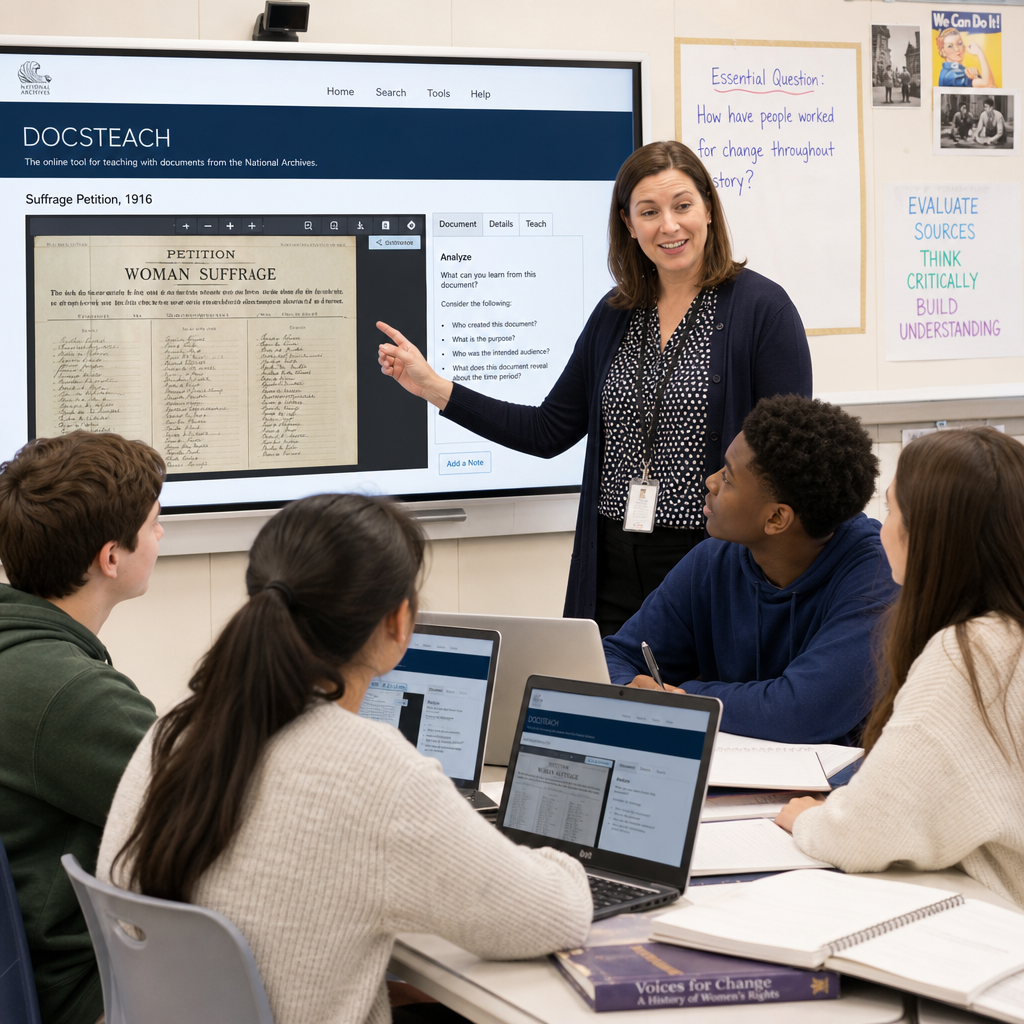
Primary sources bring history, civics, and critical thinking to life in a way that textbooks alone cannot. When teachers use DocsTeach primary sources in the classroom, they give students direct access to letters, photographs, maps, speeches, political cartoons, and other original historical records. Instead of simply reading about the past, students examine evidence, ask questions, and build interpretations from the source itself.
DocsTeach, created by the National Archives, makes that process more accessible. It offers a large collection of digitized primary sources plus interactive tools that help educators design lessons, scaffold analysis, and check student understanding. Whether you teach elementary, middle, or high school, DocsTeach can support deeper learning across social studies and beyond.
What Is DocsTeach and Why Does It Matter?
DocsTeach is an online platform from the National Archives that helps educators use historical documents in the classroom. It includes thousands of primary sources and a set of digital activities that turn document analysis into an interactive experience.
Teachers often struggle to find reliable, age-appropriate sources and to build lessons around them efficiently. DocsTeach solves that problem by combining:
A searchable archive of primary source documents
Ready-to-use teaching activities
Tools for document analysis and annotation
Options for creating custom assignments
Using DocsTeach primary sources in the classroom matters because it supports evidence-based learning. Students learn to notice details, compare perspectives, and support claims with historical evidence. These are not only history skills; they are literacy and critical thinking skills that transfer to many subjects.
Benefits for Students
Primary sources help students:
Engage more actively with content
Develop historical thinking skills
Build vocabulary through authentic texts
Practice observation and inference
Understand that history includes multiple perspectives
Benefits for Teachers
DocsTeach helps teachers:
Save time finding trusted resources
Differentiate instruction more easily
Create structured activities for document analysis
Align lessons with inquiry-based learning
Support discussion with concrete evidence
How Teachers Can Use DocsTeach Primary Sources in the Classroom
The best way to use DocsTeach primary sources in the classroom depends on grade level, subject, and learning goals. The platform is flexible enough for quick warm-ups, full lessons, independent practice, and assessment.
1. Start With a Clear Learning Objective
Before choosing a document, identify what students should learn. Are they analyzing point of view? Comparing causes of an event? Practicing context clues?
For example:
In a civics class, students might examine a petition or executive order to understand government power.
In a U.S. history class, students might compare wartime propaganda posters to discuss public opinion.
In an English class, students might analyze a speech for tone, purpose, and persuasive techniques.
A strong objective keeps the document activity focused. It also helps you choose sources that match students’ reading level and background knowledge.
2. Use the Search Tools to Find the Right Source
DocsTeach offers a searchable collection that can be filtered by topic, era, document type, and more. Teachers can look for:
Letters
Photographs
Maps
Speeches
Newspaper pages
Political cartoons
Government records
When selecting a source, consider:
Is the document visually engaging?
Is the language accessible for students?
Does it connect to the lesson’s essential question?
Will it spark discussion or inquiry?
A photograph or map may work better than a dense text for younger students. Older students may benefit from a speech or letter that requires closer reading.
3. Introduce Documents With Context, Not Answers
Students often need background knowledge to make sense of a primary source. Before they begin analyzing, provide just enough context to orient them without giving away the interpretation.
You can briefly explain:
Who created the document
When it was created
What was happening historically
Why it may have been made
This step matters because students need a frame for analysis. However, avoid turning the introduction into a lecture. The goal is to prepare students to discover meaning, not to replace their own thinking.
4. Use Interactive Activities to Guide Analysis
DocsTeach includes built-in activity formats that help structure student work. These tools make DocsTeach primary sources in the classroom especially useful for teachers who want more than passive viewing.
Common activity types may include:
Compare and Contrast
Students examine two documents side by side and identify similarities and differences. This works well for comparing political cartoons, speeches, photographs, or different accounts of the same event.
Sequence or Sorting Activities
Students place documents in chronological order or group them by theme, cause, or effect. This supports understanding of historical change over time.
Fill-in and Label Activities
Teachers can create questions or prompts that ask students to label parts of a document, identify key details, or complete a close-reading task.
Annotation and Highlighting
Students can mark up a source digitally, drawing attention to phrases, symbols, or visual clues. This is particularly helpful for multilingual learners and students who need guided reading support.
5. Teach Students How to Analyze a Primary Source
Students may not automatically know how to read a historical document. They need a routine. A simple analysis process can help them move from observation to interpretation.
Use a sequence like this:
Observe
What do you notice first? Look for words, images, dates, names, and symbols.
Infer
What might the document mean? What assumptions can you make?
Question
What do you still want to know? What is missing?
Corroborate
How does this source compare with another document or textbook information?
Conclude
What does the source tell us about the event, person, or era?
You can model this process with a think-aloud before asking students to work independently or in pairs.
6. Build Collaboration Into the Lesson
Primary source analysis becomes richer when students talk through their thinking. DocsTeach activities can support individual work, but classroom discussion often deepens understanding.
Try these formats:
Turn and talk: Students share one observation and one question.
Small-group analysis: Each student focuses on a different part of the source, then the group combines insights.
Whole-class discussion: Use one document as the basis for evidence-based debate.
Gallery walk: Students rotate among several sources and leave comments or questions.
Collaborative work is especially useful when students encounter challenging language or unfamiliar historical context. Peer discussion often helps them notice details they may have missed.
7. Connect Primary Sources to Writing Tasks
One of the most effective ways to use DocsTeach primary sources in the classroom is to connect document analysis to writing. A source becomes even more meaningful when students must explain what it shows and why it matters.
Possible writing tasks include:
A short evidence-based response
A paragraph explaining the document’s point of view
A comparison essay using two sources
A source analysis worksheet
A class discussion post or reflection
For example, after analyzing a photo from the Great Depression, students might answer:
What does this image suggest about life during the Depression? Use at least two details from the source to support your claim.
This kind of task encourages close reading and makes student thinking visible.
8. Differentiate for Diverse Learners
DocsTeach can support a range of learners when used intentionally. Teachers can adjust complexity without lowering expectations.
Here are a few practical ways to differentiate:
Use shorter documents or visual sources for emerging readers
Preteach key vocabulary before analysis
Pair stronger readers with students who need support
Provide sentence starters for discussion or writing
Offer audio or teacher-led reading of difficult text
Break a complex source into sections
For English learners, visuals, captions, and structured prompts can make a big difference. For advanced students, challenge them to compare sources, detect bias, or identify historical significance independently.
9. Use DocsTeach for Formative Assessment
DocsTeach activities can function as quick checks for understanding. Instead of waiting for a unit test, teachers can see how students interpret evidence in real time.
Use primary source tasks to assess:
Reading comprehension
Historical reasoning
Source citation
Claim-evidence reasoning
Ability to distinguish fact from interpretation
For example, after a lesson on the Civil Rights Movement, students might analyze a protest flyer and respond to a prompt about audience and purpose. Their answers reveal whether they understand the historical context and can support their thinking with evidence.
10. Extend Learning Beyond One Lesson
DocsTeach is not just for isolated document analysis. It can anchor a larger inquiry unit. A collection of sources can help students investigate a big question over several days or weeks.
For example:
Essential question: How did the Industrial Revolution change daily life?
Students examine labor records, photographs, and newspaper articles.
They compare the experiences of workers, owners, and reformers.
They write a final response using multiple sources.
This approach builds persistence, curiosity, and stronger analytical habits. It also helps students see history as a process of interpretation rather than memorization.
Lesson Ideas Using DocsTeach Primary Sources
If you want to get started quickly, here are a few classroom-ready ideas.
Historical Mystery Starter
Show students one primary source without context and ask them to infer:
Who created it?
What was happening?
What clues support your ideas?
Then reveal the background information and discuss how their interpretations changed.
Source Comparison
Choose two sources that show different perspectives on the same issue. Ask students to compare tone, audience, and message.
Exit Ticket Analysis
After a lesson, give students a short source and ask one focused question. For example:
What is one detail that connects this document to today’s lesson?
What point of view does the creator seem to have?
Document-Based Mini Debate
Assign small groups different sources related to a historical issue. Have them use evidence from the documents to support a claim.
Creative Response
Ask students to write a diary entry, headline, or social media-style post from the perspective of someone connected to the source. This works best after careful historical analysis, not before it.
Best Practices for Using DocsTeach Well
To get the most out of DocsTeach, keep these best practices in mind:
Choose sources that clearly connect to your objective
Model document analysis before releasing students to work independently
Use scaffolds for younger students and language learners
Ask open-ended questions that require evidence
Pair primary sources with secondary sources for balance
Encourage students to revise their thinking as they gather more evidence
It also helps to keep lessons simple at first. One strong source and one clear task are often more effective than a complicated activity with too many steps.
Frequently Asked Questions
What grade levels can use DocsTeach primary sources in the classroom?
DocsTeach can work across grade levels, from upper elementary through high school. Teachers should select documents and tasks that match students’ reading levels and background knowledge. Visual sources and short excerpts often work well for younger students, while older students can handle more complex texts and multi-source analysis.
Do students need an account to use DocsTeach?
In many cases, students can complete activities shared by their teacher without needing to create full accounts. Teachers typically set up the lesson or activity and then share access through a class link or assignment format. Check the platform’s current setup options to see what works best for your classroom.
How does DocsTeach support critical thinking?
DocsTeach supports critical thinking by asking students to observe details, infer meaning, compare perspectives, and justify claims with evidence. These tasks push students beyond memorization and into analysis. They also help students understand that historical sources can reflect bias, purpose, and context.
Can DocsTeach be used in subjects other than history?
Yes. While DocsTeach is especially useful for social studies, it can also support English language arts, civics, government, and even interdisciplinary projects. Teachers can use speeches for rhetoric analysis, photographs for visual literacy, and maps or charts for geography-related lessons.
What if students struggle to understand the document?
Start with context, vocabulary support, and guided questions. You can also use smaller excerpts, pair students for discussion, or choose a more visual source. Modeling how to think aloud through a document is one of the most effective ways to build confidence and comprehension.
Using DocsTeach primary sources in the classroom gives students something powerful: the chance to engage with history as evidence, not just as information. When students examine original documents, they learn to ask better questions, support ideas with proof, and recognize that every source has a context and a perspective. That kind of learning builds stronger readers, more thoughtful writers, and more critical thinkers.
For teachers, DocsTeach offers an efficient and flexible way to bring authentic documents into lessons without spending hours searching for materials or building activities from scratch. With the right source, a clear objective, and a simple routine for analysis, even a single document can spark deep discussion and meaningful insight.
Start small if needed. Choose one source, one essential question, and one student task. As you and your students grow more comfortable with the process, expand into comparisons, inquiry units, and source-based writing. The more often students practice with primary sources, the more confident and capable they become.
Jennifer, M.Ed., holds a degree in Higher Education Administration, with
a focus on U.S. college financial aid, admissions policy, and student
support systems. She researches and writes about scholarships, federal
aid programs, and the college planning process to help students and
families make informed, well-supported decisions.