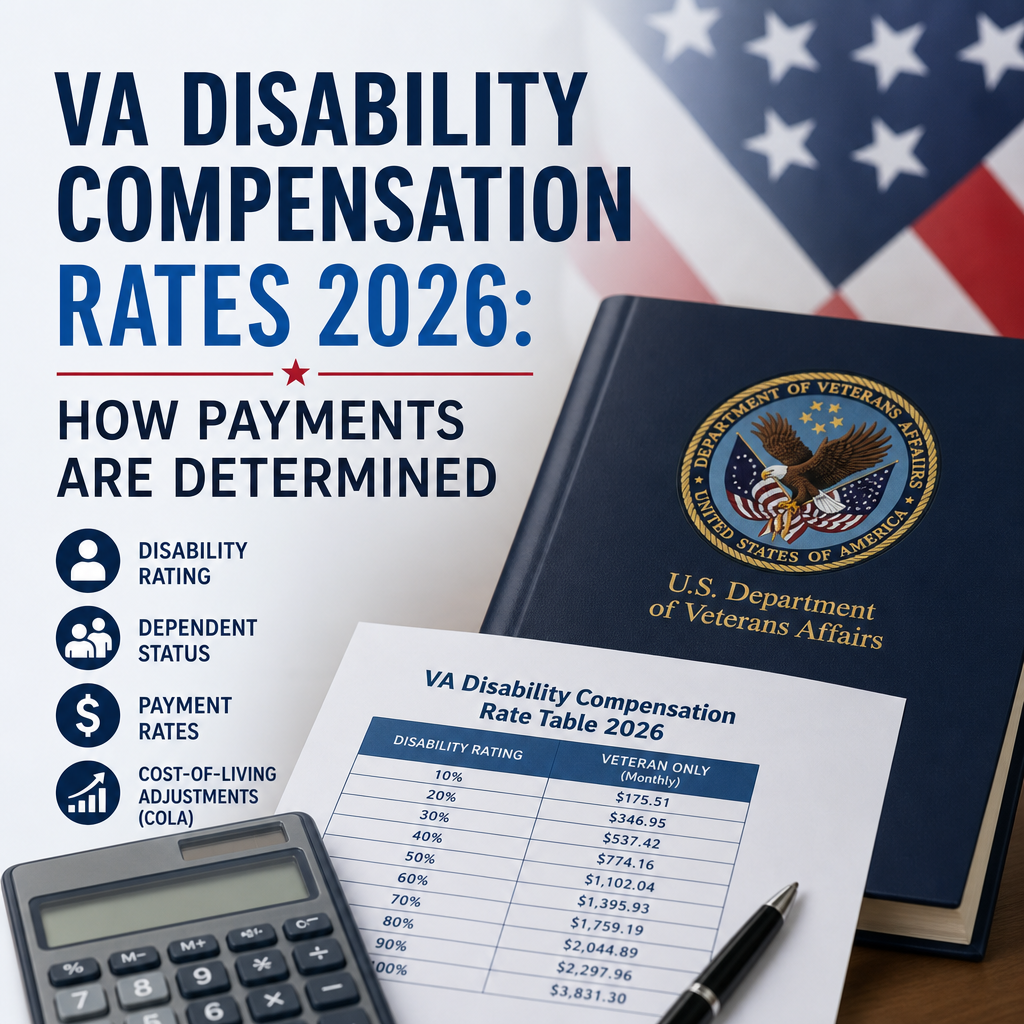
VA Disability Compensation Rates 2026: How Payments Are Determined
VA disability compensation rates are based on your disability rating, dependent status, and any special circumstances that may apply, which means two veterans with similar conditions can receive different monthly amounts. Understanding how the VA calculates these payments can help you estimate your benefit, plan ahead, and make sure you’re getting the compensation you deserve.
By: Emilly Adams on July 24, 2026
Understanding VA Disability Compensation Rates 2026 can feel confusing at first, especially if you’re trying to estimate what your monthly payment might look like. The Department of Veterans Affairs uses a structured formula to determine compensation, but the final amount depends on several personal factors, including your disability rating, dependent status, and whether you qualify for special circumstances such as additional support for a spouse, children, or parents.
If you are preparing for a claim, reviewing an increase, or simply planning your household budget, it helps to understand how the VA calculates disability pay. This guide breaks down the process in plain English, explains the major factors that affect monthly compensation, and shows you how to check the official rate tables without getting lost in jargon.
What VA Disability Compensation Covers
VA disability compensation is a tax-free monthly benefit paid to eligible veterans with service-connected disabilities. These conditions may be physical, mental, or a combination of both, and they must have been caused or worsened by military service.
The payment is not meant to replace a salary. Instead, it is intended to recognize the impact a service-connected condition has on your daily life, health, and earning capacity.
Common examples of service-connected conditions
Veterans may receive compensation for conditions such as:
Chronic back or joint pain
Hearing loss or tinnitus
PTSD and other mental health conditions
Respiratory issues
Migraines
Sleep apnea
Scars, burns, or injuries from service
Secondary conditions linked to a primary disability
The VA assigns a disability rating to each eligible condition, then uses that rating to determine the monthly payment.
How VA Disability Compensation Rates 2026 Are Determined
The main driver behind VA Disability Compensation Rates 2026 is the disability rating system. Ratings are given in 10% increments, from 0% to 100%. The higher the rating, the greater the monthly payment.
The VA looks at several factors when determining the final amount:
Your combined disability rating
Your dependent status
Whether you have qualifying dependents
Whether you qualify for special monthly compensation
Any applicable statutory or annual cost-of-living adjustments
Disability ratings explained
A disability rating reflects the severity of a service-connected condition. For example:
10% may reflect a condition with limited impact
30% may indicate a condition that requires regular treatment or creates functional limitations
70% or 100% generally reflects a much greater impact on daily life and work
If you have more than one service-connected condition, the VA does not simply add the percentages together. Instead, it uses a combined ratings formula that accounts for how the body is affected overall.
Combined ratings are not a simple sum
This is one of the biggest points of confusion for veterans. If you have two 50% ratings, your combined rating is not 100%. The VA uses a remaining-efficiency method that calculates how much additional disability exists after the first condition is considered.
For example:
A veteran with one 50% rating and one 30% rating does not end up with an 80% combined rating
The combined result is lower because the second condition is applied to the remaining efficiency, not the full body value
This is why many veterans use a combined ratings calculator or ask a Veterans Service Officer to review their award.
Important Factors That Affect Your Monthly Payment
Even with the same disability rating, two veterans may receive different compensation amounts. That is because the VA considers household and dependency information when setting payment levels.
1. Marital status
A veteran with a spouse generally receives more compensation than a veteran without a dependent spouse, especially at higher disability ratings.
2. Children
Dependent children can increase the monthly amount. The VA distinguishes between:
Children under 18
Children between 18 and 23 who are still in school
Children who qualify as dependents due to disability
3. Dependent parents
If you support a parent financially and meet VA dependency criteria, that may also increase compensation.
4. Special Monthly Compensation
Some veterans qualify for Special Monthly Compensation (SMC) when their disabilities are especially severe, involve loss of use, or meet other qualifying conditions. SMC is separate from basic compensation and can increase overall monthly payments.
5. Aid and attendance or housebound status
If a veteran needs help with daily activities or is substantially confined to home because of disability, the VA may grant additional compensation under certain circumstances.
How the VA Calculates Combined Disability Ratings
The VA’s combined ratings process is often misunderstood, so it helps to see the logic in simple terms.
Step-by-step example
Suppose a veteran has:
A 50% rating for PTSD
A 30% rating for sleep apnea
The VA starts with the largest rating, which leaves 50% “efficient.” Then it applies the 30% rating to that remaining efficiency:
30% of the remaining 50% = 15%
50% + 15% = 65%
The VA rounds to the nearest 10, which becomes 70%
This is why a veteran’s combined rating may look lower than expected.
Rounding rules matter
The VA rounds combined ratings to the nearest 10:
65% rounds up to 70%
64% rounds down to 60%
That small difference can significantly affect monthly pay and eligibility for additional benefits.
VA Disability Compensation Rates 2026 and Cost-of-Living Adjustments
Annual payment updates are tied to cost-of-living adjustments, often called COLA. These changes are based on federal adjustment methods and are intended to help benefits keep pace with inflation.
For veterans, this means the VA Disability Compensation Rates 2026 may differ from the prior year’s rates. The VA publishes the official compensation tables when the new year’s rates are finalized.
Why you should use the official rate chart
Rate tables can change, and unofficial websites may be outdated. Always confirm your payment amount through:
This is especially important if your family status changed during the year, such as marriage, divorce, birth of a child, or loss of a dependent.
What Ratings Usually Mean for Pay
While official payment tables should always be checked directly, it helps to understand the general structure of VA compensation.
Lower ratings
Veterans with ratings such as 10%, 20%, or 30% typically receive a smaller monthly amount. These ratings often involve conditions that are real and service-connected but may not severely limit employment or daily function.
Mid-range ratings
Ratings in the 40% to 70% range can produce more meaningful monthly support, especially when dependents are included. Veterans in this range may also become eligible for additional programs or administrative considerations.
Higher ratings
At 80%, 90%, and 100%, compensation becomes much more substantial. A veteran at 100% may also qualify for other benefits tied to disability status, depending on the circumstances.
Individual Unemployability
Some veterans who cannot maintain substantially gainful employment due to service-connected conditions may qualify for Total Disability based on Individual Unemployability (TDIU). This can pay at the 100% rate even if the combined rating is below 100%.
How to Check Your Estimated VA Compensation
If you want to estimate your payment, use a careful approach rather than guessing.
A simple checklist
Confirm your individual disability ratings
Determine your combined rating
Verify your dependent status
Check whether any children qualify as dependents
Review whether you receive special monthly compensation
Compare your information with the official VA rate chart
Practical example
A veteran with a 70% rating, a spouse, and one dependent child will usually receive more than a veteran with the same 70% rating and no dependents. If the veteran later adds a qualifying dependent, the payment should increase once the VA updates the record.
Keep your dependency information current
Many payment errors happen because the VA does not have updated family information. To avoid delays or underpayment, report changes such as:
Marriage
Divorce
Birth or adoption
Child turning 18 or finishing school
Parent becoming dependent or no longer dependent
Common Mistakes Veterans Make When Estimating Benefits
When people search for VA Disability Compensation Rates 2026, they often rely on calculators or forum advice that does not account for the full picture.
Mistake 1: Adding ratings together
As noted earlier, the VA uses a combined ratings formula, not a straight addition method.
Mistake 2: Forgetting dependents
Family status can materially affect the final monthly payment.
Mistake 3: Using outdated charts
Older compensation tables may not reflect the current year’s adjusted amounts.
Mistake 4: Overlooking secondary conditions
A secondary condition caused by an already service-connected disability may increase your overall rating if properly documented.
Mistake 5: Missing evidence
Medical records, exam findings, and service records all matter. Without strong evidence, a veteran may receive a lower rating than deserved or face a denial.
How to Strengthen a VA Disability Claim or Increase Request
If you believe your rating is too low or your condition has worsened, you can pursue a review or increase request.
Helpful evidence includes
Recent medical records
VA or private doctor notes
Imaging results
Mental health treatment records
Statements from family, friends, or coworkers
A personal statement describing daily limitations
Employment records showing missed work or job impact
Be specific about daily impact
Instead of writing “my back hurts,” explain how the condition affects you:
You can’t stand for more than 15 minutes
You struggle to lift groceries
You miss sleep because of pain
You need help with dressing or bathing
You cannot drive long distances comfortably
This type of detail helps the VA understand how the disability affects real life.
When to Ask for Help
Many veterans benefit from working with a trained advocate. A Veterans Service Officer (VSO), accredited claims agent, or attorney can help you:
Understand your current rating
Review dependency status
File an increase claim
Appeal an incorrect decision
Identify possible secondary conditions
Confirm whether TDIU may apply
Getting help can reduce delays and improve the quality of your claim.
Frequently Asked Questions
1. How are VA disability compensation rates determined?
VA disability compensation rates are determined mainly by your combined disability rating and your dependent status. The VA also considers special circumstances such as special monthly compensation, aid and attendance, and individual unemployability in qualifying cases.
2. Do VA disability rates change every year?
Yes. VA disability compensation rates can change annually when cost-of-living adjustments are applied. Veterans should always check the current official rate table for the year in question rather than relying on older figures.
3. Why doesn’t the VA add my ratings together?
The VA uses a combined ratings formula rather than simple addition. This method reflects how much of a veteran’s overall earning capacity is affected after each condition is considered. That is why two separate ratings may not equal a simple total.
4. Can my spouse or children increase my monthly VA payment?
Yes. Qualifying dependents can increase your monthly compensation. The amount depends on your rating level and the dependents you report to the VA. You should keep your family information updated to avoid payment issues.
5. What should I do if I think my VA disability rating is too low?
If you believe your rating is too low, gather updated medical evidence and consider filing for an increase or review. A Veterans Service Officer or accredited representative can help you understand your options and prepare a stronger claim.
Understanding VA Disability Compensation Rates 2026 is an important part of managing your benefits and planning ahead. The amount you receive depends on more than just a disability percentage. Your combined rating, dependent status, special monthly compensation eligibility, and official annual adjustments all play a role in the final monthly payment.
The good news is that once you understand the VA’s system, the process becomes much more manageable. Start by confirming your current ratings, reviewing your dependent information, and checking the official VA rate tables. If your condition has worsened or your family situation has changed, it may be time to update your claim or request a review.
Accurate information matters here. The more you understand how payments are determined, the easier it becomes to spot errors, estimate your benefits, and make informed decisions about your next steps. Whether you are filing for the first time or checking your current award, using official sources and strong evidence will always give you the best chance of getting the compensation you earned.
Emily A, holds a Master's degree in Public Administration (MPA) and has over 7 years of experience researching federal and state assistance programs. She writes educational content focused on government benefits, public policy, and community resources, using information from official agencies to help readers understand available programs and eligibility requirements.