SNAP Benefits 2026: Income Standards and Maximum Allotments Explained
SNAP benefits 2026 will depend on updated income standards and household size, making it important to understand the latest SNAP income limits before you apply. This quick guide explains how those rules affect eligibility and how much food assistance your household may receive.
By: Emilly Adams on July 24, 2026
SNAP benefits 2026 are a critical topic for millions of households that depend on the Supplemental Nutrition Assistance Program to help put food on the table. Each year, the U.S. Department of Agriculture updates key SNAP rules, including income standards and maximum allotments, to reflect changes in the cost of living and federal guidance. If you or someone in your household receives food assistance—or plans to apply—understanding these updates can help you estimate eligibility, compare benefits, and prepare the right documents.
This guide breaks down the basics in plain English. You’ll learn how SNAP income limits work, what maximum allotments mean, how household size affects benefits, and what to watch for when applying in 2026.
What Are SNAP Benefits?
SNAP, or the Supplemental Nutrition Assistance Program, provides monthly food assistance to eligible low-income individuals and families. Benefits are delivered through an Electronic Benefit Transfer (EBT) card, which works like a debit card at approved grocery stores, farmers markets, and some online retailers.
The amount a household receives depends on several factors, including:
Household size
Gross income
Net income
Deductible expenses
State rules and administration
Location, since Alaska, Hawaii, Guam, and the U.S. Virgin Islands use different allotment levels
While SNAP is federally funded and regulated, states handle applications and certification. That means your local SNAP agency will determine your eligibility based on federal rules and state procedures.
SNAP Benefits 2026: What Changes Matter Most?
When people look up SNAP benefits 2026, they usually want two things:
The income standards they need to meet
The maximum allotment they may receive if approved
Both matter because SNAP does not pay the same amount to every household. Instead, the program uses a formula that considers household finances and size.
Income Standards Explained
SNAP uses income limits to decide whether a household may qualify. In general, agencies evaluate:
Gross monthly income: income before taxes and deductions
Net monthly income: income after allowable deductions
Household size: more people usually means higher limits and benefits
Some households must meet both gross and net income limits, while others may qualify through categorical eligibility or if they include an elderly or disabled member. Your state may also apply additional rules.
Maximum Allotments Explained
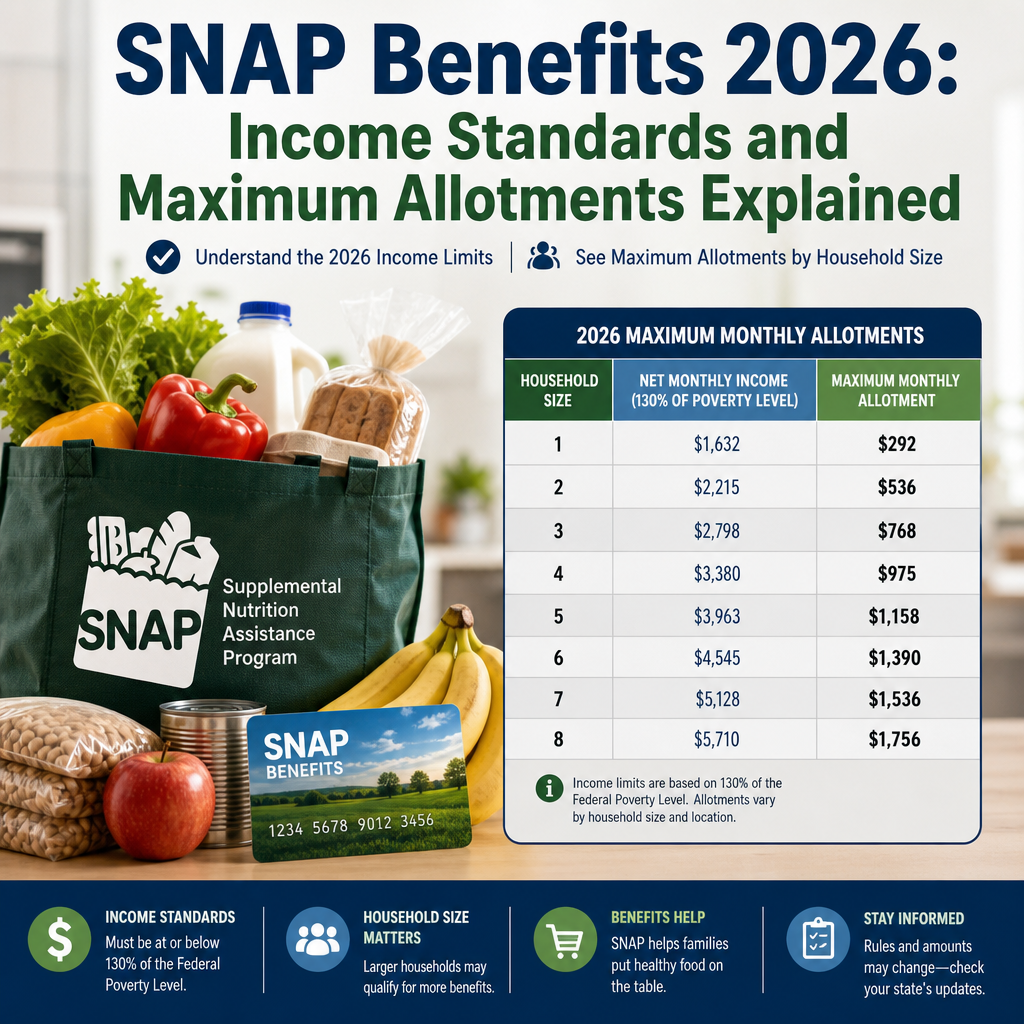
The maximum allotment is the highest monthly SNAP benefit a household can receive for its size. Households with no countable income and no deductions may receive the full allotment. Households with income usually receive less, based on the SNAP benefit formula.
In other words, the maximum allotment is not a guarantee. It is the ceiling for your household size.
How SNAP Income Standards Work
SNAP eligibility is based on a formula that can feel confusing at first, but the structure is straightforward.
Gross Income vs. Net Income
Gross income is your income before deductions. This often includes:
Wages and salary
Self-employment income
Unemployment compensation
Social Security benefits, in some cases
Child support received
Other countable income sources
Net income is what remains after allowed deductions. Common deductions may include:
Standard deduction
Earned income deduction
Dependent care costs
Medical expenses for elderly or disabled household members
Shelter and utility costs
Child support payments made to someone outside the household
Not every deduction applies to every household. Still, deductions can make a major difference in the final benefit amount.
Household Size Matters
SNAP income standards rise with household size. That makes sense: a larger household usually needs more food. For example, a one-person household has a lower income limit and lower maximum allotment than a household of four.
When reviewing SNAP benefits 2026, always check the limits for your specific household size rather than relying on a general estimate.
Special Considerations for Elderly or Disabled Household Members
Households that include an elderly or disabled person may qualify under different rules or receive additional deductions. Medical expenses above a certain threshold may count as a deduction, which can reduce net income and increase the benefit amount.
If your household includes someone who is elderly or disabled, it is especially important to report medical and shelter costs accurately.
Maximum SNAP Allotments in 2026
Maximum allotments are tied to the Thrifty Food Plan and adjusted periodically by USDA. Because allotments may differ by location and household composition, the official tables published by USDA and state agencies are the best source for exact amounts.
Why Maximum Allotments Change
Maximum allotments can change because of:
Inflation and food cost updates
Federal policy adjustments
Annual benefit updates by USDA
Special rules for non-contiguous U.S. locations
This is why it is smart to verify the current year’s chart before making budget decisions.
How Allotments Are Calculated
SNAP benefits are generally calculated using a formula that starts with net income. In simplified terms:
Determine household size.
Calculate gross income and apply any required income test.
Subtract allowable deductions to find net income.
Apply the benefit formula to determine the monthly allotment.
Compare the result with the maximum allotment for that household size.
The lower your countable income, the closer your benefit may be to the maximum allotment.
Example of How Benefit Size Can Vary
Consider two households of the same size:
Household A has very low income and high eligible expenses. It may receive close to the maximum allotment.
Household B has moderate income and fewer deductions. It may qualify for SNAP, but receive a smaller monthly amount.
This is why two families with the same number of people can receive very different SNAP benefits.
SNAP Eligibility Factors Beyond Income
Income matters, but it is not the only factor.
Asset Rules and Categorical Eligibility
Some households may not have to meet strict asset limits because their state uses broad-based categorical eligibility. Others may still need to meet resource rules. This can include checking savings, vehicles, or other assets depending on state policy and household circumstances.
Immigration and Residency Requirements
Applicants generally must live in the state where they apply and meet SNAP citizenship or immigration requirements. Households with mixed immigration status may still qualify for some members, depending on the situation.
Work Rules
Able-bodied adults without dependents may face work requirements or time limits in certain cases. States also administer exemptions for people who meet specific criteria, such as disability, pregnancy, or caregiving responsibilities.
How to Estimate Your SNAP Benefits in 2026
If you are trying to plan ahead, you can estimate your SNAP benefits 2026 using a few practical steps.
Step 1: Gather Your Income Information
Collect recent records for:
Pay stubs
Self-employment earnings
Unemployment benefits
Social Security income
Pension or retirement income
Child support received
Use monthly figures if possible, since SNAP typically evaluates monthly income.
Step 2: List Allowable Expenses
Write down costs that may count as deductions, such as:
Rent or mortgage
Utility bills
Child care costs
Medical bills for eligible household members
Court-ordered child support payments
Keep documentation handy, because your caseworker may ask for proof.
Step 3: Check Household Size
Count everyone who buys and prepares food together as one SNAP household, with some exceptions. Household composition can affect both income limits and allotments, so be careful when determining who should be included.
Step 4: Review Your State’s Rules
Even though SNAP is federal, your state agency may have different application procedures, interview rules, verification requirements, or certification periods. Some states also publish benefit calculators or screening tools.
Step 5: Use Official Tools
The USDA and many state agencies provide eligibility screeners or benefit estimators. These tools are helpful for a rough estimate, but they do not replace a formal eligibility determination.
Common Mistakes People Make With SNAP Applications
A few avoidable mistakes can delay approval or reduce benefits.
Not Reporting All Household Income
Leaving out income, even unintentionally, can create problems. Be sure to include all countable income sources for every household member.
Forgetting Deductible Expenses
Some applicants list income but forget deductions such as dependent care or medical expenses. That can cause the estimate to be lower than it should be.
Using the Wrong Household Size
SNAP household size is not always the same as who lives in the home. It depends on who purchases and prepares food together and who must be included under program rules.
Missing Renewal Deadlines
SNAP benefits are not always permanent. You usually need to recertify on schedule. Missing paperwork or interviews can interrupt benefits.
Why SNAP Benefits 2026 Matter for Household Planning
For many families, SNAP is more than temporary help. It can be a key part of a stable household budget. Knowing the income standards and maximum allotments helps you:
Plan food spending more accurately
Understand whether you may be eligible
Prepare documentation before applying
Avoid surprises during recertification
Make informed decisions about work, benefits, and budgeting
If your income has changed recently, it is worth checking whether you now qualify or whether your benefit amount should be updated.
Frequently Asked Questions
1. What are SNAP benefits 2026?
SNAP benefits 2026 refer to the Supplemental Nutrition Assistance Program rules, income standards, and maximum monthly food allotments in effect for the 2026 benefit year. These figures help determine whether a household qualifies and how much assistance it may receive.
2. How do I know if my household meets SNAP income standards?
You usually need to compare your household’s gross monthly income and net monthly income against the current limits for your household size. Your state SNAP office can help you determine whether your income qualifies, and deductions may reduce your countable income.
3. What is the maximum SNAP allotment?
The maximum SNAP allotment is the highest monthly benefit a household can receive for its size. A household with little or no countable income may receive the full allotment, while households with income typically receive a smaller amount based on the program formula.
4. Do shelter and utility costs affect SNAP benefits?
Yes. In many cases, shelter and utility costs can be deducted when SNAP calculates net income. Higher allowable deductions may increase your monthly benefit, especially if your household has low income.
5. Where can I check the official SNAP rules for my state?
You should start with your state’s SNAP agency website and the USDA Food and Nutrition Service. Those sources provide current eligibility rules, application instructions, and benefit information specific to your location.
SNAP benefits 2026 are shaped by a combination of household size, income, and allowable deductions, with maximum allotments setting the upper limit for monthly assistance. While the rules can seem technical, the basic idea is simple: the program is designed to help eligible households afford food when their budgets are stretched too thin.
If you are planning to apply or renew benefits, focus on three things: document your income, identify every deduction you may qualify for, and check the official income standards for your household size. Because state procedures can vary, using your local SNAP agency and USDA resources is the most reliable way to confirm current rules and benefit amounts.
Understanding these details can make a real difference. It can help you estimate support more accurately, avoid delays, and make informed choices about your household budget. If food costs are putting pressure on your finances, reviewing SNAP eligibility now is a practical next step.
Emily A, holds a Master's degree in Public Administration (MPA) and has over 7 years of experience researching federal and state assistance programs. She writes educational content focused on government benefits, public policy, and community resources, using information from official agencies to help readers understand available programs and eligibility requirements.