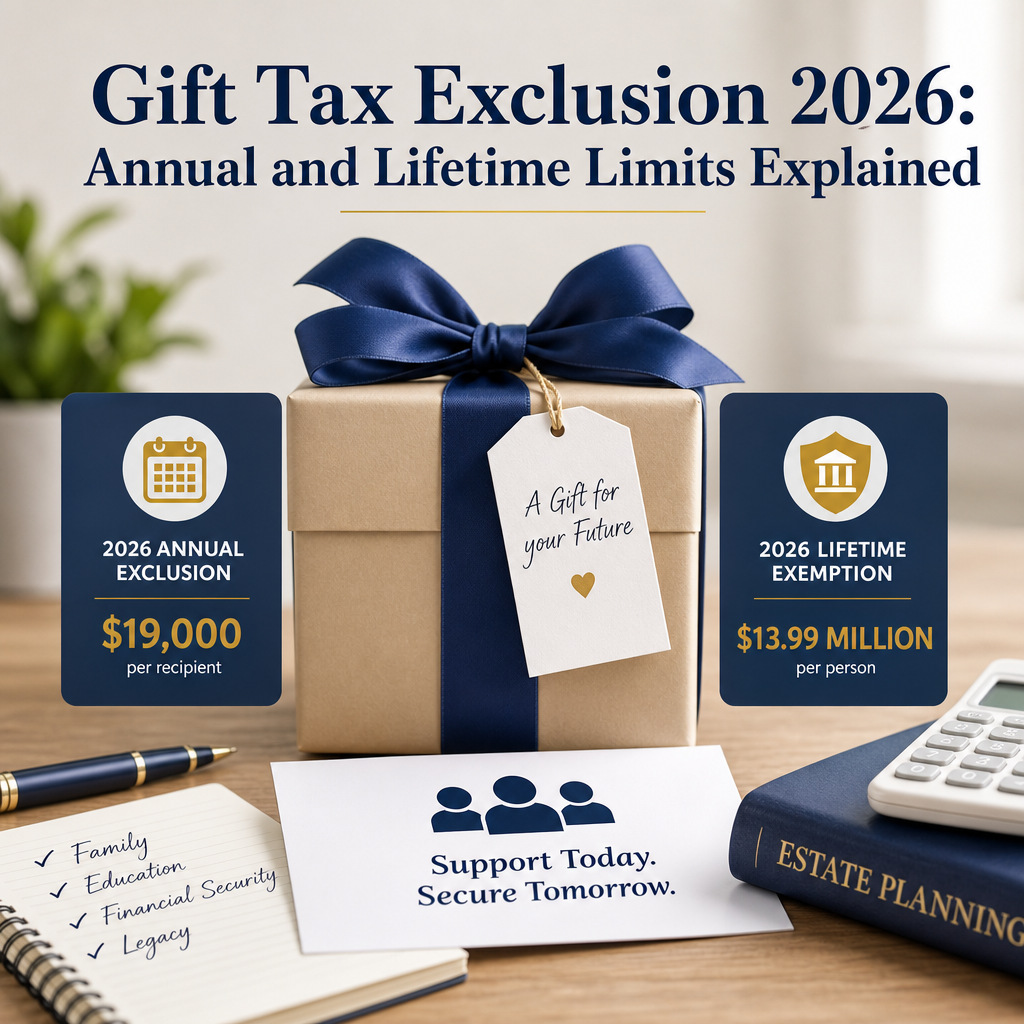
Gift Tax Exclusion 2026: Annual and Lifetime Limits Explained
The gift tax exclusion 2026 can help you give generously without triggering unnecessary taxes, but understanding the annual exclusion, lifetime exemption, and special exceptions is key. Here’s a simple breakdown of how the rules work and what they could mean for your family and estate plan.
By: Mary Smith on July 25, 2026
Gift Tax Exclusion 2026: Annual and Lifetime Limits Explained
Understanding the gift tax exclusion 2026 rules can help you make smarter financial decisions, support family members, and avoid costly surprises. Whether you’re helping a child with college costs, contributing to a loved one’s home purchase, or planning a larger estate strategy, the tax rules around gifting matter.
The good news is that the federal gift tax system gives most people plenty of room to give generously without triggering tax. But the details matter. The annual exclusion, the lifetime exemption, and special rules for direct payments can all affect how much you can give and whether you need to file a gift tax return.
In this guide, we’ll break down the gift tax exclusion 2026 in plain English, explain how annual and lifetime limits work, and share practical examples to help you use the rules correctly.
Gift Tax Exclusion 2026: The Basics
The federal gift tax applies when you transfer money or property to someone else and receive less than full value in return. In most cases, the person giving the gift—not the recipient—is responsible for any tax or reporting.
The gift tax exclusion 2026 refers to the amount you can give to another person in a year without having to file a gift tax return for that gift. This annual exclusion is separate from the lifetime gift and estate tax exemption.
Why the gift tax exists
The IRS uses the gift tax to keep people from transferring wealth tax-free during life instead of through an estate. That said, the rules are designed to allow ordinary generosity, family support, and many common financial gifts without tax consequences.
Annual Gift Tax Exclusion in 2026
The annual gift tax exclusion is the amount you can give to one person in a calendar year without it counting against your lifetime exemption or requiring gift tax reporting in many cases.
For 2026, the annual exclusion amount will be determined by IRS inflation adjustments. The exact figure is not something to guess at or assume from prior years, because these limits can change over time.
How the annual exclusion works
Each recipient gets their own annual exclusion limit. That means you can give the exclusion amount to multiple people in the same year.
For example:
You can give one child up to the annual exclusion amount.
You can give a second child the same amount.
You can give a friend or sibling the same amount as well.
The limit applies per recipient, not per giver.
What counts as a gift?
A gift can include:
Cash
Checks
Bank transfers
Stocks or mutual funds
Real estate
Personal property
Debt forgiveness
Paying someone’s expenses without expectation of repayment
A gift generally occurs when you transfer something of value for less than its full fair market value.
Lifetime Gift and Estate Tax Exemption
The annual exclusion is only part of the picture. If you give more than the annual exclusion to one person in a year, the excess typically reduces your lifetime gift and estate tax exemption.
This exemption is the total amount you can transfer during life or at death before federal gift or estate tax may apply.
How it works with gifts
If you give a person more than the annual exclusion amount in 2026, you may need to file a gift tax return using IRS Form 709. Filing the form does not automatically mean you owe tax. In many cases, it simply tracks the amount used from your lifetime exemption.
Why this matters for estate planning
The lifetime exemption is one of the most important estate planning tools available. High-net-worth families often use it strategically, but even middle-income families should understand it if they plan to make large gifts for:
A down payment on a home
Tuition support
Medical costs
Business succession
Wealth transfer to children or grandchildren
Gift Tax Exclusion 2026 and Married Couples
Married couples often have more flexibility when giving gifts. In many cases, spouses can combine their annual exclusions through a strategy known as gift splitting.
What gift splitting means
If both spouses agree, a gift made by one spouse can be treated as coming half from each spouse. This can effectively double the annual exclusion amount for one recipient.
For example, a married couple may be able to give twice the annual exclusion to one child in a year without using their lifetime exemption, as long as they follow the required filing rules.
Important caveat
Gift splitting typically requires both spouses to consent, and the appropriate tax forms must be filed. It’s a useful planning tool, but it should be handled carefully.
Common Situations Where Gift Tax Rules Apply
The gift tax exclusion 2026 comes up more often than many people realize. Here are some common situations where the rules matter.
Helping adult children
Parents often want to help adult children with:
Rent
Vehicle purchases
Student loan payments
Wedding expenses
Down payments on homes
These gifts may be perfectly legal and tax-efficient, but larger amounts can trigger reporting obligations.
Supporting grandchildren
Grandparents may want to contribute to:
College savings plans
Tuition payments
Living expenses
Long-term financial support
Direct tuition payments to an educational institution often receive special tax treatment, which we’ll cover below.
Gifts between friends
The gift tax rules do not only apply to family. If you transfer significant value to a friend, it can still count as a gift.
Business-related transfers
If you transfer ownership interests, forgive debt, or transfer assets below market value in a business context, gift tax rules may also apply.
Special Exceptions That Can Help You Give More Tax-Efficiently
Not every transfer counts against the annual exclusion in the same way. Some payments are excluded entirely from gift tax rules when structured correctly.
Direct tuition payments
If you pay tuition directly to a qualifying educational institution, the payment is generally not considered a taxable gift.
Important: the payment must go directly to the school, not to the student.
Direct medical payments
If you pay medical expenses directly to a care provider or medical institution, those payments are usually excluded from gift tax.
This can be a powerful way to help family members with major costs while preserving your annual exclusion and lifetime exemption.
Gifts to a spouse
Gifts to a U.S. citizen spouse are generally unlimited for federal gift tax purposes. Different rules may apply to gifts to a non-citizen spouse.
Charitable gifts
Donations to qualified charities are not treated as taxable gifts in the same way as gifts to individuals, though they may involve separate income tax rules.
Practical Examples of the Gift Tax Exclusion 2026
Let’s look at a few real-world examples to make the rules easier to understand.
Example 1: A birthday gift to an adult child
If you give your adult child cash for a birthday, that amount counts as a gift. If it stays within the annual exclusion amount for 2026, you generally won’t owe gift tax or use any lifetime exemption.
Example 2: Helping with a home down payment
Suppose you give your daughter a larger sum to help buy a home. If the gift exceeds the annual exclusion, you may need to file Form 709 for the excess amount. That excess typically reduces your lifetime exemption.
Example 3: Paying college tuition directly
If you pay tuition directly to the university, that payment may be excluded from gift tax rules entirely. If you instead give the money to your grandchild and they pay the school, the payment may count as a gift.
Example 4: Gifts to multiple people
You can give the annual exclusion amount to each child, grandchild, or friend separately in the same year. The exclusion resets each calendar year.
Reporting Requirements: When Do You Need to File Form 709?
Even if you don’t owe gift tax, you may still need to file a federal gift tax return.
You may need to file if you:
Give more than the annual exclusion amount to one person in a year
Split gifts with your spouse
Make certain gifts of future interests
Give a non-citizen spouse more than the special annual limit
Transfer property at less than fair market value
Why filing matters
Filing Form 709 helps the IRS track how much of your lifetime exemption you have used. It also creates a record that can be important for future estate planning.
Tips for Managing Gifts Wisely in 2026
If you plan to make significant gifts, a little preparation can save time and stress.
Keep good records
Track:
Date of the gift
Recipient’s name
Amount or description of property
Fair market value if applicable
Whether the gift was direct tuition or medical payment
Whether a Form 709 was filed
Think in terms of calendar years
The annual exclusion resets each January 1. Timing a gift near year-end versus early in the new year may affect how much you can give tax-efficiently.
Watch for non-cash gifts
A gift doesn’t have to be cash. Stock transfers, business interests, and even forgiven loans can all create gift tax issues.
Coordinate with your estate plan
If you expect to make large gifts over time, coordinate with your attorney, CPA, or financial planner. The right approach depends on your family goals, assets, and long-term tax picture.
How the Gift Tax Exclusion Fits Into Broader Financial Planning
The gift tax exclusion 2026 is more than a tax rule. It’s a tool for life planning.
People often use gifting strategies to:
Support children or grandchildren
Reduce the size of a taxable estate
Transfer appreciating assets
Help pay for education or medical care
Provide financial support while alive rather than later
Used thoughtfully, gifting can strengthen family finances and reduce future estate complexity. But large gifts should always be planned with the annual exclusion, lifetime exemption, and reporting rules in mind.
Frequently Asked Questions
1. What is the gift tax exclusion for 2026?
The gift tax exclusion for 2026 is the annual amount you can give to each recipient without using your lifetime exemption or usually needing to file a gift tax return. Because this limit can change due to inflation adjustments, it’s best to confirm the exact 2026 figure with the IRS or a qualified tax professional before making large gifts.
2. Does giving money to family count as a taxable gift?
Yes, in many cases it does. Cash gifts to family members generally count as taxable gifts for federal purposes, even if no tax is ultimately due. If the amount is within the annual exclusion, it may not require reporting. Larger gifts may require Form 709 and use part of your lifetime exemption.
3. Do I have to pay gift tax if I go over the annual exclusion?
Not necessarily. Going over the annual exclusion usually means you must report the gift, but tax may not be due unless you have already used up your lifetime gift and estate tax exemption. Most people who make occasional large gifts do not owe immediate federal gift tax.
4. Can I pay my child’s tuition or medical bills without triggering gift tax?
Yes, if you pay the school or medical provider directly. Direct tuition payments to a qualifying educational institution and direct medical payments to a provider are generally excluded from gift tax rules. If you give the money to your child first and they pay the bill, the payment may count as a gift.
5. Do married couples get double the annual gift exclusion?
Often, yes. Married couples can usually combine their exclusions through gift splitting if they meet the IRS requirements and file the proper forms. This can allow them to give more to a single recipient in one year without using the lifetime exemption.
The gift tax exclusion 2026 is an important part of smart financial planning, especially if you want to help family members or transfer wealth efficiently. The annual exclusion lets you make generous gifts to multiple people each year, while the lifetime exemption provides additional room for larger transfers. Special rules for tuition, medical expenses, and spousal gifts can also make certain transfers more tax-friendly when handled properly.
The key is to understand when a gift stays within the annual limit, when a filing requirement applies, and how large gifts affect your long-term estate plan. With accurate records and a clear strategy, you can give confidently without creating unnecessary tax headaches.
If you’re planning meaningful gifts in 2026, take time to review the rules, confirm the current IRS limits, and coordinate with a tax professional if your transfers are substantial. A little planning now can protect both your generosity and your finances in the years ahead.
Mary S, CFP®, is a Certified Financial Planner with over 12 years of experience in personal finance, retirement planning, and wealth management. She writes educational content that helps readers understand financial concepts and make informed decisions based on reliable information.