Career and Technical Education in U.S. High Schools: Programs and Pathways
Career and technical education in U.S. high schools helps students turn classroom learning into real-world skills, career awareness, and practical experience. By exploring pathways like health care, IT, and skilled trades, students can start preparing for college, credentials, or a job after graduation.
By: Jennifer on July 25, 2026
Career and technical education in U.S. high schools is becoming an increasingly important part of how students prepare for life after graduation. For many teens, college is one path, but it is not the only path. Career and technical education, often called CTE, gives students the chance to build academic knowledge, hands-on skills, and career awareness at the same time. These programs can help students explore interests, earn industry credentials, and connect classroom learning to real-world work.
As schools and employers look for stronger ways to prepare the future workforce, career and technical education in U.S. high schools is playing a larger role than ever. Whether a student wants to enter a skilled trade, health care, information technology, advanced manufacturing, or another field, CTE offers structured pathways that can start in high school and continue into college or a career.
What Is Career and Technical Education?
Career and technical education is a set of courses and experiences that prepare students for specific careers and industries. Unlike classes that focus only on theory, CTE combines academic learning with practical application.
Students in CTE programs may:
Learn technical skills tied to a specific occupation
Take career-focused courses alongside core subjects
Complete hands-on labs, projects, and simulations
Participate in internships, job shadowing, or apprenticeships
Earn certifications or college credit
Develop workplace skills such as communication, teamwork, and problem-solving
Career and technical education in U.S. high schools is designed to help students make informed decisions about their future. It also gives them a clearer sense of how school connects to the workplace.
Why Career and Technical Education Matters in High School
High school is often the first time students begin thinking seriously about careers. CTE helps make that transition more meaningful by showing students what different industries actually involve.
It Builds Career Awareness Early
Many students do not know what a job looks like beyond its title. CTE exposes them to career fields through real examples, tools, and professional expectations. A student interested in health care might learn medical terminology, patient safety basics, and lab procedures. A student in construction could study blueprint reading, safety practices, and materials handling.
It Makes Learning More Relevant
One of the biggest strengths of career and technical education in U.S. high schools is relevance. Students often engage more deeply when they understand why a concept matters. Math becomes more useful when it is applied to budgeting, engineering, or measuring materials. Writing matters when students create reports, resumes, and professional emails.
It Supports Different Learning Styles
Not every student thrives in a traditional lecture-based classroom. CTE programs often appeal to students who learn best by doing. They can be especially valuable for students who want more structure, practical experience, or a clearer sense of purpose.
It Can Lead to Stronger Post-Graduation Outcomes
CTE does not replace college preparation; in many cases, it strengthens it. Students can graduate with:
Technical experience
Better communication and workplace readiness
Industry-recognized credentials
A head start on college majors or training programs
Common Career and Technical Education Programs in High Schools
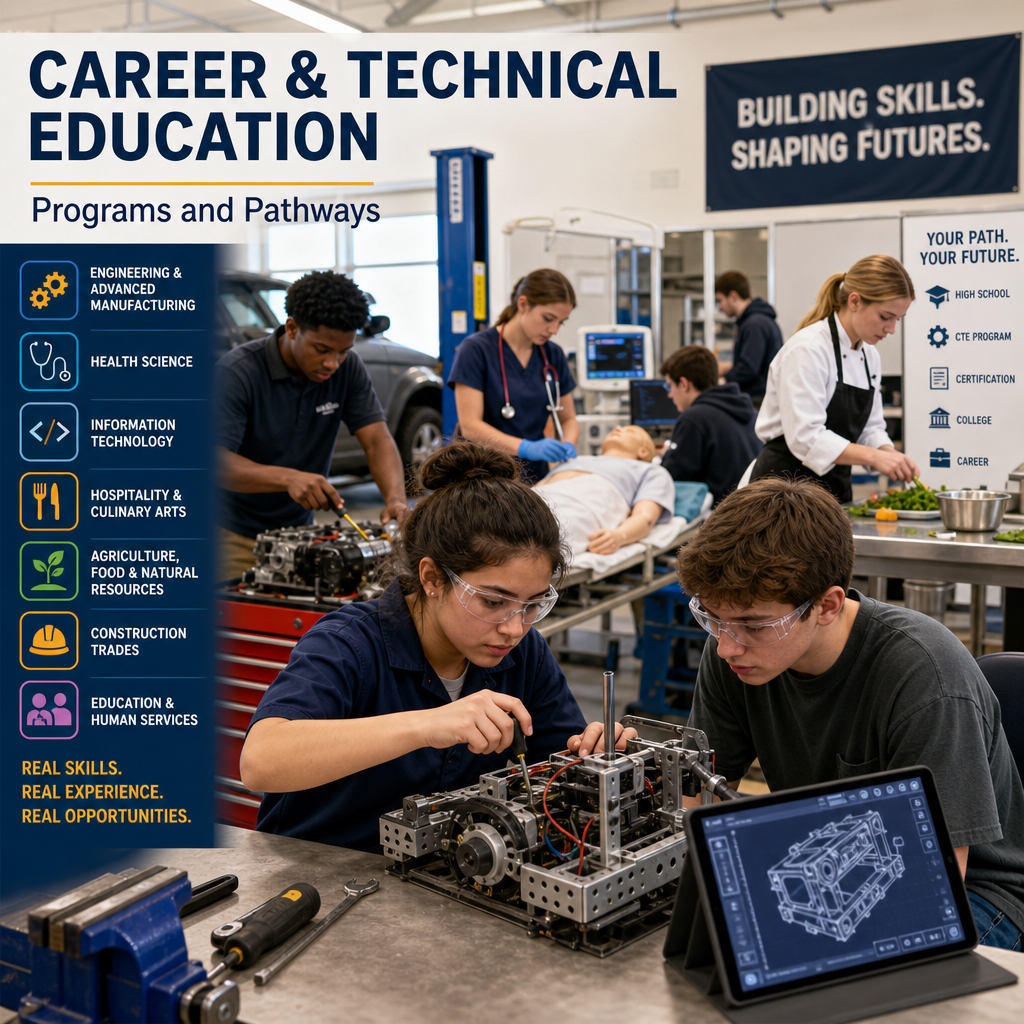
Career and technical education in U.S. high schools covers a wide range of fields. The exact offerings vary by district, state, and school resources, but many programs fall into common career clusters.
Health Sciences
Health science pathways introduce students to careers in nursing, medical assisting, emergency services, dental care, physical therapy support, and other healthcare roles. Courses may include anatomy, medical terminology, infection control, and first aid.
Students might practice:
Taking vital signs
Learning patient privacy standards
Using basic lab equipment
Understanding health and safety protocols
Information Technology
IT programs prepare students for careers in computer support, cybersecurity, network administration, and software-related fields. Students may explore coding, digital systems, troubleshooting, and cybersecurity basics.
Typical activities include:
Building simple websites
Learning programming logic
Assembling or repairing hardware
Practicing secure data handling
Skilled Trades and Construction
These programs teach students practical skills needed in building, repair, and fabrication careers. Topics often include carpentry, electrical work, welding, plumbing basics, and construction safety.
Students may work on:
Reading blueprints
Using hand and power tools safely
Measuring and cutting materials
Completing project-based builds
Manufacturing and Engineering
Manufacturing and engineering pathways help students understand how products are designed, made, and improved. Courses may cover robotics, automation, drafting, design software, and production processes.
Students may:
Design prototypes
Use CAD software
Learn quality control methods
Explore automation and robotics systems
Business, Marketing, and Finance
These programs introduce students to entrepreneurship, accounting, customer service, marketing, and business operations. Students learn skills that apply to both small businesses and large corporations.
Activities may include:
Creating marketing plans
Managing a mock business
Learning budgeting and financial literacy
Practicing customer communication
Agriculture and Natural Resources
Agriculture CTE pathways include more than farming. They may also cover agribusiness, animal science, environmental management, food systems, and horticulture.
Students might:
Study plant and animal systems
Work in school greenhouses or labs
Learn about conservation practices
Explore food production and supply chains
Education and Human Services
This career area prepares students for work in teaching, child development, social services, counseling support, and family services. Courses often focus on child growth, communication, leadership, and service-based careers.
Students may gain experience in:
Lesson planning basics
Working with younger children
Understanding development stages
Supporting community needs
How Career Pathways Work in High School
Career pathways give CTE structure. Instead of choosing random electives, students follow a sequence of courses that build toward a career area. The pathway usually starts with an introductory course and becomes more specialized over time.
A Typical Pathway May Include
Exploration course
Students learn the basics of a career field and see whether it interests them.
Foundational courses
Students begin building core technical knowledge and skills.
Advanced courses
Students focus on more specialized topics and complete more complex projects.
Work-based learning or capstone experience
Students apply what they learned through internships, apprenticeships, shadowing, or a final project.
This structure helps students move from curiosity to readiness. It also gives them a clearer picture of what a career might involve day to day.
What Students Gain from CTE Programs
The value of career and technical education in U.S. high schools goes beyond job training. It can help students grow academically, personally, and professionally.
Technical Skills
CTE gives students experience with tools, software, procedures, and methods used in real jobs. That technical foundation can make the transition to college, trade school, or employment much smoother.
Academic Connections
Students often strengthen reading, math, science, and communication skills because they apply them in meaningful ways. For example, a student in a culinary pathway may need to measure ingredients accurately, interpret directions, and manage time effectively.
Workplace Readiness
Employers value reliable, adaptable workers who can communicate well and solve problems. CTE often includes soft skills such as:
Time management
Collaboration
Professional communication
Responsibility
Attention to detail
Confidence and Motivation
When students see progress in a hands-on program, they often gain confidence. That can improve attendance, engagement, and long-term motivation. Some students who struggled in traditional settings find new energy in CTE because it connects school with real outcomes.
CTE, College, and Career Readiness
A common misconception is that CTE is only for students who do not plan to attend college. In reality, many pathways support both college and career goals.
CTE Can Support College Bound Students
Students who plan to earn a degree may still benefit from CTE because it helps them:
Explore majors before committing
Enter college with practical experience
Earn dual credit in some programs
Build resume-worthy projects and certifications
CTE Can Lead Directly to Employment
Other students may want to enter the workforce after high school or after short-term training. CTE can help them develop skills for entry-level roles and create a smoother transition into apprenticeship or certification programs.
CTE Often Supports Multiple Paths at Once
Many pathways allow students to keep their options open. A student in an engineering pathway, for example, might choose college later or move into a technician role first. The point is flexibility.
Work-Based Learning: A Key Part of CTE
One of the most powerful parts of career and technical education in U.S. high schools is work-based learning. This gives students a chance to learn in actual workplace environments or through employer-connected experiences.
Common Work-Based Learning Options
Job shadowing
Internships
Apprenticeships
Clinical experiences
School-based enterprises
Industry tours
Guest speaker events
These experiences help students connect classroom learning to real jobs. They also give employers a chance to engage with future workers and support local talent development.
Why It Matters
Work-based learning can help students answer important questions:
What does this job actually require?
What skills matter most?
Do I enjoy this type of work?
What education or training comes next?
That kind of clarity can be hard to get from a textbook alone.
Challenges and Equity in CTE Access
While CTE has many strengths, access is not equal everywhere. Some schools offer a wide range of programs, while others have limited staffing, equipment, or industry partnerships.
Common Barriers
Limited course offerings in small or rural districts
Outdated equipment or facilities
Transportation challenges for off-site learning
Uneven access to internships or apprenticeships
Misconceptions that CTE is only for certain students
Why Equity Matters
All students should have access to high-quality career and technical education in U.S. high schools, not just those in large districts or affluent communities. Strong CTE programs should reflect local labor market needs while remaining open to students with different goals, backgrounds, and abilities.
Schools can improve access by:
Expanding course variety
Partnering with local employers and community colleges
Providing transportation support when possible
Offering advising so students understand their options
Ensuring that programs welcome all learners
How Families Can Support Career Exploration
Parents and guardians play an important role in helping students think through their future. Families do not need to have all the answers. They just need to encourage exploration and ask good questions.
Helpful Questions to Ask
What subjects or activities do you enjoy most?
Do you like working with people, tools, technology, or ideas?
Would you prefer a college-based path, a job-focused path, or both?
What careers sound interesting to you right now?
Have you looked into any CTE programs at your school?
Ways Families Can Help
Attend school career nights
Review pathway options together
Encourage internships or job shadowing
Talk about local industries and job trends
Support a balanced view of college and career readiness
How Schools Can Strengthen CTE Programs
High-quality CTE programs depend on planning, partnerships, and ongoing improvement.
Best Practices for Schools
Align courses with current industry standards
Train teachers in both content and workplace relevance
Offer modern equipment and updated labs
Build partnerships with employers, unions, and colleges
Track student outcomes and improve programs regularly
Promote CTE as a valuable option for all students
When schools invest in strong programs, career and technical education becomes more than a set of electives. It becomes a meaningful pathway to opportunity.
Frequently Asked Questions
What is the main goal of career and technical education in high school?
The main goal is to help students prepare for future careers by combining academic learning with technical and workplace skills. CTE gives students practical experience, career awareness, and in many cases, credentials that can support college, training, or direct employment after graduation.
Is career and technical education only for students who are not going to college?
No. Many students use CTE to prepare for college, explore majors, or gain experience before choosing a degree path. CTE can also help students enter the workforce, but it is not limited to that purpose. In many schools, it supports both college and career readiness.
What kinds of jobs can students explore through CTE?
Students can explore a wide range of fields, including healthcare, information technology, construction, manufacturing, business, agriculture, education, and human services. The specific options depend on the school district and available partnerships.
Do CTE programs offer certifications?
Some high school CTE programs do. Students may be able to earn industry-recognized credentials, especially in fields like health care, information technology, welding, or business. These certifications vary by program and state, so students should check local offerings.
How do students know which CTE pathway is right for them?
Students should think about their interests, strengths, and long-term goals. Job shadowing, introductory courses, career fairs, and conversations with school counselors can help. Trying an exploration-level pathway is often a smart first step if a student is unsure.
Career and technical education in U.S. high schools gives students a practical, flexible way to prepare for the future. It helps them discover interests, build job-ready skills, and make smarter decisions about college, training, or employment. Just as importantly, CTE shows students that learning has real-world value. A class in health science, engineering, business, or construction can open the door to a career pathway that feels both meaningful and achievable.
For families, educators, and students, the key is to treat CTE as a serious option rather than a backup plan. These programs can support academic growth, career exploration, and long-term success. When schools offer strong pathways and students take advantage of them early, high school becomes more than a place to prepare for graduation—it becomes a launchpad for the future.
If you are exploring your next step, career and technical education is worth a close look. The right pathway can help turn interest into experience and experience into opportunity.
Jennifer, M.Ed., holds a degree in Higher Education Administration, with
a focus on U.S. college financial aid, admissions policy, and student
support systems. She researches and writes about scholarships, federal
aid programs, and the college planning process to help students and
families make informed, well-supported decisions.