Index Funds vs. ETFs: Costs, Trading, and Key Differences
Index funds vs ETFs both offer an easy, low-cost way to diversify your portfolio, but they differ in how they’re bought, sold, and managed. In this guide, you’ll learn the key cost and trading differences so you can choose the option that best fits your investing style.
By: Mary Smith on July 25, 2026
If you’ve started investing, you’ve probably come across index funds vs. ETFs as two of the most popular low-cost ways to build a diversified portfolio. Both can give you broad market exposure, both are often recommended for long-term investors, and both are simpler than trying to pick individual stocks. But they are not the same.
Understanding the differences between index funds vs. ETFs can help you choose the option that fits your goals, budget, and investing style. In this guide, we’ll break down how they work, how they differ in cost and trading, and what to consider before buying either one.
What Are Index Funds?
An index fund is a mutual fund designed to track a market index, such as the S&P 500, the total U.S. stock market, or a bond index. Instead of trying to beat the market, the fund aims to match the performance of the index it follows.
How index funds work
Index funds hold the same or similar securities as the benchmark index. For example, an S&P 500 index fund may own shares of the 500 large U.S. companies in the index. Because the fund is passively managed, it typically has lower turnover and lower operating costs than actively managed funds.
Why investors like index funds
Index funds are popular because they offer:
Broad diversification
Simple long-term investing
Lower management costs than many active funds
Automatic investing options at many brokers and retirement plans
They are often a strong fit for retirement accounts, monthly contributions, and investors who prefer a hands-off approach.
What Are ETFs?
ETFs, or exchange-traded funds, are investment funds that trade on an exchange like a stock. Many ETFs are also index funds because they track a specific index, but not all ETFs are passive. Some track sectors, commodities, bonds, or even active strategies.
How ETFs work
You buy and sell ETF shares throughout the trading day at market prices. Their price changes based on supply and demand, just like stocks. Most ETFs publish their holdings daily, making them transparent and easy to understand.
Why investors like ETFs
ETFs are often attractive because they offer:
Intraday trading flexibility
Low expense ratios in many cases
Easy access to specific market segments
Tax efficiency in some taxable accounts
For investors who want to trade during market hours or build a custom portfolio, ETFs can be especially useful.
Index Funds vs. ETFs: The Core Difference
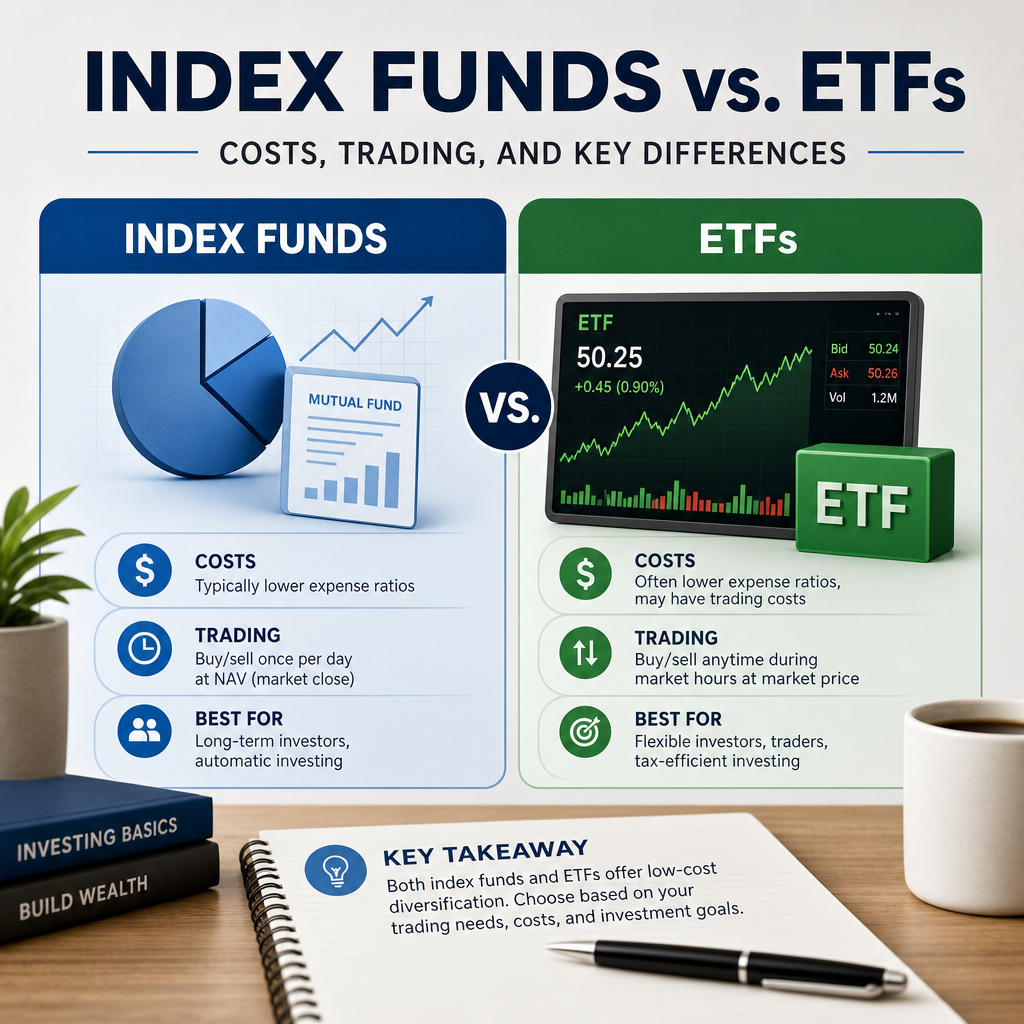
At a high level, the biggest difference in index funds vs. ETFs is how you buy and sell them.
Index funds are purchased directly from the fund company or through a brokerage, usually at the end-of-day net asset value (NAV).
ETFs trade on an exchange throughout the day, with prices changing in real time.
That single distinction affects trading, pricing, and in some cases, taxes and fees.
Costs: Which One Is Cheaper?
When comparing index funds vs. ETFs, cost matters, but it’s important to look at the full picture. The cheapest option is not always the best one for your situation.
Expense ratios
Both index funds and ETFs often have low expense ratios, which are the annual fees charged by the fund. These fees are taken out of fund assets, not billed separately.
In many cases:
Broad-market index funds have very low expense ratios
Broad-market ETFs can have equally low, or even slightly lower, expense ratios
Some specialty ETFs cost more because they track niche markets or use more complex strategies
A small difference in expense ratio can matter over time, especially for large balances, but it should not be your only consideration.
Trading costs
With ETFs, you may also face trading costs such as:
Bid-ask spreads
Brokerage commissions, if your broker charges them
Premiums or discounts to NAV, though these are usually small for highly liquid ETFs
Index funds typically do not have bid-ask spreads because they are not traded on exchanges. However, some mutual funds may have purchase or redemption fees, though many low-cost index funds do not.
Minimum investment requirements
Some index funds require a minimum initial investment. That can be a barrier for new investors.
ETFs usually don’t have fund-level minimums beyond the cost of one share, which makes them more accessible if you are starting with a smaller amount. Fractional shares at some brokerages have reduced this gap, but the pricing structure still matters.
Trading: Flexibility vs. Simplicity
Trading is one of the clearest differences in index funds vs. ETFs.
ETFs trade during the day
Because ETFs are exchange-traded, you can:
Buy and sell during market hours
Place limit orders and stop orders
React to market movements in real time
This flexibility can be helpful for active investors, but it can also encourage emotional trading. If you are tempted to watch price movements closely, ETF trading may lead you to make decisions based on short-term noise.
Index funds trade once per day
Index funds are priced once per day after the market closes. You place an order during the day, but the transaction executes at the next calculated NAV.
This approach has a built-in behavioral advantage for many investors. It makes frequent trading less tempting and supports a more disciplined, long-term strategy.
Practical example
Imagine you want to invest $500 every month:
With an index fund, your automatic investment can be set up easily, and the order executes once per day.
With an ETF, you can also invest regularly, but you may need to buy whole shares unless your broker offers fractional ETF shares.
For automatic monthly investing, index funds often feel simpler. For investors who want more control over trade timing, ETFs may be more appealing.
Taxes: Are ETFs More Efficient?
Taxes are another important part of the index funds vs. ETFs comparison, especially in taxable brokerage accounts.
Why ETFs are often tax-efficient
ETFs are often considered more tax-efficient because of the way shares are created and redeemed. This structure can reduce taxable capital gains distributions in many cases.
That said, tax efficiency depends on the ETF itself, the type of investments it holds, and whether you hold it in a taxable account or a tax-advantaged account such as a 401(k) or IRA.
Index funds and capital gains distributions
Index funds can also be tax-efficient, especially broad-market funds with low turnover. However, mutual funds may distribute capital gains to shareholders more often than ETFs. If you own the fund in a taxable account, those distributions can create a tax bill.
Best account types for each
A simple rule of thumb:
Taxable accounts: ETFs may have an edge in tax efficiency
Retirement accounts: Taxes matter less inside tax-advantaged accounts, so choose based on convenience, cost, and investment strategy
Always consider your own tax situation, and if needed, speak with a qualified tax professional.
Diversification and Investment Strategy
Both index funds and ETFs can give you diversification, but the exact exposure depends on the fund you choose.
Broad-market exposure
You can find both index funds and ETFs that track:
U.S. stocks
International stocks
Total bond markets
Specific market sectors
Small-cap or large-cap companies
A single fund can cover a lot of ground, which is one reason passive investing has become so widely used.
Sector and thematic options
ETFs are especially common for sector-specific or thematic investing, such as clean energy, artificial intelligence, or cybersecurity. While these funds can be interesting, they often carry more concentration risk than broad-market funds.
If your goal is long-term wealth building, broad diversification usually makes more sense than chasing trends.
Which Is Better for Long-Term Investors?
There is no universal winner in index funds vs. ETFs. The better choice depends on how you invest.
Index funds may be better if you:
Want automatic investing
Prefer simple, end-of-day pricing
Are investing in a 401(k), IRA, or retirement plan
Like a set-it-and-forget-it strategy
Want to avoid temptation to trade intraday
ETFs may be better if you:
Want to trade anytime during market hours
Prefer lower or no minimum investment beyond share price
Want more flexibility with order types
Invest in a taxable account and want potential tax advantages
Like building a portfolio from individual funds
For many long-term investors, either option works well. The most important factor is choosing a low-cost, diversified fund and sticking with your plan.
Common Mistakes to Avoid
When comparing index funds vs. ETFs, investors sometimes focus too much on the wrapper and not enough on the underlying fund.
1. Chasing the lowest fee alone
A slightly lower expense ratio is nice, but it should not override fund quality, diversification, and your investing habits.
2. Overtrading ETFs
Because ETFs trade like stocks, it can be tempting to buy and sell too often. That can lead to poor timing and emotional decisions.
3. Ignoring fund holdings
Two funds can have similar names but different indexes, sectors, or bond durations. Always check what the fund actually owns.
4. Assuming all ETFs are passive
Some ETFs are actively managed or use complex strategies. Read the prospectus if you do not understand the strategy.
5. Forgetting about account type
A fund that makes sense in a taxable brokerage account may not be meaningfully different from another one inside a retirement account.
How to Choose Between Index Funds and ETFs
A practical decision process can make the choice easier.
Step 1: Define your goal
Ask yourself what you want the fund to do:
Track the broad market
Add international diversification
Hold bonds for stability
Target a specific sector or theme
Step 2: Consider your account type
For a retirement account, simplicity may matter most
For a taxable account, tax efficiency may carry more weight
Step 3: Look at total costs
Compare:
Expense ratio
Minimum investment
Trading costs
Bid-ask spread for ETFs
Step 4: Think about your habits
If you’re likely to trade too often, an index fund may be the better behavioral choice. If you want control and flexibility, an ETF may fit better.
Example Scenarios
New investor with small monthly contributions
A beginner with $100 to invest each month may prefer an index fund with automatic investing or an ETF with fractional shares.
Taxable account investor
Someone holding investments in a taxable brokerage account may lean toward ETFs for potential tax efficiency.
Retirement saver
An investor contributing to a 401(k) or IRA may choose the lowest-cost option available in the plan, whether that’s an index fund or ETF.
DIY portfolio builder
An investor who wants to mix U.S. stocks, international stocks, and bonds may prefer ETFs for their flexibility and exchange-traded convenience.
Frequently Asked Questions
Are index funds and ETFs the same thing?
No. They can both track an index, but they are not identical. Index funds are bought and sold through the fund company or brokerage at end-of-day pricing. ETFs trade on an exchange throughout the day like stocks.
Are ETFs always cheaper than index funds?
Not always. Many ETFs have very low expense ratios, but some index funds are just as cheap or cheaper. You also need to consider trading costs, bid-ask spreads, and any fund minimums.
Which is better for beginners: index funds or ETFs?
Many beginners find index funds easier because they support automatic investing and reduce the temptation to trade. However, ETFs can also work well, especially if your brokerage offers fractional shares and low trading costs.
Do ETFs pay dividends?
Yes, many ETFs pay dividends if the underlying securities generate them. The fund may distribute dividends to shareholders periodically, and you can often reinvest them automatically.
Can I lose money in index funds or ETFs?
Yes. Even diversified funds can lose value when the market declines. Index funds and ETFs reduce company-specific risk through diversification, but they do not eliminate market risk.
When it comes to index funds vs. ETFs, the right choice depends less on which one is “better” in the abstract and more on how you invest. Both can offer broad diversification, low costs, and a simple path toward long-term growth. The biggest differences come down to trading style, tax treatment, convenience, and account type.
If you want automated investing and a less hands-on experience, index funds may be the smoother fit. If you value intraday trading, flexible order types, and potential tax advantages in a taxable account, ETFs may be a better match. Either way, the most important step is to focus on the underlying strategy: choose a diversified, low-cost fund and stay consistent.
Investing success usually comes from discipline, not complexity. Once you understand how index funds vs. ETFs differ, you can make a more confident decision and build a portfolio that supports your long-term goals.
Mary S, CFP®, is a Certified Financial Planner with over 12 years of experience in personal finance, retirement planning, and wealth management. She writes educational content that helps readers understand financial concepts and make informed decisions based on reliable information.