How Central Bank Rate Decisions Move Global Markets
Central bank rate decisions can send shockwaves through global markets, moving everything from stocks and bonds to currencies and commodities in minutes. Because investors react not just to the rate change itself but to what it signals about the economy ahead, even a small surprise can have a big impact.
By: Peter B on July 24, 2026
Central bank rate decisions sit at the center of modern finance. When the Federal Reserve, the European Central Bank, the Bank of England, or another major central bank changes interest rates—or even signals that it might—investors around the world react quickly. Stocks, bonds, currencies, commodities, and even real estate prices can move within minutes.
Understanding how central bank rate decisions move global markets helps you make sense of headlines that often sound technical but have real-world effects. A rate hike can strengthen a currency, pressure growth stocks, and cool borrowing. A rate cut can do the opposite, encouraging lending and risk-taking. But the market response is rarely simple. Investors care not only about the decision itself, but also about the central bank’s guidance, inflation outlook, labor market conditions, and overall economic tone.
What Central Bank Rate Decisions Actually Do
A central bank controls key benchmark rates that influence the cost of money across an economy. These decisions affect:
Consumer loans and mortgages
Business borrowing costs
Bank lending conditions
Bond yields
Stock valuations
Currency strength
When rates rise, borrowing usually becomes more expensive. When rates fall, money becomes cheaper to borrow and spend. That basic mechanism is one reason central bank policy has such broad influence over global markets.
Why markets care so much
Markets are forward-looking. Investors try to anticipate what central banks will do next, not just what they do today. That means the reaction often starts before the official announcement. If the market expects a rate hike and gets one, the move may already be priced in. If the central bank surprises investors, the reaction can be much larger.
This is why central bank rate decisions move global markets even when the policy change seems small. The true driver is often the gap between expectations and reality.
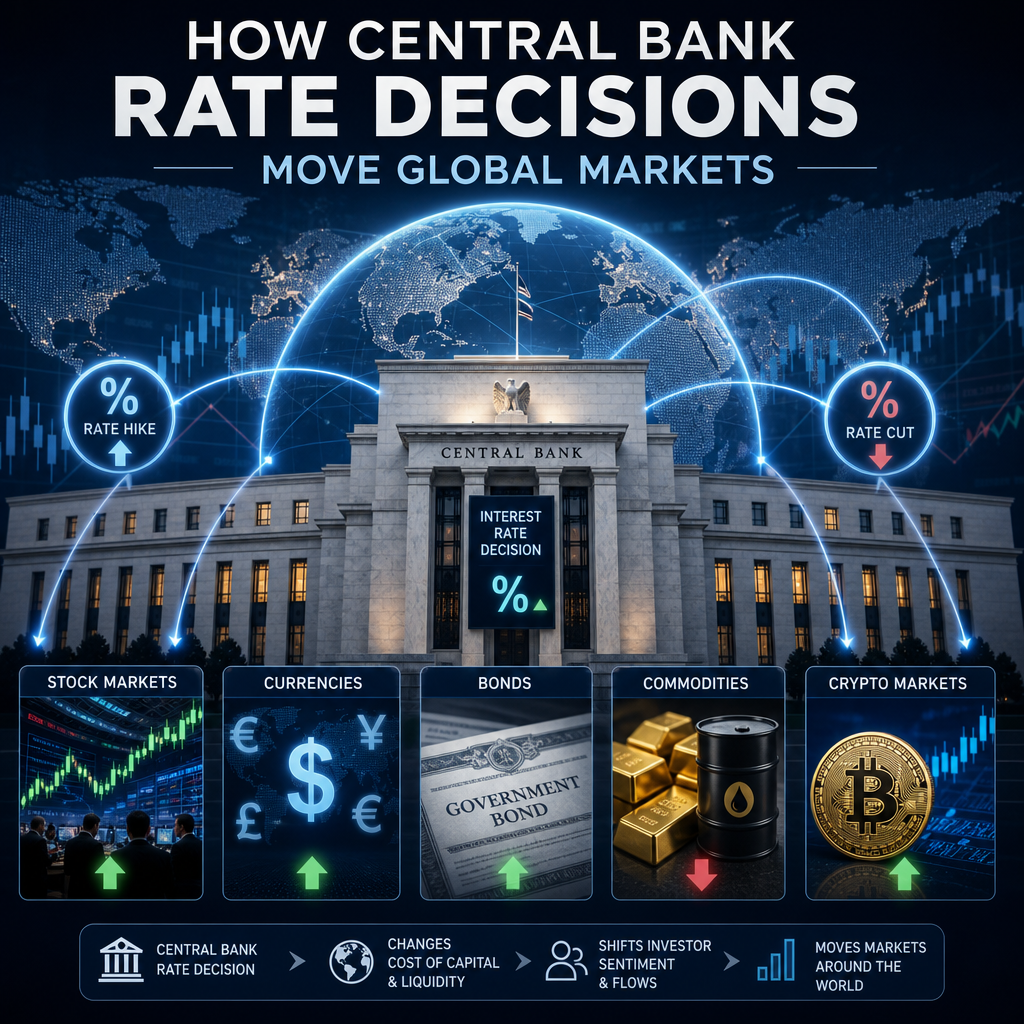
How Central Bank Rate Decisions Move Global Markets
The effects of rate decisions spread through multiple channels at once. Here are the most important ones.
1. Bond markets react first
Bond prices and interest rates move in opposite directions. When a central bank raises rates, newly issued bonds often offer higher yields, which can push existing bond prices lower. When rates fall, bond prices may rise.
Government bond yields are especially important because they influence pricing across the financial system. A shift in U.S. Treasury yields, for example, can affect borrowing costs and investment decisions globally.
2. Currency values adjust quickly
Interest rates influence currency demand. If one country offers higher rates than another, global investors may move capital toward the higher-yielding currency. That increased demand can strengthen the currency.
For example:
A rate hike in the U.S. may support the U.S. dollar
A rate cut in Europe may weaken the euro
Expectations of future easing may reduce demand for a currency even before a cut happens
Currency moves matter because they affect trade, inflation, and corporate earnings. A stronger domestic currency can make exports more expensive, while a weaker currency can help exporters but raise import costs.
3. Stock markets price in borrowing and earnings effects
Higher rates can weigh on stocks, especially companies that rely on debt or whose profits are expected far in the future. Lower rates often help equities by reducing borrowing costs and improving the present value of future earnings.
Different parts of the stock market respond differently:
Growth stocks: Often more sensitive to rates because future profits matter more
Banks: May benefit from higher rates up to a point, depending on lending margins
Utilities and real estate: Often pressured by higher borrowing costs
Consumer companies: Can be affected by changes in spending power
That said, stock reactions depend on whether the market views the move as a sign of a strong economy, weak inflation control, or future recession risk.
4. Commodities can move through the dollar and growth outlook
Commodities such as oil, gold, and industrial metals often respond to rate changes indirectly.
A stronger U.S. dollar can make commodities priced in dollars more expensive for foreign buyers
Higher rates can slow economic activity, which may reduce demand for energy and raw materials
Lower rates can support growth expectations and lift commodity demand
Gold often behaves differently from other commodities because it is also viewed as a store of value. If rate cuts weaken the dollar or lower real yields, gold can become more attractive to some investors.
Why the Announcement Is Only Part of the Story
Central bank rate decisions move global markets not only because of the decision itself, but because of the message behind it.
The statement matters
A central bank may keep rates unchanged but still move markets sharply if its statement signals a future hike or cut. Traders study the wording carefully for clues about inflation, employment, financial stability, and economic momentum.
The press conference matters
Central bank leaders often explain the decision in a press conference or public remarks. Investors listen for:
Confidence or concern about inflation
Views on labor market strength
Changes in risk assessment
Hints about future rate paths
Even a single phrase can shift market expectations.
Forecasts matter too
Many central banks publish economic projections or “dot plots,” policy summaries, or outlook statements. These can affect markets as much as the rate decision itself because they reveal how policymakers think about the future.
Real-World Market Reactions: A Practical Example
Imagine a central bank is expected to hold rates steady, but instead it signals that inflation remains too persistent and more hikes may be needed.
Here’s how markets might react:
Bond yields rise as investors price in tighter policy
Stock indexes fall, especially rate-sensitive sectors
The currency strengthens on higher yield expectations
Gold dips if real yields and the dollar move up
Emerging market assets weaken if global financing gets tighter
Now imagine the opposite: the bank cuts rates and sounds open to more easing because growth is slowing.
Possible response:
Bond yields decline
Equity markets rise, especially dividend and growth sectors
The currency weakens
Commodities may gain if investors expect easier financial conditions
Credit markets improve as borrowing becomes cheaper
These reactions are not automatic, but they show how central bank rate decisions move global markets across asset classes.
How Global Markets Interconnect
A rate change in one major economy rarely stays local. Global capital flows move toward the best combination of yield, safety, and growth potential.
The U.S. dollar’s global role
Because the dollar is the world’s primary reserve currency and a major funding currency, Federal Reserve decisions often ripple far beyond the United States. When the Fed tightens policy, borrowing in dollars can become more expensive around the world. That can affect:
Emerging market debt
International trade finance
Multinational company earnings
Cross-border investment flows
Spillover effects on emerging markets
Emerging markets are especially sensitive to U.S. and other major central bank decisions. Higher rates in advanced economies can attract capital away from riskier markets. That may put pressure on local currencies, increase debt servicing costs, and tighten financial conditions.
When global rates ease, some of that pressure can reverse, encouraging capital inflows and improving investor sentiment.
European and Asian policy also matters
The Federal Reserve gets the most attention, but other central banks shape global markets too. The European Central Bank, Bank of Japan, Bank of England, Reserve Bank of Australia, and others all influence regional and international asset prices. When multiple major central banks move in different directions, the effects on currencies and capital flows can be especially strong.
What Investors Should Watch Before a Rate Decision
If you want to understand how central bank rate decisions move global markets, focus on the indicators that policymakers themselves watch.
Inflation trends
Central banks usually prioritize price stability. Persistent inflation often pushes them toward tighter policy, while slowing inflation can make cuts more likely.
Labor market data
Strong employment may give central banks room to keep rates higher. Weakening job numbers can increase the chance of easing.
Growth indicators
GDP growth, manufacturing activity, retail sales, and consumer spending all shape policy expectations.
Market expectations
Watch:
Futures pricing
Government bond yields
Currency moves
Analyst commentary
These indicators reveal what the market thinks the central bank will do before the announcement.
Financial conditions
Central banks also care about whether markets themselves are tight or loose. If credit spreads widen, lending slows, or asset prices fall sharply, policymakers may respond even if economic data is mixed.
Common Mistakes Investors Make
Even experienced investors can misread central bank decisions. A few common mistakes include:
Assuming a rate hike is always negative for stocks
Ignoring guidance and focusing only on the headline rate
Forgetting that expectations may already be priced in
Overlooking regional differences between central banks
Treating short-term volatility as a long-term trend
For example, a rate hike could actually boost stocks if investors expected an even larger hike and the central bank sounds more optimistic than feared. Context matters more than the decision alone.
A Simple Framework for Reading Rate Decisions
When a central bank announces a policy move, use this quick framework:
What did the bank do?
Hike, cut, or hold rates?
What did the market expect?
Was the result already priced in?
What did the statement say?
Dovish, hawkish, or balanced?
What does the bank expect next?
One-time move or part of a longer cycle?
Which assets are most exposed?
Bonds, currency, equities, commodities, or credit?
This approach helps you move beyond headlines and understand the broader market impact.
Frequently Asked Questions
1. Why do central bank rate decisions affect markets so quickly?
Markets trade on expectations. Traders and investors often position themselves before the announcement, so when the decision is released, prices can adjust almost instantly. Bond yields, currencies, and stock indexes may move within seconds because the new information changes the outlook for inflation, growth, and future policy.
2. Do rate hikes always make stocks fall?
No. Rate hikes often create pressure on stocks, but not always. If investors expected a larger hike, or if the central bank sounds confident about economic growth, stocks may hold up or even rise. The market usually reacts to the surprise relative to expectations, not just the direction of the policy move.
3. Why does the U.S. Federal Reserve matter so much globally?
The Federal Reserve influences the world’s most important currency and a major benchmark for global borrowing costs. U.S. rate changes can affect the dollar, international capital flows, emerging market debt, and commodity prices. Because so much global finance is connected to the dollar, Fed policy has unusually wide reach.
4. How do rate decisions affect the bond market?
When central banks raise rates, bond yields often move higher and existing bond prices can fall. When rates are cut, yields often decline and bond prices may rise. Longer-term bonds can be especially sensitive because they reflect expectations for future policy and inflation.
5. What should investors read besides the rate announcement?
The statement, press conference, and economic projections often matter just as much as the rate itself. These materials can reveal whether the central bank is worried about inflation, growth, or financial stability, and they may hint at future rate changes. That forward guidance often drives the biggest market reactions.
Central bank rate decisions move global markets because they influence the cost of money, investor expectations, and the flow of capital across borders. A small change in policy can affect bond yields, currency values, stock prices, commodity demand, and borrowing conditions around the world. But the headline rate is only part of the story. Investors also need to pay attention to central bank statements, press conferences, forecasts, and the economic data that shape policy decisions.
The most useful way to think about these events is to ask not only what the central bank did, but what it signaled about the future. That shift in expectations often matters more than the immediate move. By watching inflation, growth, labor markets, and market pricing, you can better understand why assets react the way they do.
If you want to read global markets more clearly, central bank policy is one of the best places to start. The more you understand how these decisions connect to everyday investing, the easier it becomes to interpret volatility and identify the forces behind it.
Peter B holds a degree in Journalism and has 5 years
of experience covering U.S. economic policy, labor markets, and
financial news. He writes data-driven news content on topics
like inflation, interest rates, and employment trends.