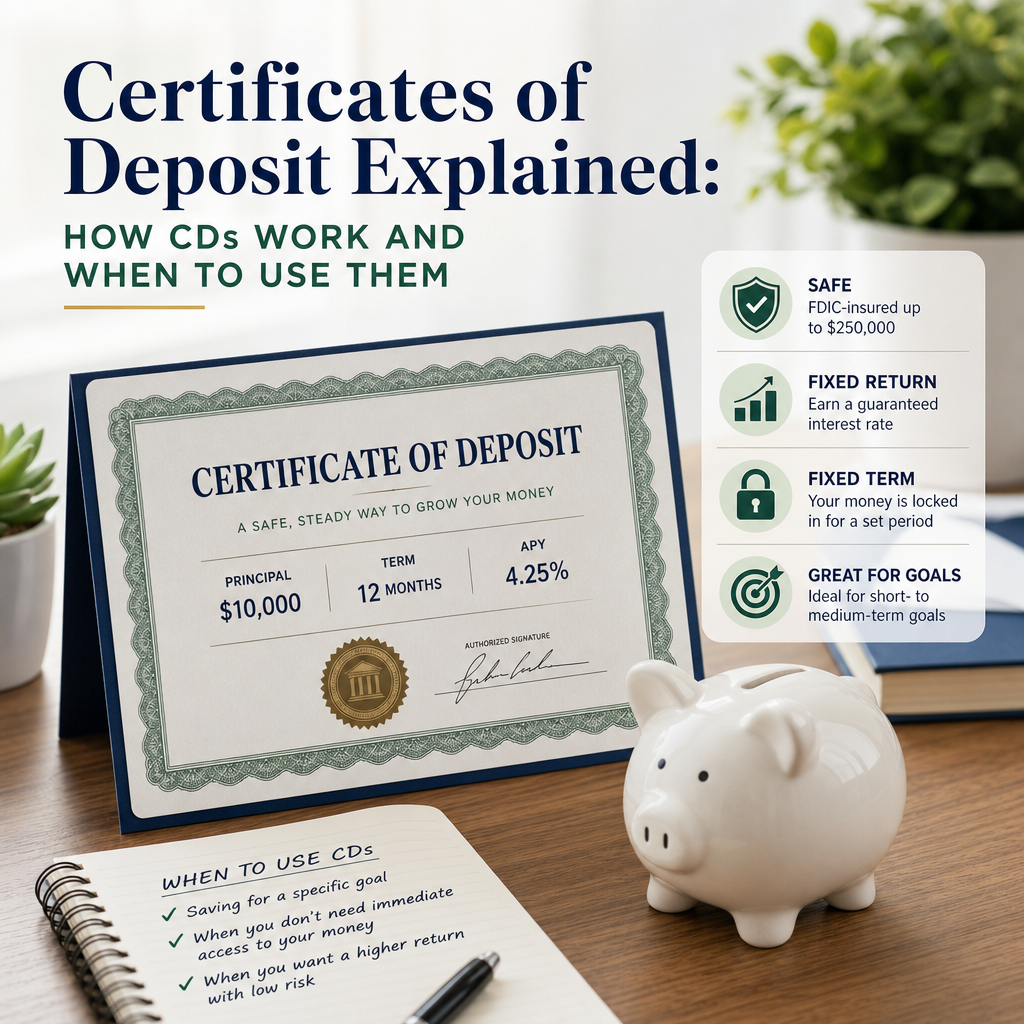
Certificates of Deposit Explained: How CDs Work and When to Use Them
A certificate of deposit can be a simple, low-risk way to earn a predictable return when you know you won’t need your money right away. Learn how CDs work, what they offer, and when they might fit your savings goals.
By: Mary Smith on July 25, 2026
If you’re looking for a savings option that offers predictability, a certificate of deposit can be a smart tool to understand. A certificate of deposit, often called a CD, lets you lock in money for a set period in exchange for a fixed interest rate. That simplicity is part of the appeal: you know how long your money will stay put, and you know how much interest you’ll earn if you keep it there until maturity.
For people who want to save with less risk than the stock market, CDs can play an important role. They are especially useful for short- to medium-term goals, emergency funds you do not expect to tap right away, or money you want to preserve with more certainty than a regular savings account may offer. But CDs are not ideal for every situation. Understanding how they work, when they make sense, and what trade-offs they involve can help you decide whether a CD belongs in your financial plan.
What Is a Certificate of Deposit?
A certificate of deposit is a savings product offered by banks and credit unions. You deposit a lump sum and agree to leave it untouched for a specific term, such as three months, one year, three years, or five years. In return, the institution pays interest at a fixed or sometimes variable rate, depending on the product.
Unlike a standard savings account, you usually cannot withdraw money from a CD whenever you want without paying a penalty. That restriction is what allows the bank to offer a predictable return. In other words, a CD is a trade-off between access and yield.
Key features of a CD
Fixed term: You choose a length of time for your deposit.
Fixed rate: Many CDs lock in an interest rate for the full term.
Early withdrawal penalty: Cashing out before maturity may cost you part of the interest or even principal in some cases.
Federal insurance: CDs from banks are generally insured by the FDIC, and credit union CDs are generally insured by the NCUA, up to applicable limits.
How CDs Work
The basic mechanics of a certificate of deposit are simple, but the details matter.
1. You deposit a lump sum
Most CDs require an initial deposit, often called the principal. Some banks have minimum deposit requirements as low as a few hundred dollars, while others may require more.
2. You choose a term
CD terms vary widely. Common options include:
3 months
6 months
12 months
18 months
2 years
5 years
Shorter terms usually give you more flexibility. Longer terms may offer higher interest rates, though that is not always guaranteed.
3. Interest accrues over time
A CD earns interest based on the rate and compounding schedule. Some CDs compound daily, monthly, quarterly, or at maturity. The more frequently interest compounds, the more you may earn over time.
For example, if you place money into a one-year CD, you generally cannot spend that cash without penalty until the term ends. At maturity, you receive your original deposit plus the interest earned.
4. The CD reaches maturity
When the term ends, the CD matures. At that point, the bank or credit union usually gives you a grace period to decide what to do next. You may:
Withdraw the money
Renew the CD
Move the funds into another account
If you do nothing, many institutions automatically renew the CD for another term, sometimes at the current market rate. That makes it important to track maturity dates.
Why People Use Certificates of Deposit
A certificate of deposit is not about chasing the highest return. It is about finding a balance between safety, certainty, and access. That makes CDs useful in several financial situations.
Saving for a known future expense
If you know you will need money in six months or a year, a CD can help you avoid the temptation to spend it while still earning interest. Common examples include:
A wedding
Property taxes
Tuition payments
A car down payment
A planned home repair
Parking cash you do not need right away
Some people keep a portion of their savings in a CD ladder or mix of terms so they can earn more interest than a standard savings account while keeping some money maturing at regular intervals.
Preserving principal
For conservative savers, the main benefit of a CD is stability. As long as the institution is federally insured and you stay within coverage limits, your principal is protected from market fluctuations.
Supporting a low-risk savings strategy
CDs can work well for people who prefer low-risk products and want a predictable return. That makes them attractive for retirees, cautious savers, and anyone with a short timeline.
When a CD Makes Sense
A certificate of deposit works best when your need for the money is predictable and your priority is preserving value rather than maximizing growth.
Good times to consider a CD
A CD may be a good fit if:
You have cash you will not need before the maturity date.
You want a fixed rate instead of a variable one.
You are comparing it with a savings account and want potentially better returns.
You are saving for a specific goal with a clear deadline.
You already have a liquid emergency fund elsewhere.
Example: short-term goal
Suppose you want to save $5,000 for a kitchen appliance upgrade next year. If you keep that money in a checking account, it may sit idle. A one-year CD could earn interest while still keeping the money safely set aside for the project.
Example: emergency reserve overflow
A well-funded emergency fund should remain accessible. But if you already have several months of expenses in a high-yield savings account, additional reserve money that you rarely touch might be moved into a short-term CD for a little extra return.
When a CD May Not Be the Best Choice
Even a good certificate of deposit is not always the right answer. The main drawback is lack of flexibility.
Avoid CDs if you may need the money soon
If there is a real chance you will need the funds before maturity, a CD can create hassle and penalties. A high-yield savings account may be a better choice.
Be careful with inflation
If inflation rises faster than your CD’s interest rate, your money may lose purchasing power over time. This is one reason CDs are often better for shorter time frames than for long-term wealth building.
Watch for low rates
A CD makes more sense when the interest rate is competitive. If rates are low, locking your money away may not be worth the limited return.
Consider opportunity cost
If you place money into a long-term CD and interest rates rise afterward, you may miss the chance to earn more elsewhere. This is especially important during changing rate environments.
CD Types You Should Know
Not all CDs are the same. Understanding the different types can help you choose the right one for your goals.
Traditional CDs
These are the standard version: fixed term, fixed rate, and early withdrawal penalties.
High-yield CDs
Offered by some banks and online institutions, these CDs may pay more interest than typical savings accounts. They are often attractive when you want a stronger return without taking on market risk.
No-penalty CDs
A no-penalty CD lets you withdraw your money early without a fee, usually after a short waiting period. The trade-off is that the rate may be lower than a traditional CD.
Jumbo CDs
These require a larger minimum deposit and may offer slightly better rates, though not always. They are worth comparing carefully because the higher deposit requirement may not justify the rate difference.
Brokered CDs
These are sold through brokerage firms rather than directly by banks. They can offer access to a wider range of rates and terms, but they may have different rules for selling before maturity.
How to Compare CD Offers
Before opening a certificate of deposit, compare the fine print, not just the headline rate.
Look at the annual percentage yield
The annual percentage yield, or APY, reflects the effect of compounding and gives you a more accurate picture of what you’ll earn.
Check the term length
Make sure the maturity date aligns with your cash needs. A slightly higher rate is not helpful if the money gets locked up longer than you can afford.
Review early withdrawal penalties
Penalties can vary significantly. Some banks charge a set number of months’ interest, while others may impose harsher terms. Read the account disclosure carefully.
Confirm the minimum deposit
A great rate does not help if the minimum deposit is too high for your budget.
Ask about automatic renewal
Know how the CD renews and whether there is a grace period to make changes. Set calendar reminders so you do not miss the maturity window.
What Is a CD Ladder?
A CD ladder is a strategy that spreads money across multiple CDs with different maturity dates. It can help you balance yield and access.
How a ladder works
Instead of putting all your cash into a single five-year CD, you might divide it into five equal parts and open CDs that mature in one year, two years, three years, four years, and five years.
As each CD matures, you can:
Use the cash
Reinvest it into a new long-term CD
Adjust your plan based on interest rates and goals
Why people use ladders
A ladder can provide:
More regular access to money
Protection from locking everything up at one rate
A smoother way to manage interest rate changes
This approach can be especially helpful for retirees or savers with recurring cash needs.
CDs vs. Savings Accounts
It helps to compare a certificate of deposit with a savings account because the two products serve different purposes.
CDs offer:
Fixed terms
Fixed rates
Potentially higher yields
Less liquidity
Savings accounts offer:
Easy access
Flexible deposits and withdrawals
Variable rates
Lower or comparable yields, depending on the account
A savings account is usually better for money you may need at any moment. A CD is better for money you can set aside for a defined period.
CDs vs. Bonds
People sometimes compare CDs with bonds because both are relatively conservative. But they are not the same.
CDs are bank or credit union deposits with insurance protection up to limits.
Bonds are debt investments issued by governments or companies and may fluctuate in value if sold before maturity.
If you want simplicity and federally insured principal, a certificate of deposit is often easier to understand. If you want more flexibility and are willing to accept some market risk, bonds may offer other advantages.
Tax Considerations
Interest earned on a CD is usually taxable as ordinary income in the year it is paid or credited, even if you do not withdraw it. That means your after-tax return may be lower than the headline APY suggests.
If you hold CDs in a tax-advantaged account, such as certain retirement accounts, tax treatment may differ. It is wise to consult a tax professional if you are unsure how CD interest affects your situation.
Practical Tips Before You Open a CD
A little planning can help you avoid common mistakes.
Use CDs only for the right money
Do not lock up funds needed for rent, bills, or emergency use. A CD works best with cash you can set aside.
Compare multiple institutions
Rates can vary widely between banks and credit unions. Online banks often compete aggressively on APY.
Track maturity dates
Set reminders well before the maturity date so you can decide whether to withdraw, renew, or move the money.
Read the account disclosure
Pay attention to minimum balances, penalties, grace periods, and renewal terms.
Consider laddering
If you want both access and better rates, a CD ladder may help.
Frequently Asked Questions
What is a certificate of deposit in simple terms?
A certificate of deposit is a savings account with a fixed time commitment. You deposit money, agree not to withdraw it for a set period, and earn interest in return.
Are CDs safe?
CDs from banks are generally insured by the FDIC up to applicable limits, and CDs from credit unions are generally insured by the NCUA. That makes them one of the safer savings options for protecting principal within those limits.
Can you lose money in a CD?
You usually do not lose money if you keep the CD until maturity and the institution is federally insured. However, early withdrawal penalties can reduce your earnings, and depositing more than the insurance limit can expose excess funds to risk.
What happens when a CD matures?
When a CD matures, you can withdraw the money, renew it, or move it to another account. Many institutions offer a short grace period before automatic renewal starts.
Are CDs better than high-yield savings accounts?
It depends on your goal. A high-yield savings account offers more flexibility, while a CD may offer a fixed rate and potentially higher return for money you do not need immediately.
A certificate of deposit can be an effective way to earn predictable interest while keeping your money safe and separate from day-to-day spending. It is especially useful when you have a clear timeline, want a fixed return, and do not need immediate access to the funds. CDs are not designed for maximum growth, but they can serve an important purpose in a balanced savings strategy.
The key is to match the product to the goal. If you need flexibility, a savings account may be a better fit. If you can lock money away for a set period and want stability, a CD may be worth considering. Compare APYs, check penalties, and pay attention to maturity dates so the account works for you instead of surprising you later.
Used thoughtfully, CDs can help you protect cash, stay disciplined, and make your savings more purposeful. For many people, that combination is exactly what a solid financial plan needs.
Mary S, CFP®, is a Certified Financial Planner with over 12 years of experience in personal finance, retirement planning, and wealth management. She writes educational content that helps readers understand financial concepts and make informed decisions based on reliable information.