Why Semiconductor Supply Chains Matter to the Global Economy
Semiconductor supply chains power everything from smartphones to smart factories, making them a critical backbone of the global economy. When these supply chains run smoothly, innovation moves faster—but even small disruptions can quickly ripple through industries, prices, and trade.
By: Peter B on July 24, 2026
Semiconductors power the modern world. They run the phones in our pockets, the cars on our roads, the servers behind cloud computing, and the industrial systems that keep factories moving. That is why semiconductor supply chains matter so much to the global economy. When these supply chains are efficient, businesses innovate faster, consumers get better products, and industries can scale with confidence. When they break down, the effects ripple across manufacturing, trade, pricing, and even national security.
Most people only notice chips when something goes wrong. A shortage may delay a new car, limit laptop production, or increase lead times for medical devices. But behind every chip is a complex network of research, mining, design, fabrication, packaging, shipping, and assembly spread across many countries. Understanding semiconductor supply chains helps explain why this industry has become one of the most strategically important in the world.
What Are Semiconductor Supply Chains?
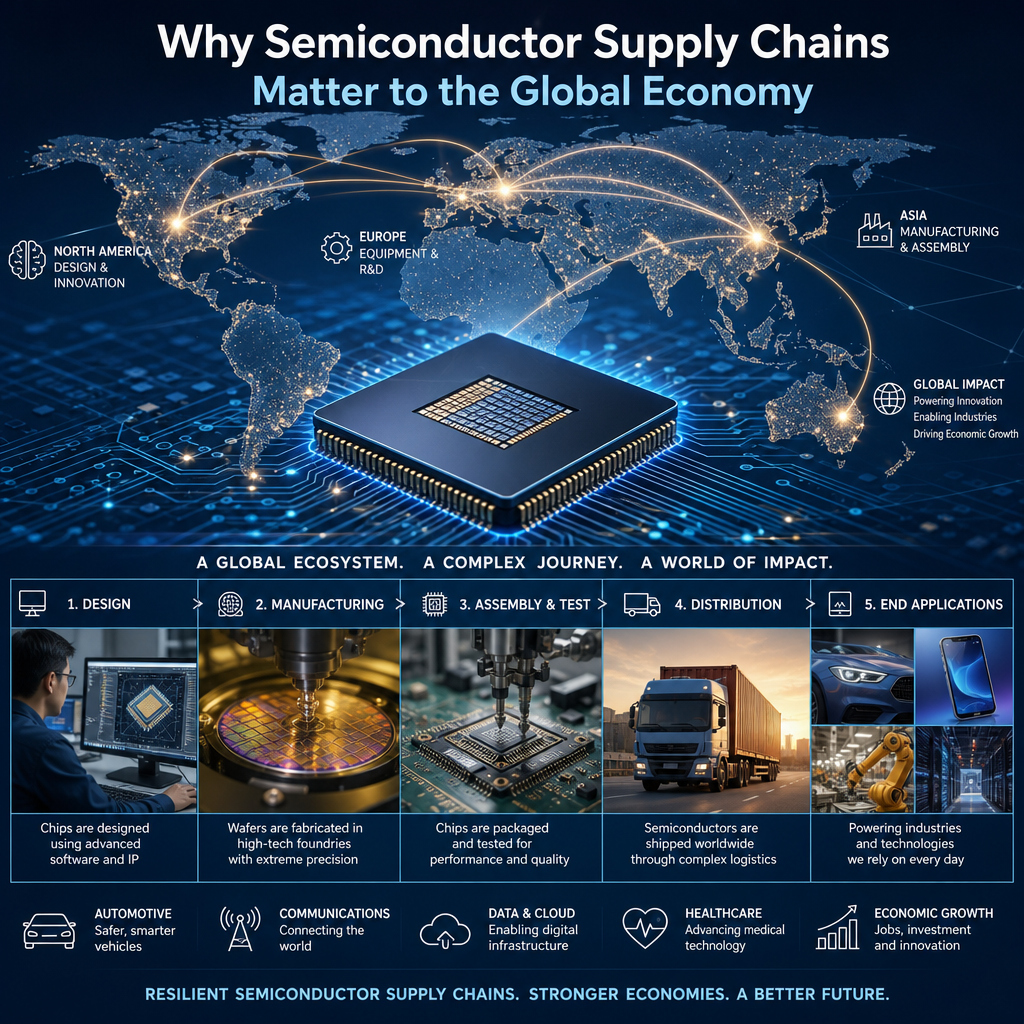
Semiconductor supply chains cover every step involved in creating, testing, transporting, and integrating chips into finished products. They are global by nature because no single country controls every stage of the process.
Key stages in the semiconductor process
A typical chip supply chain includes:
Design
Engineers and software teams create chip architectures and test how they will perform.
Raw material sourcing
Materials such as silicon, rare gases, metals, and specialty chemicals are gathered and refined.
Assembly and packaging
Chips are cut, packaged, and prepared for use in electronic systems.
Testing and quality control
Manufacturers verify performance, reliability, and compliance with technical standards.
Logistics and distribution
Finished chips travel to device makers, automakers, data center operators, and industrial users.
Each stage depends on precision, coordination, and stable international trade. Even a small disruption in one part of the chain can affect production elsewhere.
Why Semiconductor Supply Chains Matter to the Global Economy
Semiconductors are not just another product category. They are a foundational input for nearly every advanced industry. That makes semiconductor supply chains central to global economic performance.
They support nearly every major industry
Modern industries depend on chips for automation, computing, sensing, control, and connectivity. This includes:
Consumer electronics
Automotive manufacturing
Telecommunications
Aerospace and defense
Healthcare equipment
Energy systems
Industrial automation
Artificial intelligence and cloud infrastructure
A shortage in chip supply can slow production across all of these sectors at once. That is why semiconductor availability affects economic growth far beyond the tech industry.
They influence inflation and product prices
When supply tightens, manufacturers may pay more for components, and those costs can pass down to consumers. Higher chip prices can raise the cost of vehicles, appliances, computers, and other electronics. In a connected global economy, chip shortages can contribute to broader pricing pressure.
This is one reason policymakers and business leaders watch semiconductor supply chains closely. They are not only about innovation; they also affect affordability and market stability.
They shape trade relationships
Semiconductors move through an international network of design firms, equipment makers, foundries, and assembly plants. Countries rely on trade agreements, shipping routes, and regulatory cooperation to keep that network working.
When trade disputes, export controls, or geopolitical tensions arise, semiconductor supply chains often feel the impact quickly. Governments may restrict access to advanced equipment, critical minerals, or certain technologies. These moves can reshape global trade patterns and influence where future chip production is built.
The Global Nature of Chip Production
One reason semiconductor supply chains are so important is that they are highly specialized and deeply interconnected. Different countries often lead in different parts of the process.
A network built on specialization
For example:
Some countries excel in chip design software and intellectual property.
Others lead in wafer fabrication or advanced lithography equipment.
Certain regions specialize in packaging, assembly, and testing.
Additional markets provide critical minerals, industrial gases, and logistics infrastructure.
This specialization boosts efficiency and innovation, but it also creates dependency. A disruption in one region can slow progress across the entire chain.
Why concentration creates risk
Advanced chip manufacturing requires huge investments, skilled workers, clean-room facilities, and exacting standards. As a result, production has concentrated in a limited number of locations. That concentration makes the system efficient, but it also creates vulnerability.
If a factory shuts down because of a natural disaster, power outage, labor shortage, or political conflict, global customers may face delays. The more concentrated the supply chain, the greater the risk of bottlenecks.
How Semiconductor Supply Chain Disruptions Affect Businesses
A semiconductor shortage can create a domino effect. Businesses that depend on chips often operate on tight production schedules and low inventory buffers, so delays can be costly.
Common business impacts
Semiconductor disruptions may lead to:
Slower manufacturing output
Higher procurement costs
Delayed product launches
Unpredictable inventory planning
Contract penalties or missed delivery deadlines
Reduced revenue and margin pressure
Automakers offer a clear example. A modern vehicle can contain dozens or even hundreds of chips, depending on the model and features. If a key component is unavailable, the entire assembly line may slow or stop.
A practical example
Imagine a consumer electronics company planning to release a new tablet before the holiday season. If its chip supplier faces a shipment delay, the company may have to postpone the launch, revise its marketing strategy, and lose sales momentum. Competitors with better inventory planning may gain market share instead.
That is why supply chain resilience has become a core business strategy, not just a back-office concern.
Why Governments Care About Semiconductor Supply Chains
Governments treat semiconductors as a strategic resource because the chips underpin economic competitiveness, defense capability, and digital infrastructure.
Economic security and resilience
Many countries want more resilient access to essential technologies. They do not want critical industries to rely too heavily on a single foreign supplier or region. This has led to policies encouraging domestic fabrication, research funding, workforce development, and supply chain diversification.
National security considerations
Semiconductors support communications systems, military electronics, satellites, and cybersecurity tools. That makes access to advanced chips a matter of national security as well as economic policy. Governments often monitor chip exports, sensitive manufacturing equipment, and foreign investment in the sector.
Public investment and industrial policy
In recent years, many governments have supported semiconductor manufacturing through incentives, tax programs, grants, and research partnerships. These efforts aim to strengthen local capacity, reduce supply risks, and create high-value jobs. While the exact policy tools vary, the underlying goal is the same: stabilize semiconductor supply chains and protect economic competitiveness.
The Role of Innovation in Semiconductor Supply Chains
Semiconductor supply chains do more than move products. They also drive innovation. New chip designs make possible faster computing, better energy efficiency, and more advanced applications in AI, medical devices, and automotive systems.
Why advanced chips matter
Smaller, more efficient chips can improve:
Battery life in mobile devices
Performance in data centers
Safety systems in vehicles
Precision in medical imaging tools
Energy management in smart grids and industrial equipment
Because technology evolves quickly, semiconductor manufacturers must constantly invest in new tools, materials, and engineering methods. This creates a feedback loop: better chips enable new products, and those products create demand for even better chips.
Innovation depends on supply chain stability
Design breakthroughs only matter if companies can manufacture and deliver chips at scale. A weak supply chain can slow the adoption of new technologies, even when the engineering is ready. Stable semiconductor supply chains help turn research into real-world economic value.
Building More Resilient Semiconductor Supply Chains
Businesses and governments are taking steps to reduce risk and improve flexibility.
Common resilience strategies
Organizations often focus on:
Supplier diversification to avoid dependence on a single source
Regional manufacturing expansion to shorten shipping routes and reduce exposure
Inventory planning to protect against short-term shocks
Long-term sourcing agreements to secure priority access
Risk monitoring for weather events, geopolitical shifts, and transport disruptions
Workforce development to train engineers, technicians, and equipment specialists
Resilience does not mean eliminating interdependence
No one is likely to build a completely self-contained semiconductor ecosystem in every country. The industry is too complex and capital-intensive for that. Instead, the practical goal is to build supply chains that are more transparent, diversified, and adaptable.
That balance matters. Efficient semiconductor supply chains keep costs manageable, while resilient ones help the global economy absorb shocks without major disruption.
The Future of Semiconductor Supply Chains
The importance of semiconductor supply chains will only grow as more devices become connected and more industries rely on digital systems.
Emerging trends to watch
Several developments are shaping the next phase of the industry:
Greater demand from AI, cloud computing, and data centers
Expansion of electric vehicles and advanced driver-assistance systems
Growth in industrial automation and smart manufacturing
Ongoing investment in domestic fabrication capacity
Increased attention to supply chain traceability and compliance
Rising need for skilled technical labor
These trends suggest that semiconductor supply chains will remain a central issue for business leaders, investors, and policymakers. The companies that understand them best will be better positioned to manage risk and capture growth.
Frequently Asked Questions
1. Why are semiconductor supply chains so complex?
Semiconductor supply chains are complex because chip production requires many specialized stages, advanced equipment, and international coordination. Design, fabrication, packaging, testing, and logistics often happen in different countries, each with its own suppliers and regulations.
2. How do semiconductor shortages affect everyday consumers?
Shortages can delay the release of phones, laptops, cars, and household electronics. They can also increase prices when manufacturers pay more for scarce components. Consumers may notice longer wait times, fewer product options, or higher costs.
3. Why is semiconductor manufacturing concentrated in certain regions?
Manufacturing is concentrated because building and operating advanced fabs is extremely expensive and technically demanding. Companies tend to locate production where they can access skilled labor, reliable infrastructure, supportive policies, and established supplier ecosystems.
4. What industries rely most on semiconductor supply chains?
Nearly all modern industries use semiconductors, but the most dependent sectors include consumer electronics, automotive manufacturing, telecommunications, healthcare, aerospace, defense, and cloud computing. These sectors need chips for control, processing, sensing, and connectivity.
5. How can businesses reduce semiconductor supply chain risk?
Businesses can reduce risk by diversifying suppliers, improving demand forecasting, building strategic inventory, negotiating long-term contracts, and monitoring geopolitical and logistics risks. Some firms also redesign products to use more available chip alternatives.
Semiconductors sit at the heart of the modern economy, and semiconductor supply chains determine how reliably the world can access the chips that power everyday life. From smartphones and electric vehicles to cloud computing and critical infrastructure, nearly every advanced industry depends on these supply chains functioning smoothly.
Their importance goes beyond manufacturing efficiency. Semiconductor supply chains influence prices, trade policy, industrial competitiveness, and national security. They also shape how quickly new technologies reach the market. When the system works well, innovation accelerates and businesses can grow with confidence. When it breaks down, the consequences spread across borders and industries.
That is why companies and governments are investing more attention in resilience, diversification, and long-term planning. The future of the global economy will continue to depend on how well these supply chains adapt to new risks and new demands. For businesses, students, and policymakers alike, understanding semiconductor supply chains is no longer optional—it is essential to understanding how the modern world works.
Peter B holds a degree in Journalism and has 5 years
of experience covering U.S. economic policy, labor markets, and
financial news. He writes data-driven news content on topics
like inflation, interest rates, and employment trends.