How Economic Sanctions Affect Countries, Companies, and Consumers
Economic sanctions can quickly reshape a country’s economy, disrupt business operations, and raise costs for everyday consumers. In this article, we’ll break down how they work and why their effects often reach far beyond the intended target.
By: Peter B on July 24, 2026
Economic sanctions shape global trade, diplomacy, and everyday life in ways many people only notice when prices rise, products disappear, or a business suddenly changes course. Whether imposed by one country, a coalition of nations, or an international body, economic sanctions are designed to influence behavior without using military force. They can freeze assets, restrict exports, block financial transactions, or limit access to vital markets.
But the effects of economic sanctions rarely stay limited to the targeted government. They ripple through national economies, private companies, supply chains, and household budgets. Understanding those effects helps make sense of headlines about foreign policy, inflation, and business risk.
What Are Economic Sanctions?
Economic sanctions are policy tools used to pressure a country, organization, or individual to change behavior. Governments often use them in response to human rights abuses, military aggression, corruption, terrorism, or nuclear noncompliance.
Sanctions can take many forms, including:
Trade restrictions on goods and services
Asset freezes that block access to money or property
Financial sanctions that limit banking and investment
Travel bans on officials or business leaders
Export controls on sensitive technology and equipment
Import bans on products from a sanctioned country
Some sanctions are broad and affect entire sectors of an economy. Others are targeted, aiming at specific people, companies, or industries.
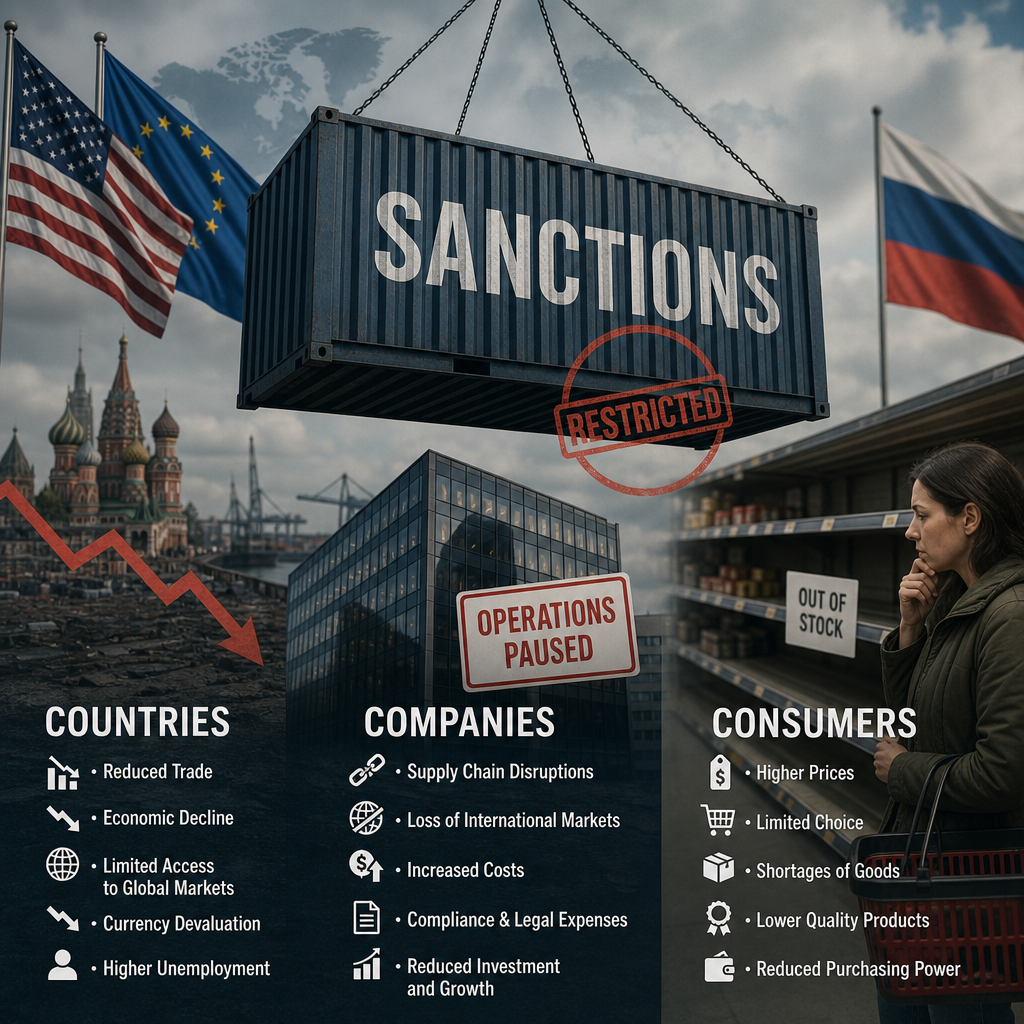
How Economic Sanctions Affect Countries
For governments and national economies, sanctions can be powerful but costly. They often reduce revenue, weaken growth, and limit access to global markets.
Pressure on government revenue
When a sanctioned country relies on exports such as oil, minerals, or agricultural goods, restrictions can cut deeply into public income. Less revenue means less money for:
Infrastructure
Public services
Healthcare
Education
Currency stabilization
If sanctions affect state-owned enterprises or major exporters, the government may struggle to raise funds through normal economic channels.
Currency instability and inflation
Sanctions can reduce foreign investment and limit access to hard currency like U.S. dollars or euros. When that happens, a local currency may weaken. A weaker currency makes imports more expensive, which can lead to inflation.
That inflation can hit essentials first:
Fuel
Food
Medicine
Industrial parts
Consumer electronics
For ordinary people, this often means lower purchasing power and higher daily living costs.
Disruption to trade and technology access
Many countries depend on imports for machinery, advanced software, medical equipment, and manufacturing inputs. Economic sanctions can disrupt these supply chains and slow industrial production.
In some cases, sanctions also block access to:
Semiconductor technology
Aircraft parts
Banking software
Energy exploration equipment
Specialized pharmaceuticals
These restrictions can slow long-term development, especially if the country cannot easily replace foreign suppliers.
Political and social consequences
Sanctions are meant to influence policy, but they can also affect civilians. Shortages, unemployment, and rising prices may increase public frustration. In some countries, leaders use sanctions as political proof of foreign hostility, which can strengthen domestic propaganda.
This creates a difficult policy balance: sanctions may pressure a government, but they can also deepen hardship for citizens who have little control over the policies being punished.
How Economic Sanctions Affect Companies
Businesses often feel the impact of sanctions quickly, even when they are not directly targeted. Companies must manage legal compliance, customer relationships, logistics, banking, and long-term strategic planning.
Compliance risks and legal exposure
One of the biggest challenges for companies is staying compliant. Sanctions rules can change rapidly and vary by country. A business that violates sanctions may face:
Fines
Loss of export privileges
Frozen assets
Reputational damage
Criminal investigations in serious cases
This is especially important for companies with international clients, distributors, suppliers, or financial institutions in multiple countries.
Supply chain disruption
Sanctions can interrupt sourcing, shipping, and manufacturing. If a company depends on a sanctioned country for raw materials or components, it may need to find alternatives quickly.
Examples include:
A manufacturer replacing a restricted metal supplier
A tech company sourcing chips from a different region
A retailer revising product lines because of import bans
Even indirect exposure can create problems. A company might not work with a sanctioned entity directly, but one of its suppliers might. That is why many businesses now perform stricter supply chain due diligence.
Banking and payment complications
Financial sanctions can make it difficult to send or receive payments. Banks may block transactions if they detect a sanctioned party in the transfer chain. Companies may also face delays if compliance teams need to review customers, invoices, or shipping documents.
This can affect:
Cross-border trade
Licensing agreements
Insurance coverage
Currency exchange
International payroll
For small and mid-sized businesses, these delays can hurt cash flow and strain operations.
Market access and lost revenue
A company may be forced to leave a sanctioned market entirely. For some industries, that means losing a meaningful share of revenue. For others, it can mean canceling partnerships, closing local offices, or rewriting distribution contracts.
Commonly affected industries include:
Energy
Aviation
Finance
Telecommunications
Luxury goods
Software and cloud services
Even when a company can legally continue operating in a market, the uncertainty surrounding sanctions may discourage long-term investment.
Reputational and investor concerns
Public perception matters. Consumers, investors, and business partners may scrutinize companies that operate in or near sanctioned markets. Firms that appear careless about sanctions compliance can lose trust quickly.
At the same time, companies that exit a market may face criticism for abandoning customers or workers. The reputational effects are complex and often depend on how transparent and responsible the company appears.
How Economic Sanctions Affect Consumers
Consumers often feel the effects of economic sanctions through price changes, fewer product choices, and slower economic growth. Even if a sanction targets a foreign government, the consequences can show up in local stores and household budgets.
Higher prices for imported goods
When sanctions disrupt international supply chains, imported goods can become more expensive. Businesses pass some of those costs to consumers.
Common examples include:
Fuel and energy bills
Food products
Auto parts
Home appliances
Electronics
Pharmaceuticals
The impact is often stronger in countries that rely heavily on imports for everyday goods.
Fewer product options
Sanctions can reduce the number of brands and models available in a market. Consumers may lose access to products from targeted countries or from multinational companies that have withdrawn.
This can lead to:
Longer wait times for repairs
Limited access to replacement parts
Reduced competition
Less innovation in some sectors
In some cases, gray markets emerge, but those can bring counterfeit, unsafe, or overpriced products.
Job losses and wage pressure
When companies lose access to key markets or face higher operating costs, they may cut jobs or slow hiring. That can affect workers not only in directly sanctioned industries but also in logistics, retail, finance, and manufacturing.
If a country’s economy slows, consumers may also face:
Lower wage growth
Reduced hours
Smaller retirement contributions
Less consumer confidence
These effects can create a cycle where households spend less, businesses earn less, and the broader economy weakens.
Everyday uncertainty
Consumers often do not think about sanctions until a familiar product disappears or a service becomes unreliable. That uncertainty can affect planning, especially for people who depend on imported medicine, remittances, or specialized equipment.
For families and small business owners, the main concern is often practical: What is available, what will it cost, and how long will it last?
Why Sanctions Sometimes Backfire
Economic sanctions are intended to change behavior, but they do not always work as planned. In some cases, they strengthen the targeted government’s political narrative, encourage domestic substitution, or push trade toward alternative partners.
Common unintended outcomes
Increased hardship for civilians
Growth of black markets
Stronger ties between sanctioned states and rival powers
Reduced influence of the sanctioning country over time
Harder diplomatic negotiations
That does not mean sanctions are ineffective in every case. It means policymakers must weigh the intended pressure against the economic and humanitarian costs.
How Businesses Can Adapt to Sanctions Risk
Companies that operate internationally need a practical sanctions strategy. Waiting until a problem appears can be expensive.
Smart risk management steps
Screen customers and suppliers regularly
Use updated compliance tools to check names, ownership structures, and jurisdictions.
Monitor regulatory changes
Sanctions lists and rules can change quickly. Assign responsibility for tracking updates.
Review contracts carefully
Include sanctions clauses, payment protections, and termination rights where appropriate.
Map supply chains
Know where products, parts, and raw materials come from, including indirect suppliers.
Train staff
Sales, finance, procurement, and logistics teams should know warning signs and escalation procedures.
Consult legal and compliance experts
When rules are unclear, professional advice can reduce the risk of costly mistakes.
Practical example
Imagine a U.S.-based electronics distributor that buys components through a third-party supplier in Europe. If that supplier sources materials from a sanctioned region, the distributor may still face compliance issues. A simple supplier review and origin check can prevent a major disruption later.
The Broader Economic Impact of Sanctions
Sanctions are not just a foreign policy issue. They influence global markets, investor confidence, shipping patterns, insurance rates, and diplomatic alliances.
They can also reshape how companies think about risk. After major sanctions events, businesses often increase due diligence, diversify suppliers, and reduce dependence on single countries or payment channels. That can make global commerce more resilient in some ways, but it can also make trade more expensive and less efficient.
In short, economic sanctions are a tool with real leverage, but they carry real costs. Their effects depend on how broadly they are applied, how well they are enforced, and how prepared companies and consumers are to adapt.
Frequently Asked Questions
1. What is the main purpose of economic sanctions?
The main purpose of economic sanctions is to pressure a government, group, or individual to change behavior without using military force. They are often used to respond to actions such as aggression, terrorism, corruption, or human rights violations.
2. Do economic sanctions only hurt the targeted country?
No. While the targeted country usually feels the biggest impact, sanctions also affect companies, foreign suppliers, banks, workers, and consumers in other countries. Costs can spread through trade, finance, and global supply chains.
3. Why do sanctions sometimes raise prices for consumers?
Sanctions can disrupt imports, shipping, energy markets, and financial transactions. When businesses pay more for inputs or face shortages, they may pass those costs on to consumers through higher prices.
4. How can companies avoid sanctions violations?
Companies can reduce risk by screening customers and suppliers, monitoring sanction updates, reviewing contracts, mapping supply chains, and working with legal or compliance professionals. Regular training is also important.
5. Are sanctions always effective?
Not always. Sanctions can create pressure, but they may also produce unintended consequences such as black markets, civilian hardship, or stronger political resistance. Their effectiveness depends on design, enforcement, and diplomatic context.
Economic sanctions are one of the most widely used tools in modern international policy, but their effects extend far beyond the governments they target. Countries can lose revenue, face inflation, and struggle with trade disruptions. Companies must manage compliance, protect supply chains, and navigate banking restrictions. Consumers often experience the consequences through higher prices, fewer choices, and greater uncertainty in daily life.
Because sanctions operate through complex economic networks, their impact is rarely neat or isolated. A policy meant to pressure one actor can quickly influence markets, workers, and households across borders. That is why businesses and individuals benefit from understanding how sanctions work and staying alert to regulatory changes.
If you want to make better decisions in a connected global economy, keep learning how sanctions shape trade, risk, and consumer costs. A basic understanding today can help you recognize supply chain shifts, compliance obligations, and pricing changes before they become major problems.
Peter B holds a degree in Journalism and has 5 years
of experience covering U.S. economic policy, labor markets, and
financial news. He writes data-driven news content on topics
like inflation, interest rates, and employment trends.