What the World Trade Organization Does and Why It Matters
The World Trade Organization helps make global trade more predictable by setting rules, supporting negotiations, and resolving disputes between countries. Understanding how it works shows why its decisions can influence everything from prices to product availability in everyday life.
By: Peter B on July 24, 2026
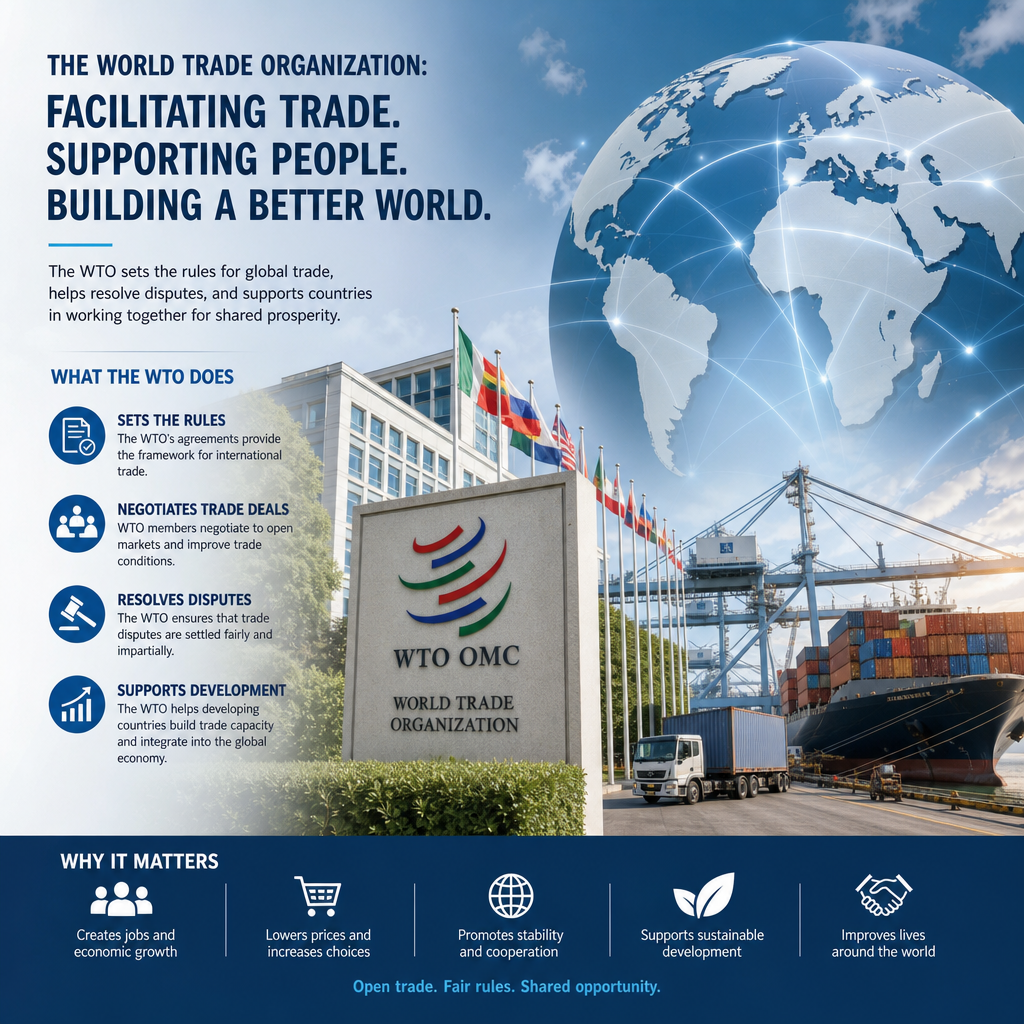
World Trade Organization plays a central role in how countries trade goods and services across borders. Whether you’re buying groceries, using a smartphone, or running a business that imports materials, the rules shaped by the World Trade Organization affect the prices, access, and reliability of global trade. Yet many people know the name without understanding what the organization actually does or why it matters.
At its core, the World Trade Organization helps create a predictable framework for international commerce. It does this by setting rules, supporting negotiations, and offering a process for resolving disputes between member countries. That might sound technical, but the impact reaches everyday life in very practical ways—from product availability to the stability of supply chains.
What Is the World Trade Organization?
The World Trade Organization is an international organization that deals with the rules of trade between nations. It began in 1995, replacing the General Agreement on Tariffs and Trade, or GATT, which had guided trade rules since the late 1940s.
Today, the WTO includes the vast majority of the world’s trading nations. Its members agree to follow a set of rules designed to make trade more open, transparent, and predictable.
The WTO’s Main Purpose
The organization exists to help countries trade with fewer barriers and fewer misunderstandings. It does this by:
Encouraging fairer trade rules
Providing a forum for trade negotiations
Monitoring national trade policies
Helping settle trade disputes
Supporting developing countries in the global trading system
The World Trade Organization does not run a global economy or set prices. Instead, it creates a rules-based system that countries use when they trade with one another.
How the World Trade Organization Works
The World Trade Organization works because member countries agree to follow shared trade principles. Those principles are not perfect, and they do not eliminate conflict. But they do provide a structure that reduces chaos and makes cooperation more likely.
Key WTO Principles
Several ideas sit at the heart of the WTO system:
Most-favored-nation treatment: If a country gives one WTO member a trade advantage, it generally must give the same advantage to other members.
National treatment: Imported goods should be treated no less favorably than domestic goods once they enter a country’s market.
Transparency: Countries are expected to publish and explain their trade rules.
Predictability: Tariffs and trade barriers should be known and limited where possible.
These principles help reduce unfair discrimination and make the trade environment more stable.
The Negotiation Process
The WTO also serves as a place where countries negotiate trade agreements. These negotiations can cover:
Tariffs on goods
Trade in services
Agricultural rules
Intellectual property
Digital trade
Customs procedures
Negotiations are often slow because members have different economic interests. Still, the WTO provides a formal arena where those interests can be discussed rather than handled through unilateral trade fights.
Dispute Settlement
One of the most important functions of the World Trade Organization is dispute settlement. If a member country believes another member is violating trade rules, it can file a complaint.
A dispute process typically involves:
Consultations between the countries involved
Panel review by trade experts
Appellate review in some cases, depending on the system in place
Implementation of the ruling or possible retaliation if the losing side does not comply
This process matters because it gives countries a legal, rules-based way to handle trade conflicts instead of relying solely on political pressure or trade retaliation.
Why the World Trade Organization Matters
The World Trade Organization matters because trade is not just about businesses and governments. It affects consumers, workers, farmers, manufacturers, and service providers around the world.
It Supports Predictable Trade
Predictability is one of the biggest benefits of the WTO. Businesses need to know whether goods can move across borders, what tariffs apply, and whether rules will change suddenly.
When trade rules are clearer:
Companies can plan investments more confidently
Supply chains become easier to manage
Consumers may benefit from more product choices
Smaller businesses gain better access to foreign markets
Without shared rules, trade becomes more uncertain and costly.
It Helps Reduce Trade Conflicts
Trade disputes are inevitable. Countries protect industries, respond to political pressure, and sometimes impose barriers they believe are justified. The WTO helps channel those disputes into a structured process.
That matters because unmanaged trade conflicts can escalate quickly. A rules-based system helps keep disagreements from spreading into broader economic damage.
It Can Support Economic Growth
Trade can expand markets, lower production costs, and improve access to goods and services. By reducing barriers and establishing common rules, the World Trade Organization can help countries participate more effectively in global commerce.
This is especially important for smaller economies that depend on access to larger markets. When trade rules are clearer and more consistent, it is easier for those countries to compete.
It Encourages Fairer Competition
The WTO does not eliminate inequality in the global economy, but it does promote standards that aim to reduce arbitrary discrimination. For example, the national treatment principle helps prevent countries from favoring domestic products once imports have entered the market.
This creates a more level playing field, at least in theory, for businesses trying to compete internationally.
What the World Trade Organization Does Not Do
It’s just as important to understand what the World Trade Organization does not do.
It Does Not Control National Governments
Each member country still makes its own trade and economic policies. The WTO does not replace national sovereignty. Instead, members agree to bind themselves to certain rules in exchange for access to the wider system.
It Does Not Eliminate All Trade Barriers
Countries still use tariffs, quotas, licensing rules, and other restrictions in many situations. The WTO aims to manage and limit these tools, not erase them entirely.
It Does Not Solve Every Global Problem
The WTO is not a cure-all for unemployment, inflation, supply shortages, or geopolitical conflict. Trade rules are one part of a much larger system. Environmental policy, labor protections, industrial strategy, and national security concerns all shape how governments trade.
Real-World Examples of the WTO’s Impact
The work of the World Trade Organization may seem abstract, but its effects show up in practical ways.
Example 1: A Manufacturer Importing Parts
A U.S. company that assembles electronics may rely on components from several countries. If trade rules are stable, the company can source parts more efficiently and keep production costs predictable.
Example 2: A Farmer Exporting Produce
A farmer in one country may want to sell produce overseas. WTO rules can help reduce unjustified barriers and improve market access, especially when countries negotiate lower tariffs or clearer sanitary standards.
Example 3: A Consumer Buying Imported Goods
When trade runs more smoothly, consumers often have access to a wider range of products. That can mean more choices in clothing, food, electronics, and household goods.
Challenges Facing the World Trade Organization
Like any major international institution, the WTO faces serious challenges.
Slow Negotiations
Because decisions often require broad agreement, reaching consensus among many members can be difficult. This can slow progress on modern issues like digital commerce and industrial subsidies.
Dispute System Strains
The dispute settlement process has faced institutional strain in recent years, creating uncertainty about how some trade conflicts are resolved. That has led many observers to call for reforms.
Growing Trade Tensions
Geopolitical competition, national security concerns, and shifting industrial policy have made trade more politically sensitive. Countries are increasingly balancing openness with strategic independence.
Development Gaps
Not all members enter the system with the same resources or bargaining power. Developing countries often want more flexibility, technical assistance, and policy space to support domestic growth.
Why the WTO Still Matters Today
Even with its challenges, the World Trade Organization remains important because the global economy still depends on rules. Trade can be a source of growth, innovation, and lower costs—but only when countries have some level of trust in the system.
The WTO matters today for several reasons:
It creates a common language for trade rules
It helps prevent trade disputes from becoming uncontrolled conflicts
It supports businesses that depend on cross-border commerce
It gives developing countries a seat at the table
It provides a framework for updating trade rules over time
In a world shaped by supply chains, digital services, and fast-moving geopolitical shifts, having a shared trade framework is still valuable.
How the World Trade Organization Affects Everyday Life
Most people never read WTO agreements, but the organization influences daily life in subtle ways.
You May Notice Its Impact In:
The availability of imported foods and products
The variety of brands on store shelves
The cost of items that rely on global supply chains
The ability of local businesses to export abroad
The stability of product sourcing during trade disputes
When trade rules work well, consumers often experience fewer disruptions and more options. When rules break down, prices and availability can become less predictable.
Frequently Asked Questions
1. What is the main purpose of the World Trade Organization?
The main purpose of the World Trade Organization is to create a rules-based system for international trade. It helps countries negotiate trade agreements, reduces trade barriers where possible, and provides a process for resolving disputes.
2. How does the World Trade Organization affect consumers?
The WTO can affect consumers by influencing the availability, variety, and price of imported goods and services. When trade flows more smoothly, consumers often have access to more choices and more stable supply chains.
3. Does the World Trade Organization make laws?
Not in the way a national legislature does. The WTO creates trade rules that member countries agree to follow, but each government still maintains its own legal and policy systems.
4. Can countries ignore WTO rules?
Countries can choose to violate WTO rules, but doing so may lead to formal disputes and potential retaliation by other members. The organization’s value comes largely from the fact that its members generally commit to following the system.
5. Why is the World Trade Organization often criticized?
The WTO is criticized for several reasons, including slow decision-making, unequal bargaining power among members, and difficulty adapting to modern trade issues. Some critics also argue that trade rules should give more attention to labor, environment, and public health concerns.
The World Trade Organization remains one of the most important institutions in the global economy because it gives countries a framework for managing trade in a structured, predictable way. It does not eliminate conflict or guarantee fair outcomes for everyone, but it does provide rules, procedures, and a forum for negotiation that help reduce uncertainty. For businesses, that can mean more stability in sourcing and market access. For consumers, it can mean more choice and better access to goods. For governments, it offers a way to resolve disputes without relying entirely on escalation.
As global trade becomes more complex, the WTO’s role continues to evolve. Issues like digital commerce, supply chain resilience, and industrial policy are pushing the organization to adapt. Understanding what the WTO does—and what it cannot do—makes it easier to follow trade news, evaluate policy debates, and see how international decisions affect everyday life. If you want to better understand the global economy, the WTO is a smart place to start.
Peter B holds a degree in Journalism and has 5 years
of experience covering U.S. economic policy, labor markets, and
financial news. He writes data-driven news content on topics
like inflation, interest rates, and employment trends.