How Artificial Intelligence Is Changing the Global Job Market
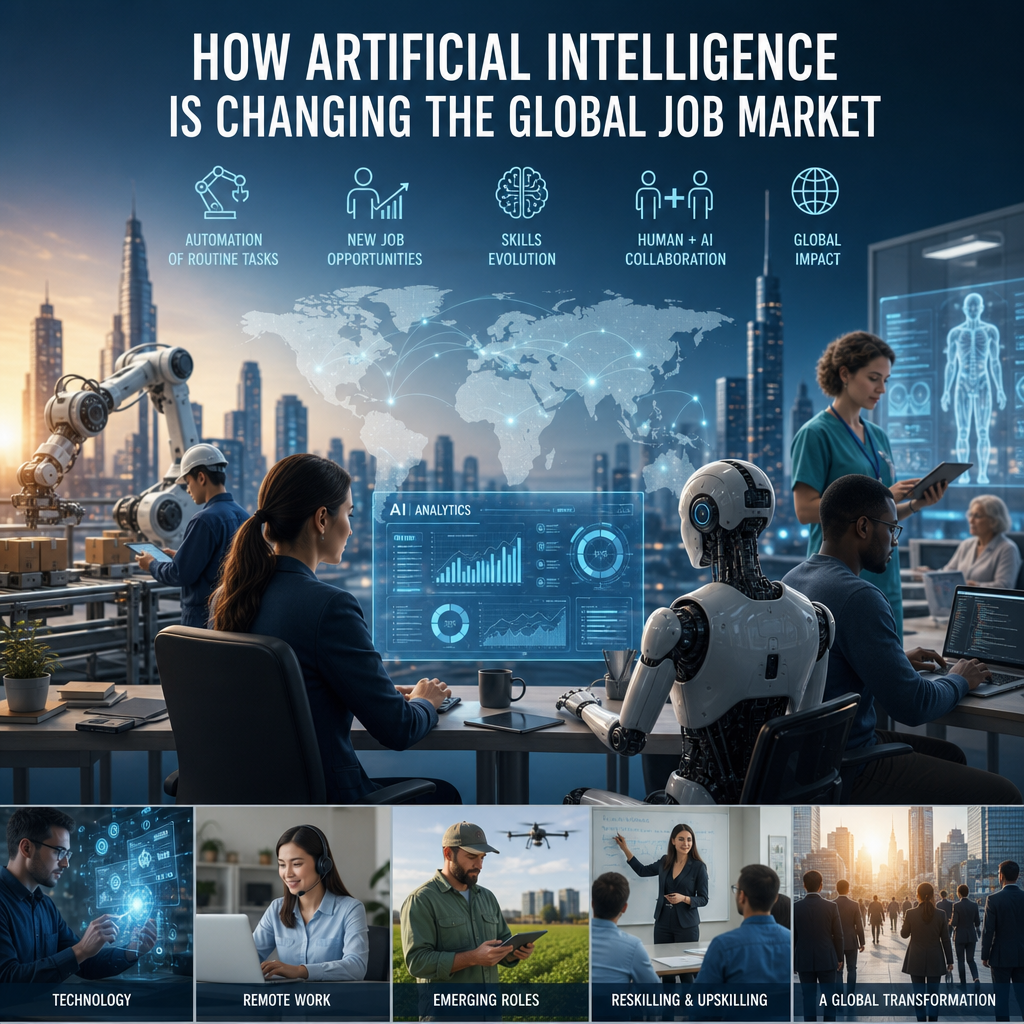
Artificial intelligence job market changes are reshaping careers faster than ever, from automating routine tasks to creating new roles that demand digital and analytical skills. Whether you’re a worker, employer, or policymaker, understanding these shifts is key to staying competitive in a rapidly evolving economy.
By: Peter B on July 24, 2026
Artificial intelligence is no longer a future concept—it is already reshaping how people work, hire, train, and build careers. From automated customer support to AI-assisted software development, the global job market is changing in real time. For workers, employers, and policymakers, understanding how artificial intelligence is changing the global job market has become essential for staying competitive and making informed decisions.
AI is not simply replacing jobs in every industry. In many cases, it is also creating new roles, changing skill requirements, and improving productivity. The real challenge is not whether AI will affect work, but how quickly workers and organizations can adapt to it.
Artificial intelligence is changing the global job market in several major ways:
Automating repetitive and routine tasks
Increasing demand for digital and analytical skills
Creating new job categories and hybrid roles
Transforming how companies recruit and evaluate talent
Changing the way employees learn and reskill
These shifts are happening across industries, from manufacturing and finance to healthcare, education, logistics, and marketing. The impact is uneven, but the overall direction is clear: jobs that rely heavily on repetition are more exposed to automation, while jobs that depend on creativity, judgment, communication, and technical expertise are evolving rather than disappearing.
Automation Is Reshaping Routine Work
One of the most visible effects of AI is automation. Machines and software can now perform tasks that used to require human labor, especially tasks that are repetitive, predictable, and data-driven.
Common examples include:
Chatbots handling basic customer service questions
Automated transcription and document processing in office settings
This does not always mean full job elimination. Often, AI removes repetitive parts of a job so employees can focus on higher-value work. For example, an accountant may spend less time on data entry and more time on financial analysis and advising clients.
New Jobs Are Emerging Alongside AI
AI is not only replacing tasks; it is also generating new kinds of work. As companies adopt AI tools, they need people who can build, manage, monitor, and improve those systems.
Examples of growing roles include:
AI prompt specialists
Machine learning engineers
Data annotators and labelers
AI ethicists and compliance experts
Automation consultants
Human-in-the-loop quality reviewers
Some of these jobs are highly technical. Others require domain knowledge, communication skills, or business expertise. Many are hybrid roles that combine traditional experience with AI literacy. This means career growth increasingly depends on learning how to work with AI, not just compete against it.
Skills Demand Is Shifting Fast
A major consequence of artificial intelligence is the changing value of workplace skills. Employers are still hiring for experience, but they now place greater emphasis on adaptability, digital fluency, and problem-solving.
Skills in higher demand often include:
Data analysis
Critical thinking
Technical literacy
Cybersecurity awareness
Project management
Communication and collaboration
Creativity and innovation
AI tool usage
At the same time, some tasks that once required large teams can now be completed more efficiently with AI tools. That means workers who can combine human judgment with AI-powered workflows often have an advantage.
Why Soft Skills Matter More Than Ever
AI can process information quickly, but it still struggles with empathy, leadership, negotiation, and ethical judgment. That is why soft skills remain highly valuable in the global job market.
Employers increasingly look for people who can:
Explain complex ideas clearly
Work across teams and cultures
Solve ambiguous problems
Make thoughtful decisions under pressure
Adapt to change without losing focus
In many workplaces, the most successful employees will be those who can use AI without becoming dependent on it.
Hiring and Recruitment Are Changing
Artificial intelligence is also transforming how employers find and evaluate talent. Recruitment platforms increasingly use AI to scan resumes, rank applicants, schedule interviews, and match candidates to roles.
This can make hiring faster and more efficient, but it also creates new challenges. If AI systems are trained on biased data, they may unintentionally reinforce unfair hiring patterns. As a result, many organizations are paying closer attention to transparency, oversight, and human review in recruitment processes.
For job seekers, this means resumes and online profiles need to be clear, relevant, and keyword-aware. It also means candidates should prepare for:
AI-assisted screening
Digital skills assessments
Automated interview scheduling
Skills-based hiring methods
The hiring process is becoming more data-driven, and job seekers who understand that shift are better positioned to succeed.
Industries Most Affected by AI
Artificial intelligence is changing the global job market across nearly every sector, but some industries are seeing faster disruption than others.
Technology and Software
AI tools now assist with coding, testing, debugging, and documentation. Developers who learn to work with AI can often move faster, but they also need to verify outputs carefully.
Customer Service
Chatbots and virtual assistants can handle common questions, freeing human representatives for more complex cases. This changes the role from basic support to problem-solving and relationship management.
Finance
Banks and financial firms use AI for fraud detection, credit scoring, risk analysis, and customer personalization. Workers in this field increasingly need both financial knowledge and technology awareness.
Healthcare
AI helps analyze medical images, support diagnostics, and streamline administrative tasks. While AI can assist clinicians, it cannot replace human care, patient communication, or clinical judgment.
Manufacturing and Logistics
Robotics and predictive systems improve efficiency in production and supply chains. Workers in these sectors may need new technical skills to operate, maintain, and troubleshoot AI-enabled systems.
Marketing and Content
AI can generate drafts, analyze audience behavior, and optimize campaigns. Marketers who understand strategy, brand voice, and audience psychology still play a central role.
The Global Divide: Different Countries, Different Impacts
AI does not affect every economy in the same way. Countries with strong digital infrastructure, high levels of education, and advanced industries are more likely to adopt AI quickly. Others may face slower adoption due to limited access to technology, training, or investment.
This global divide matters because it can widen inequality between workers and between countries. Economies that invest in education, broadband access, digital skills, and innovation are better positioned to benefit from AI-driven growth.
For developing economies, the challenge is balancing opportunity and risk. AI can expand access to services and improve productivity, but it can also put pressure on jobs that rely on routine administrative work or low-cost labor.
Reskilling and Upskilling Are No Longer Optional
One of the clearest lessons from AI’s rise is that workers cannot rely on a single skill set for an entire career. Lifelong learning is becoming a practical necessity.
Reskilling means learning new skills for a different role. Upskilling means improving the skills needed in a current role. Both are important in an AI-driven economy.
Helpful steps include:
Learning how AI tools work in your industry
Taking online courses in data, automation, or digital communication
Practicing with productivity tools and AI assistants
Strengthening soft skills like leadership and adaptability
Following industry trends and labor market changes
Employers also benefit from investing in employee development. Organizations that support training are more likely to retain talent and adapt successfully to technological change.
What Workers Can Do Now
Workers do not need to become AI engineers to stay relevant. In many cases, the smarter move is to understand how AI affects your specific role and how you can use it to improve your performance.
A practical approach includes:
Identifying which tasks in your job are routine and could be automated
Learning which parts of your role require human judgment
Using AI tools to save time on research, drafting, or analysis
Updating your resume to reflect digital and AI-related skills
Building a portfolio that shows adaptability and problem-solving ability
For example, a teacher might use AI to personalize lesson planning, but still rely on professional judgment to support students. A sales professional might use AI to organize leads, but still depend on trust-building and communication to close deals.
What Employers Should Consider
Businesses that want to navigate AI successfully need more than technology adoption. They also need thoughtful workforce planning.
Employers should focus on:
Identifying tasks that can be automated safely
Retraining employees for higher-value responsibilities
Maintaining human oversight in sensitive decisions
Communicating clearly about how AI will be used
Evaluating productivity without ignoring employee well-being
Companies that treat AI as a tool for augmentation, not just cost-cutting, are often better positioned to build trust and long-term resilience.
Ethical and Policy Questions Still Matter
As AI changes the global job market, policy decisions become increasingly important. Governments, educators, and employers all have a role in shaping outcomes.
Key questions include:
How can workers displaced by automation find new opportunities?
How should AI hiring tools be regulated for fairness?
What training programs are needed for large-scale reskilling?
How can schools prepare students for an AI-enabled workplace?
How do we protect privacy and labor rights as AI adoption grows?
These are not abstract concerns. They influence real lives, economic stability, and the quality of future work.
Frequently Asked Questions
1. Will artificial intelligence eliminate most jobs?
Not necessarily. AI is more likely to change jobs than eliminate all of them. Many roles will shift toward tasks that require human judgment, communication, creativity, and oversight. Some jobs may shrink, while others expand or evolve.
2. Which jobs are safest from AI automation?
Jobs that depend heavily on empathy, complex decision-making, physical adaptability, or interpersonal trust are generally less vulnerable. Examples include healthcare caregiving, skilled trades, leadership roles, and jobs requiring nuanced human interaction. Even these roles may still use AI tools in some capacity.
3. What skills should workers learn to stay competitive?
Workers should focus on digital literacy, data analysis, problem-solving, adaptability, and communication. Learning how to use AI tools in a specific profession is also valuable. Soft skills remain important because AI cannot fully replace human collaboration and judgment.
4. How is AI changing the hiring process?
AI is being used to screen resumes, match candidates, schedule interviews, and analyze applications. This can speed up hiring, but it also raises concerns about bias and transparency. Job seekers should keep resumes clear, relevant, and tailored to the role.
5. Can small businesses benefit from AI too?
Yes. Small businesses can use AI to improve customer support, automate repetitive admin tasks, analyze marketing performance, and save time. When used thoughtfully, AI can help smaller companies compete more effectively without requiring large teams.
Artificial intelligence is changing the global job market in deep and lasting ways. It is automating repetitive work, reshaping hiring, increasing demand for digital skills, and creating new opportunities in industries across the world. At the same time, it is pushing workers and employers to rethink how careers are built and how talent is developed.
The biggest takeaway is that AI should be viewed as a force for transformation, not just disruption. Workers who build adaptability, strengthen technical and soft skills, and learn how to use AI tools will be better prepared for the future. Employers that invest in training, fairness, and thoughtful adoption will be better positioned to grow responsibly.
The global job market is not standing still, and neither should the people and organizations within it. Whether you are a job seeker, manager, student, or policymaker, now is the time to pay attention, keep learning, and make informed choices about how AI fits into your future.
Peter B holds a degree in Journalism and has 5 years
of experience covering U.S. economic policy, labor markets, and
financial news. He writes data-driven news content on topics
like inflation, interest rates, and employment trends.