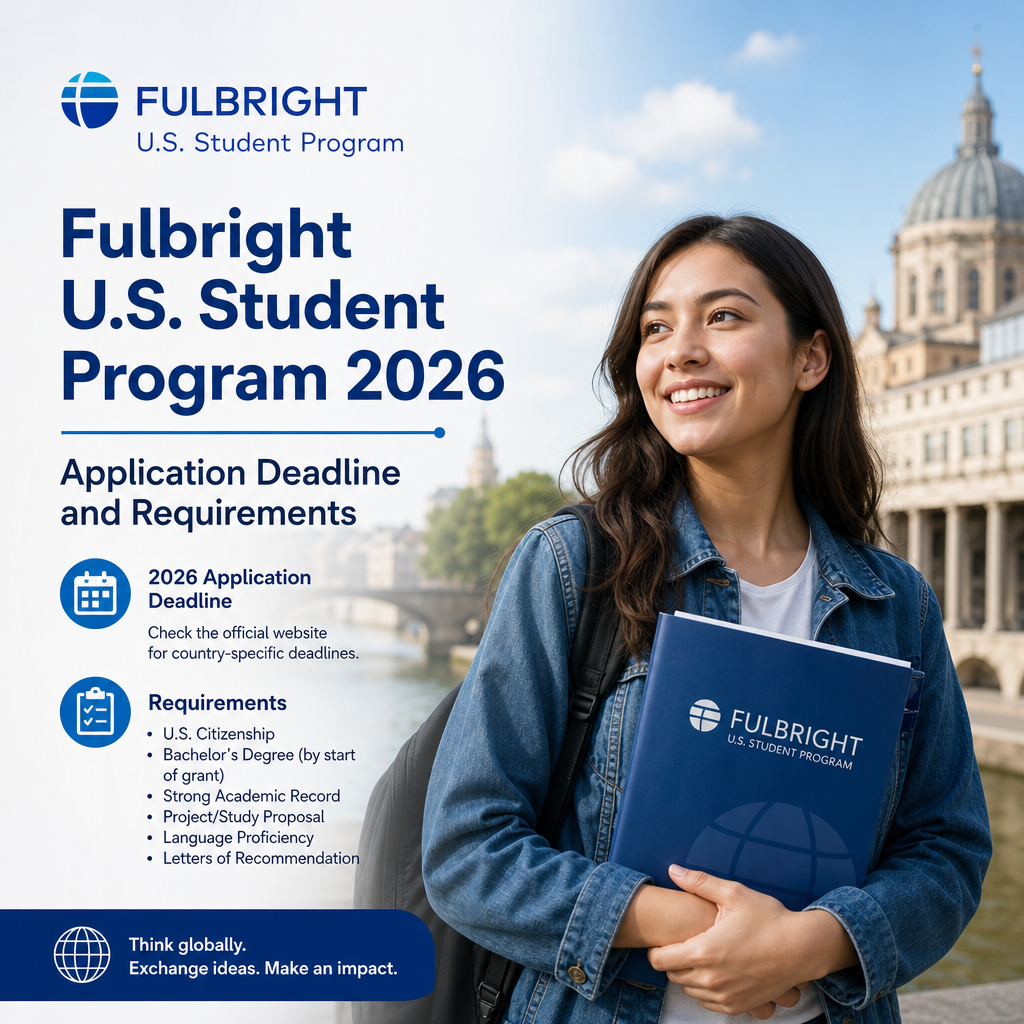
Fulbright U.S. Student Program 2026 Application Deadline and Requirements
Planning to apply for the Fulbright US Student Program in 2026? This guide breaks down the deadline, eligibility rules, and key application materials so you can prepare a stronger, more competitive submission from the start.
By: Jennifer on July 25, 2026
The Fulbright U.S. Student Program remains one of the most respected international exchange opportunities for recent graduates, graduate students, and early-career professionals. If you are planning to apply for the Fulbright U.S. Student Program: 2026 Application Deadline and Requirements, now is the time to understand the timeline, eligibility rules, application materials, and what makes a competitive submission.
This program gives U.S. citizens the chance to study, conduct research, or teach English in more than 140 countries. But while the opportunity is prestigious, the application process is detailed and highly structured. Missing a deadline, submitting the wrong document, or misunderstanding the country-specific requirements can weaken an otherwise strong application.
In this guide, you’ll find a clear breakdown of the 2026 application cycle, the core requirements, and practical tips to help you prepare a stronger application from the start.
What Is the Fulbright U.S. Student Program?
The Fulbright U.S. Student Program is a federally funded international exchange program that supports U.S. citizens pursuing opportunities abroad in three main categories:
Study/Research grants
English Teaching Assistant (ETA) grants
Open Study/Research opportunities, depending on host country availability
Applicants can propose independent research, pursue a graduate degree, or assist with English language instruction, depending on the grant type and host country. The program is administered through the U.S. Department of State and coordinated by the Institute of International Education (IIE).
What makes Fulbright distinctive is its emphasis on cross-cultural exchange. The program is not just about academic achievement. It also looks for applicants who can represent the United States abroad with professionalism, curiosity, adaptability, and cultural sensitivity.
Fulbright U.S. Student Program: 2026 Application Deadline and Timeline
The most important rule is simple: deadlines are firm. For the 2026 cycle, the exact deadline can vary by campus or institutional affiliation, so applicants should verify the date through their university’s Fulbright office or the official Fulbright website.
Typical Fulbright timeline
While you should always confirm the official deadline for your application route, the process usually follows a pattern like this:
Spring to early summer 2025
Begin researching host countries, grant types, and eligibility.
Summer 2025
Draft your statements, request recommendations, and gather transcripts.
Early fall 2025
Submit the complete application through the Fulbright portal before the national deadline.
Fall 2025 to spring 2026
Applicants move through campus review, national screening, and final selection.
Mid-2026 and beyond
Finalists prepare for placement, visas, and travel depending on the country and grant type.
Because the application includes several moving parts, starting early is one of the best ways to reduce stress and improve quality.
Basic Eligibility Requirements
Before investing time in the application, make sure you meet the basic eligibility standards for the Fulbright U.S. Student Program.
General eligibility
To apply, you must typically:
Be a U.S. citizen
Hold at least a bachelor’s degree or equivalent before the grant begins
Meet any country-specific language or academic requirements
Apply to a country and grant type that matches your qualifications
Who should pay close attention?
Some applicants assume Fulbright is only for top students from elite schools. That is not true. The program values a broad range of backgrounds and life experiences. Competitive applicants may come from:
Public and private universities
Community-centered academic programs
STEM, humanities, social science, and arts disciplines
First-generation and nontraditional academic paths
What matters most is whether your proposed project, background, and goals fit the host country and grant type.
Choosing the Right Grant Type
Selecting the right grant category is one of the most important parts of the application process. Your materials must align with the program you choose.
Study/Research grants
These are designed for applicants who want to:
Conduct independent research
Pursue graduate-level study
Combine academic work with fieldwork or community engagement
A strong study/research proposal should clearly explain your project, why it matters, and why the host country is the best place to do it.
English Teaching Assistant grants
ETA grants place you in educational settings where you help teach English and support classroom learning. These are a strong option for applicants who enjoy teaching, mentoring, and cultural exchange.
A strong ETA applicant usually demonstrates:
Communication skills
Flexibility
Interest in education
Cultural adaptability
Country-specific differences
Some countries only offer certain grant types. Others require advanced language ability, a host institution affiliation, or a more developed research plan. Always check the country summary before you begin writing.
Key Application Components
The Fulbright application is more than a form. It is a package of documents that together present your academic background, project plan, and suitability for the award.
1. Statement of Grant Purpose
This is often the most important essay in a study/research application. It should explain:
What you plan to do
Why the project matters
How it fits the host country
Why you are the right person to complete it
Keep the focus on your project, not on your personal life story. The statement should be specific, organized, and realistic.
2. Personal Statement
The personal statement gives reviewers a broader view of who you are. Use it to describe:
Experiences that shaped your goals
Leadership, resilience, or service
Cross-cultural experiences
Motivation for applying to Fulbright
This is where you can show personality and purpose, but avoid repeating the exact same content from your grant purpose statement.
3. Letters of recommendation
Most applicants need several letters of recommendation from people who can speak to their abilities, character, and readiness.
Strong recommenders might include:
Faculty advisors
Research mentors
Supervisors
Community leaders, depending on the grant type
Choose people who know your work well enough to give specific examples, not just general praise.
4. Transcripts
You will need official academic transcripts from all postsecondary institutions attended. Make sure they are accurate, complete, and submitted in the correct format.
5. Language evaluations or proficiency evidence
Some countries require language ability, especially for research or study grants. Even when not required, language preparation can strengthen your application if the host country’s local language is relevant to your project.
6. Affiliation letter, if required
For many research applications, you may need a letter from a host institution, professor, laboratory, archive, or organization abroad. This letter should confirm interest in your project and explain how the affiliation supports your work.
How to Build a Competitive Fulbright Application
A successful application usually reflects careful planning, clarity, and strong alignment between the applicant and the grant.
Start with fit, not just ambition
A common mistake is designing a project that sounds impressive but doesn’t fit the country or available resources. The best applications show that the proposal is both ambitious and feasible.
Ask yourself:
Is this project realistic within the grant period?
Does the host country have the expertise, archives, communities, or institutions I need?
Can I explain why this location is essential?
Show cultural engagement
Fulbright reviewers want to see that you will engage with the host community respectfully and meaningfully. Mention how you will:
Build local relationships
Adapt to the environment
Participate in community life
Share your background appropriately
Be specific about your goals
Vague statements weaken applications. Instead of writing, “I want to learn more about education,” explain exactly what you will study, how you will do it, and what you hope to contribute.
Demonstrate preparation
Preparation matters. That can include:
Relevant coursework
Research experience
Teaching experience
Language study
Volunteer work
Community engagement
The goal is to show that you are ready for the responsibility and complexity of an overseas grant.
Common Mistakes to Avoid
Many applications fail because of avoidable errors rather than weak potential. Watch out for these issues:
Missing the deadline
Submitting essays that are too broad
Choosing the wrong country or grant type
Repeating the same content in every document
Ignoring host-country context
Writing in overly formal, vague language
Failing to proofread for grammar and clarity
A polished application does not need flashy language. It needs precision, purpose, and coherence.
Practical Example: What a Strong Application Looks Like
Suppose you are applying for a study/research grant to examine public health communication in a specific country. A strong application would likely include:
A clearly defined research question
A credible reason for choosing that country
A host institution or local expert connection
Evidence that you have relevant academic preparation
A personal statement that shows commitment to public service or cross-cultural learning
A realistic plan for completing the project during the grant period
By contrast, a weaker application might say only that the applicant wants to “learn about public health abroad” without explaining what they will study or why that location matters.
How to Prepare Before the Deadline
If you are aiming for the 2026 cycle, use the months before submission wisely.
A simple preparation checklist
Review the official Fulbright country pages
Confirm your eligibility
Decide between study/research and ETA
Draft your project proposal or teaching narrative
Ask recommenders early
Request transcripts
Check language requirements
Revise essays multiple times
Get feedback from a campus advisor or mentor
Submit before the deadline, not on it
Starting early lets you improve both the content and the quality of your application.
Frequently Asked Questions
1. When is the Fulbright U.S. Student Program 2026 application deadline?
The exact deadline depends on your application route, especially if you are applying through a university or other institutional process. In many cases, the national deadline is in early fall 2025 for the 2026 grant cycle, but you should verify the official date through the Fulbright website and your campus Fulbright advisor.
2. Can recent graduates apply to the Fulbright U.S. Student Program?
Yes. Recent graduates are often strong candidates as long as they meet the citizenship and degree requirements. The program is designed for applicants at different stages, including graduating seniors, recent alumni, and graduate students.
3. Do I need a host institution for a Fulbright research grant?
In many cases, yes. A host institution, advisor, lab, archive, or local organization may be required or strongly recommended, depending on the country and project. The affiliation should show that your project is grounded in the local context and has practical support.
4. What makes a Fulbright application competitive?
Strong applications usually show clear project goals, strong academic or professional preparation, thoughtful cultural engagement, and a realistic plan for completing the grant. Reviewers also look for applicants who can represent the United States well and adapt to life in the host country.
5. Can I apply for both study/research and ETA grants?
Application rules vary by country. Some countries allow applicants to indicate interest in multiple grant types, while others require a single choice. Always check the country-specific instructions before submitting your materials.
The Fulbright U.S. Student Program: 2026 Application Deadline and Requirements may seem demanding at first, but a strong application becomes much more manageable when you understand the timeline, eligibility rules, and expectations. The key is to start early, choose the right grant type, and build an application that clearly connects your academic or professional goals to the host country’s needs and opportunities.
Whether you are pursuing research, graduate study, or English teaching, Fulbright looks for more than credentials. It values applicants who are prepared, thoughtful, adaptable, and genuinely interested in cultural exchange. That means your essays, recommendations, and project plan should work together to tell a clear story about who you are and what you hope to accomplish.
If you are serious about applying, use the months before the deadline to research carefully, write deliberately, and seek feedback from mentors or campus advisors. A well-prepared application not only improves your chances of success, it also helps you clarify your goals for the experience ahead. For many applicants, the process itself is a valuable step toward a larger international and professional journey.
Jennifer, M.Ed., holds a degree in Higher Education Administration, with
a focus on U.S. college financial aid, admissions policy, and student
support systems. She researches and writes about scholarships, federal
aid programs, and the college planning process to help students and
families make informed, well-supported decisions.