Magnet Schools vs. Charter Schools: Key Differences for Families
Magnet schools vs charter schools can both give families public-school options with a special focus, but they differ in how they’re run, who can enroll, and how students are admitted. Understanding those differences can make it much easier to find the best fit for your child’s needs and your family’s goals.
By: Jennifer on July 25, 2026
Choosing the right school is one of the biggest decisions a family can make, and the options can feel confusing fast. Two of the most commonly discussed alternatives in public education are magnet schools vs. charter schools. Both can offer specialized programs, different teaching approaches, and a school culture that may fit some students better than a traditional neighborhood school. But they are not the same.
If you are comparing magnet schools vs. charter schools, it helps to understand how each one works, who can attend, how admissions happen, and what kinds of experiences families can expect. The right choice often depends on your child’s learning style, your priorities, and the options available in your district.
What Are Magnet Schools?
Magnet schools are public schools that offer a specialized theme, curriculum, or instructional approach designed to attract students from across a district or region. Common themes include:
STEM
Performing arts
International studies
Montessori
Language immersion
Gifted education
Because magnet schools are part of the public school system, they are tuition-free and usually funded by the local school district, state, and sometimes federal grants.
How Magnet Schools Work
Magnet schools often exist to promote diversity, reduce school segregation, or give students access to specialized programs not available at every neighborhood school. Some are open to all students in a district, while others use a lottery, application, audition, or academic criteria.
For families, that means a magnet school may offer:
A focused curriculum
Smaller or more specialized learning communities
Access to advanced classes or unique programs
Students from a wider geographic area
What Are Charter Schools?
Charter schools are also public schools, but they operate under a charter, which is a performance contract that gives them more flexibility in exchange for accountability. A charter school is publicly funded and free to attend, but it is usually run by an independent nonprofit organization, a charter management organization, or sometimes a school district.
How Charter Schools Work
Charter schools often have more freedom than traditional public schools in areas such as:
Curriculum design
School day structure
Teaching methods
Staffing decisions
Academic focus
That flexibility allows some charter schools to create distinctive educational models, such as project-based learning, college-prep programs, classical education, or dual-language instruction.
Families considering charter schools should know that each one is different. One charter school may strongly emphasize discipline and college readiness, while another may focus on creativity, community-based learning, or special education support.
Magnet Schools vs. Charter Schools: The Main Differences
The easiest way to compare magnet schools vs. charter schools is to look at how they are governed, how students are admitted, and what kind of choices they offer.
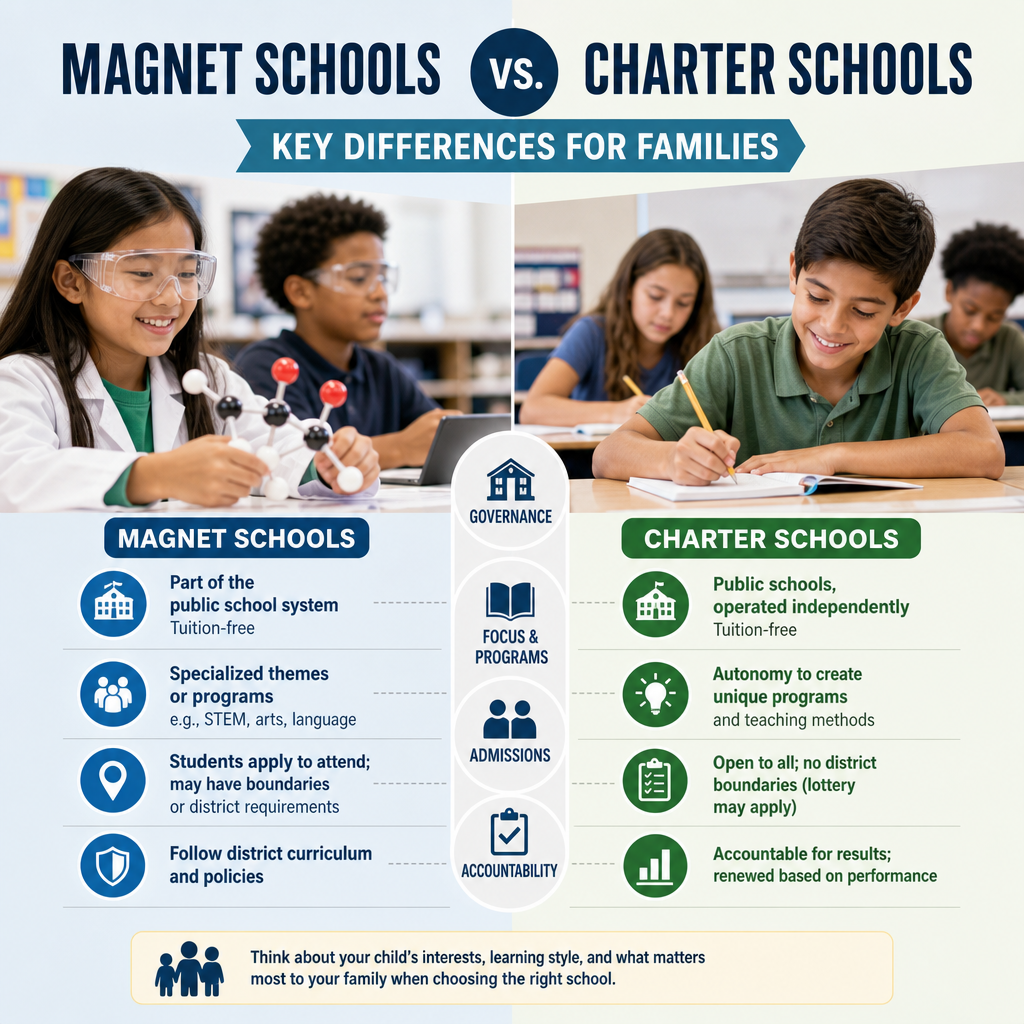
1. Governance and Oversight
Magnet schools are part of a public school district. They follow district policies, school board oversight, and state education rules.
Charter schools are still public schools, but they are operated by a charter authorizer, which may be a school district, university, state board, or another approved entity. They have more independence in daily operations.
2. Admissions Process
Magnet schools often use a selective or semi-selective admissions process. Some require:
An application
A lottery
Academic records
Teacher recommendations
Auditions or portfolios for arts programs
Charter schools usually use a lottery if they have more applicants than available seats. Many charters are open enrollment, meaning any student can apply if space is available. They cannot charge tuition, and they generally must follow nondiscrimination rules.
3. School Boundaries
Magnet schools often draw students from a larger area than traditional neighborhood schools. Some may prioritize students within a district first, then accept others if space remains.
Charter schools may also accept students from outside a neighborhood boundary, but enrollment rules depend on state law and the school’s charter.
4. Academic Focus
Magnet schools are typically built around a specific theme or specialization. The academic offering is often designed to deepen student interest in that area.
Charter schools vary more widely. Some have a strong academic theme, while others focus on:
Arts integration
Social-emotional learning
Classical education
College readiness
STEM innovation
Character development
5. Accountability and Flexibility
Both magnet schools and charter schools are accountable for student outcomes, but charter schools usually have more operational flexibility. If a charter school fails to meet performance expectations, its charter can be renewed, revised, or revoked.
Magnet schools are accountable through the school district and state education system, just like other public schools.
Benefits of Magnet Schools
Magnet schools can be a great fit for students who thrive when they have a strong area of interest or a structured, theme-based environment.
Specialized Learning Opportunities
A magnet school can give your child access to classes and programs that may not be available at your neighborhood school. For example, a STEM magnet may offer robotics, engineering labs, or coding courses.
Diverse Peer Group
Because magnet schools often draw students from many parts of a district, children may meet peers with different backgrounds and experiences.
Public School Status
Since magnet schools are public, they are tuition-free and may still offer services like transportation, special education, and meal programs, depending on the district.
Strong Fit for Motivated Students
Some magnet programs are ideal for students who already show strong interest or talent in a specific area, such as music, math, or foreign language.
Benefits of Charter Schools
Charter schools appeal to families looking for a different school culture, a unique instructional model, or more innovation than a typical district school provides.
Flexibility in Teaching Approach
Charter schools can often design lessons and schedules in ways that better fit their mission. That may include more hands-on projects, longer school days, or interdisciplinary teaching.
Distinct School Culture
Many charter schools build a very specific culture around college prep, behavior expectations, family involvement, or community values.
Potentially Smaller Schools
Some charter schools are smaller than traditional public schools, which can create a close-knit atmosphere and more individualized attention.
Innovation and Choice
Because charter schools are built to try different educational models, they can offer families more options within public education.
Things Families Should Consider Before Choosing
When comparing magnet schools vs. charter schools, it’s not just about the label. It’s about whether the school meets your child’s academic, social, and logistical needs.
1. Your Child’s Learning Style
Ask whether your child does best in a structured environment, a creative setting, or a specialized academic program.
For example:
A child who loves science may thrive in a STEM magnet.
A child who learns well through projects may do well at a charter school with experiential learning.
A child who needs routine may prefer a school with a clear schedule and predictable expectations.
2. The Admissions Odds
Some magnet schools are highly competitive. If your child needs a lottery spot or application approval, it may be wise to have backup options.
Charter schools also may have waitlists if demand is high. Make sure you understand deadlines and enrollment policies early.
3. Transportation
Transportation can be a major factor. Some magnet schools provide district transportation, while others do not. Charter schools vary widely, and many families must arrange their own transportation.
Before applying, ask:
Is bus service available?
Is there a mileage limit?
Are there before- and after-school options?
4. Academic Support
If your child needs extra help, check whether the school offers:
Special education services
English learner support
Reading intervention
Gifted services
Counseling and behavioral support
Public schools, including magnet and charter schools, must serve eligible students, but service quality and availability can vary.
5. School Outcomes and Climate
Test scores are only one piece of the picture. Visit the school if possible, and ask about:
Attendance rates
Student behavior expectations
Teacher turnover
Parent communication
Graduation rates, if applicable
Extracurricular activities
A school that feels safe, welcoming, and consistent may be a better fit than one with a flashy theme but weak follow-through.
Questions to Ask During a School Visit
A school visit can tell you a lot that a brochure cannot. Whether you are considering a magnet school or a charter school, use the visit to get specific.
Useful Questions to Ask
What is the school’s mission, and how is it reflected in daily instruction?
How are students admitted, and what happens if there is a waitlist?
What support is available for students who struggle academically or socially?
How often do teachers communicate with families?
What extracurricular activities, clubs, or enrichment programs are offered?
How does the school measure success beyond test scores?
What is the school’s policy on discipline, homework, and attendance?
These questions can help you judge whether the school’s values and practices match your family’s needs.
Common Myths About Magnet Schools vs. Charter Schools
There is a lot of confusion around school choice, and not all of it is accurate.
Myth 1: Charter Schools Are Private Schools
Not true. Charter schools are public schools. They do not charge tuition and must accept students under public enrollment rules.
Myth 2: Magnet Schools Are Always More Selective
Not always. Some magnet schools are selective, but many use lotteries or are open to a wide range of students.
Myth 3: Charter Schools Do Not Have to Follow Any Rules
Charter schools have more flexibility, but they are still accountable to state law, charter authorizers, civil rights requirements, and academic performance standards.
Myth 4: One Type Is Automatically Better
There is no universal winner in the magnet schools vs. charter schools debate. The best option depends on the child, the family, and the specific school.
How to Compare Schools in Your Area
A practical way to evaluate schools is to create a simple comparison chart. You can list each option and rate it on factors that matter most to your family.
Comparison Factors to Include
Academic program
School culture
Transportation
Admissions process
Distance from home
Extracurricular activities
Special education support
Parent communication
Cost beyond tuition
Class size
You can also talk with other parents, read school handbooks, and review school performance data from your state education department.
Which One Is Better for Your Family?
The answer depends on what you value most.
A magnet school may be a better fit if:
Your child has a strong interest in a specific subject
You want a public school with a specialized theme
You prefer a district-run school structure
Your child benefits from a diverse student body
A charter school may be a better fit if:
You want a different teaching philosophy
Your child does well in a mission-driven environment
You are open to a school with more flexible operations
You want to explore a specific instructional model
In many cases, families should apply to both and see which option becomes available. That gives you more flexibility and a better chance of finding the right match.
Frequently Asked Questions
Are magnet schools and charter schools both public schools?
Yes. Both magnet schools and charter schools are public schools, which means they are tuition-free and funded with public money. The difference is in how they are run and how much flexibility they have. Magnet schools are usually part of a school district, while charter schools operate under a charter agreement with more independence.
Do magnet schools and charter schools require tuition?
No. Families do not pay tuition for either type of school. However, there may be costs related to uniforms, supplies, field trips, or extracurricular activities, depending on the school. It’s a good idea to ask about any extra fees before enrolling.
How do students get into a magnet school?
Admission rules vary by district and program. Some magnet schools are open to all applicants through a lottery, while others may require grades, test scores, auditions, or other criteria. Because demand is often high, it helps to apply early and understand the deadline.
How do charter schools choose students?
Most charter schools use a lottery when applications exceed available seats. Some may prioritize siblings or students from a certain area if state law allows it. Charter schools cannot discriminate in admissions and must follow public enrollment rules.
Can students with special needs attend magnet or charter schools?
Yes. Students with disabilities have the right to attend public schools, including magnet and charter schools, and receive appropriate services. The level of support can vary, so families should ask detailed questions about individualized education programs, staffing, and service availability before choosing a school.
When it comes to magnet schools vs. charter schools, the best choice is not the one with the most buzz—it is the one that fits your child’s needs and your family’s priorities. Magnet schools offer specialized themes within the public school system and can be a strong option for students with focused interests or a need for a structured academic program. Charter schools, meanwhile, provide public-school access with more operational flexibility and a wide range of educational models.
As you compare options, look beyond labels and ask practical questions about admissions, transportation, support services, school culture, and teaching style. Visit schools when you can, talk to staff and families, and pay attention to how each environment feels for your child.
A thoughtful decision today can lead to a better learning experience tomorrow. Start with the schools available in your area, gather reliable information, and use your child’s needs as the guide. The right school choice can make a meaningful difference in confidence, achievement, and day-to-day happiness.
Jennifer, M.Ed., holds a degree in Higher Education Administration, with
a focus on U.S. college financial aid, admissions policy, and student
support systems. She researches and writes about scholarships, federal
aid programs, and the college planning process to help students and
families make informed, well-supported decisions.