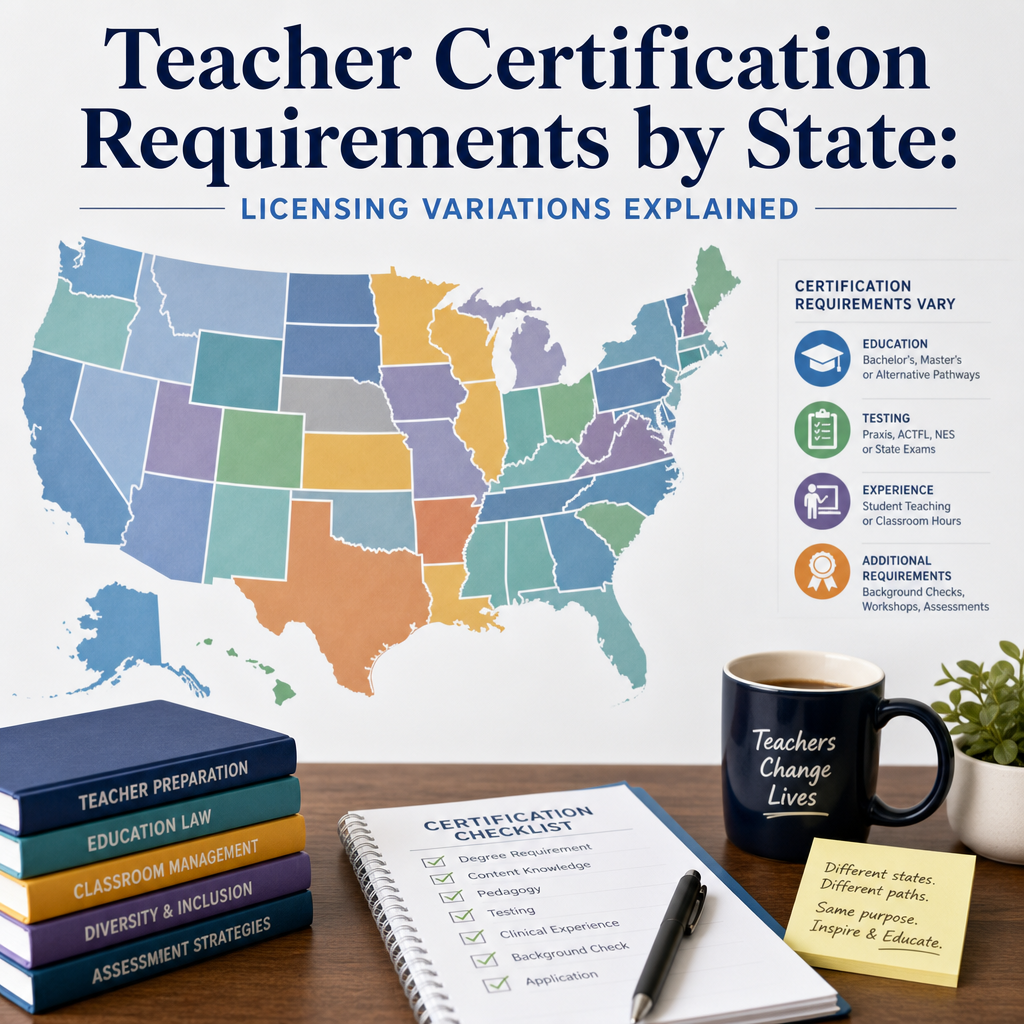
Teacher Certification Requirements by State: Licensing Variations Explained
Teacher certification requirements can look similar at first, but the details vary widely by state—from exams and coursework to student teaching and background checks. Understanding those differences early can help you choose the right program, avoid delays, and stay on track toward your teaching license.
By: Jennifer on July 25, 2026
If you’re planning to become a teacher, one of the first things you’ll discover is that teacher certification requirements are not the same everywhere. Each state sets its own licensing rules, and those differences can affect everything from the college coursework you need to the exams you must pass and the timeline for getting hired.
That can feel overwhelming at first, especially if you’re comparing programs or thinking about moving to another state later in your career. The good news is that the overall path is usually similar: earn a degree, complete teacher preparation, pass required tests, and apply for a license. The details, however, vary widely by state.
In this guide, we’ll break down how teacher certification requirements work, what changes from state to state, and how to make sure you’re on the right track.
What Teacher Certification Means
Teacher certification is the official approval that allows you to teach in public schools and, in many cases, some charter or specialized schools. Some states use the term certification, while others say licensure or credentialing. The meaning is usually the same: you must meet state standards before teaching in a classroom.
At a high level, most states want to confirm that you have:
A bachelor’s degree
Completed a state-approved teacher preparation program
Passed background checks
Met subject-area and basic skills testing requirements
Demonstrated classroom readiness through student teaching or an internship
Even though those requirements sound consistent, the specific rules differ. That’s why researching your state early is so important.
Why Teacher Certification Requirements Vary by State
Education policy in the United States is largely controlled at the state level. The federal government influences public education through funding and civil rights laws, but each state decides how teachers should be licensed.
This means one state may require a content knowledge exam and a performance assessment, while another may waive certain tests for candidates with strong academic records. A state might also offer multiple license types for elementary, secondary, special education, or career and technical education teachers.
Common reasons for variation
Different state education standards
Local teacher shortage concerns
Distinct approaches to preparation and testing
Separate rules for traditional and alternative certification routes
Reciprocity agreements with neighboring states
Because of that, a teacher who is fully licensed in one state may still need extra steps to teach somewhere else.
Core Teacher Certification Requirements Most States Share
Even with differences, most states follow a similar foundation for initial licensure.
1. Earn a bachelor’s degree
A bachelor’s degree is the standard minimum for most teaching licenses. In many states, the degree does not have to be in education, but you will still need to complete an approved teacher preparation program.
If you want to teach middle or high school, your degree often needs to align with your subject area. For example, a future math teacher may major in mathematics or math education.
2. Complete a teacher preparation program
Most states require teacher candidates to finish a state-approved preparation program. This typically includes:
Educational psychology
Classroom management
Instructional methods
Literacy development
Special education basics
Student teaching or supervised fieldwork
Preparation programs can be part of a college degree or an alternative certification route.
3. Pass required exams
States usually require some combination of exams to assess general knowledge, subject knowledge, and teaching skills. Common examples include:
Basic skills tests in reading, writing, and math
Subject-area exams
Pedagogy or professional teaching exams
Performance-based assessments
The exact test names and passing scores depend on the state.
4. Complete background checks
Almost every state requires a criminal background check, often including fingerprinting. This is a standard safety measure before you can work with children.
5. Apply for a teaching license
Once you’ve completed the requirements, you submit an application to the state education agency or licensing board. You may also need transcripts, test scores, recommendation letters, and a fee.
How Licensing Varies by State
This is where things get more complex. The broad path is similar, but the details can change a lot.
Different license names
One state might call it an “initial license,” while another uses “provisional,” “professional,” or “standard” license. The label matters because it often reflects how long the license lasts and what you must do to renew it.
For example:
Initial license: Typically the first license you receive
Provisional license: May require additional mentoring or coursework
Professional license: Usually granted after classroom experience and advanced requirements
Emergency or temporary license: Sometimes used to fill urgent staffing needs
Different testing rules
Some states still require a basic skills exam before licensure. Others have removed that requirement or allow waivers under certain conditions. Subject-area tests also vary.
A few states emphasize performance assessments, while others focus more on content knowledge. If you are moving between states, this can be one of the biggest obstacles.
Different grade-level endorsements
States often issue separate certifications for:
Early childhood
Elementary education
Middle school
Secondary education
Special education
English as a Second Language
Career and technical education
The age range covered by each endorsement can differ. For instance, one state may define elementary grades as K–5, while another uses K–6.
Different student teaching expectations
Most states require supervised classroom experience, but the number of hours or weeks may vary. Some programs require a full semester of student teaching. Others may use a yearlong residency model or allow earlier field experiences to count toward the total.
Different renewal requirements
Licenses are not permanent. States usually require continuing education, professional development hours, or additional coursework for renewal.
In one state, renewal may happen every five years with a set number of professional development units. In another, you might need graduate credits or proof of teaching experience.
Traditional vs. Alternative Certification
Not every teacher takes the same route into the profession.
Traditional certification
This route usually includes:
Earning a degree in education or a related field
Completing an approved teacher prep program
Student teaching
Passing state exams
Applying for licensure
This path is common for college students who know early that they want to teach.
Alternative certification
Alternative certification is designed for people who already have a bachelor’s degree and want to transition into teaching. These programs may be faster and more flexible, but they still include state-specific requirements.
Common features include:
Intensive summer training
Paid teaching internships
Mentorship from experienced teachers
Required testing during the first year
Temporary or probationary licenses while completing program requirements
Alternative routes vary widely by state. Some states have many options, while others limit eligibility to shortage subjects or high-need districts.
Teacher Certification Reciprocity: Can You Teach in Another State?
If you move, you may not need to start over completely, but reciprocity is not automatic.
Teacher certification reciprocity means one state may recognize part or all of another state’s license. However, most states still require you to meet their own standards before granting full licensure.
What reciprocity often involves
Verification of your current license
Proof of a clean background check
Transcript review
Test score review
Additional coursework or exams if requirements differ
Some states have more flexible reciprocity agreements, while others are more strict. A state may accept your teaching experience but still require you to pass a local content exam or complete a state law training module.
Practical example
Suppose you are licensed in Texas and want to move to New York. You may find that New York recognizes your experience, but still asks for specific tests, fingerprinting, and certification paperwork. Even if your classroom experience is strong, you may still need to satisfy state-specific rules.
That’s why teachers who may relocate should compare licensing rules before accepting a program or internship.
How to Research Your State’s Requirements
A state’s teacher licensing website should be your first stop. School district HR departments and university education programs can also help, but the official state agency is the best source for current rules.
What to look for
License types and grade spans
Degree and GPA requirements
Required exams and passing scores
Approved preparation programs
Student teaching or clinical experience rules
Background check instructions
Renewal requirements
Reciprocity policies
Questions to ask before enrolling in a program
Is the preparation program approved in my state?
What tests are required for my subject and grade level?
Does the state accept out-of-state licenses?
How long is my first license valid?
What do I need to renew it later?
Getting answers now can save time, money, and frustration later.
Factors That Can Affect Your Path
Teacher certification requirements are based on state rules, but your personal path also depends on your background.
Your subject area
High-demand subjects such as math, science, special education, and bilingual education may have alternative pathways or shortage-specific licenses in some states.
Your degree
If your degree is not in education, you may need extra coursework before you qualify.
Your teaching level
Elementary, secondary, and special education certifications often have different exams and methods courses.
Your location
Urban, rural, and high-need districts may participate in state programs that support emergency staffing or fast-track licensure.
Your employment status
Some states allow you to teach under a provisional license while finishing requirements, especially if a district sponsors your placement.
Common Mistakes to Avoid
Many future teachers run into delays because they assume licensing works the same everywhere.
Avoid these errors
Assuming an out-of-state license transfers automatically
Registering for the wrong certification exam
Enrolling in a non-approved preparation program
Ignoring renewal deadlines
Waiting until after graduation to research state rules
Overlooking endorsements for special education or ESL
A little planning goes a long way.
Tips for Staying Organized
If you’re navigating teacher certification requirements, a checklist can help.
Use this simple approach
Choose your intended state
Identify the correct grade level and subject endorsement
Review official licensure requirements
Confirm your degree plan matches those requirements
Schedule required exams early
Keep copies of transcripts, test scores, and program records
Track application deadlines and renewal dates
This kind of organization can prevent avoidable setbacks during job searches.
Frequently Asked Questions
1. Do all states require a teaching degree for certification?
Not always. Most states require at least a bachelor’s degree, but not necessarily a degree in education. Some states also offer alternative certification routes for people who already hold a degree in another field.
2. Can I teach in another state with my current license?
Sometimes, but not always immediately. Many states offer reciprocity or streamlined review, yet they may still require additional tests, paperwork, or coursework before granting full licensure.
3. What tests do I need for teacher certification?
That depends on the state and the subject you want to teach. Common tests include basic skills exams, subject-area exams, and professional teaching assessments. Check your state’s official licensing site for the exact requirements.
4. How long does a teaching license last?
License lengths vary by state. Some are valid for three years, others for five or more. Renewal usually requires professional development, teaching experience, or additional coursework.
5. What if I complete a teacher prep program in one state but want to work in another?
Your program may still be useful, but the new state will review whether it meets its own standards. You may need to submit transcripts, pass local exams, or complete a state-specific application before you can teach there.
Understanding teacher certification requirements is one of the most important first steps in building a teaching career. While the basic path is familiar across the country, the details change from state to state in ways that can affect your degree plan, exam schedule, student teaching experience, and long-term career mobility.
The smartest approach is to start with the official licensing rules in the state where you plan to teach, then compare them with any future states you may want to work in. Pay close attention to endorsements, testing requirements, renewal rules, and reciprocity policies, because those are often the areas where candidates get delayed.
Whether you are a college student, a career changer, or a licensed teacher planning a move, careful research can save time and money. With the right information, you can choose a certification path that fits your goals and keeps you moving toward the classroom with confidence.
Jennifer, M.Ed., holds a degree in Higher Education Administration, with
a focus on U.S. college financial aid, admissions policy, and student
support systems. She researches and writes about scholarships, federal
aid programs, and the college planning process to help students and
families make informed, well-supported decisions.