Why Undersea Internet Cables Are Critical Global Infrastructure
Undersea internet cables are the hidden highways that keep the world connected, carrying nearly all international data beneath the oceans. From video calls and cloud services to financial trades and emergency communications, they make modern life and the global economy possible.
By: Peter B on July 24, 2026
When people think about the internet, they often picture satellites, Wi-Fi routers, or powerful data centers. But the real backbone of global connectivity runs quietly across the ocean floor. Undersea internet cables carry the vast majority of international data, making them one of the most important pieces of modern infrastructure.
These fiber-optic lines connect countries, continents, businesses, governments, and billions of people. They support everything from cloud computing and video calls to financial transactions and emergency communications. Without undersea internet cables, the modern digital economy would slow dramatically.
What Undersea Internet Cables Actually Do
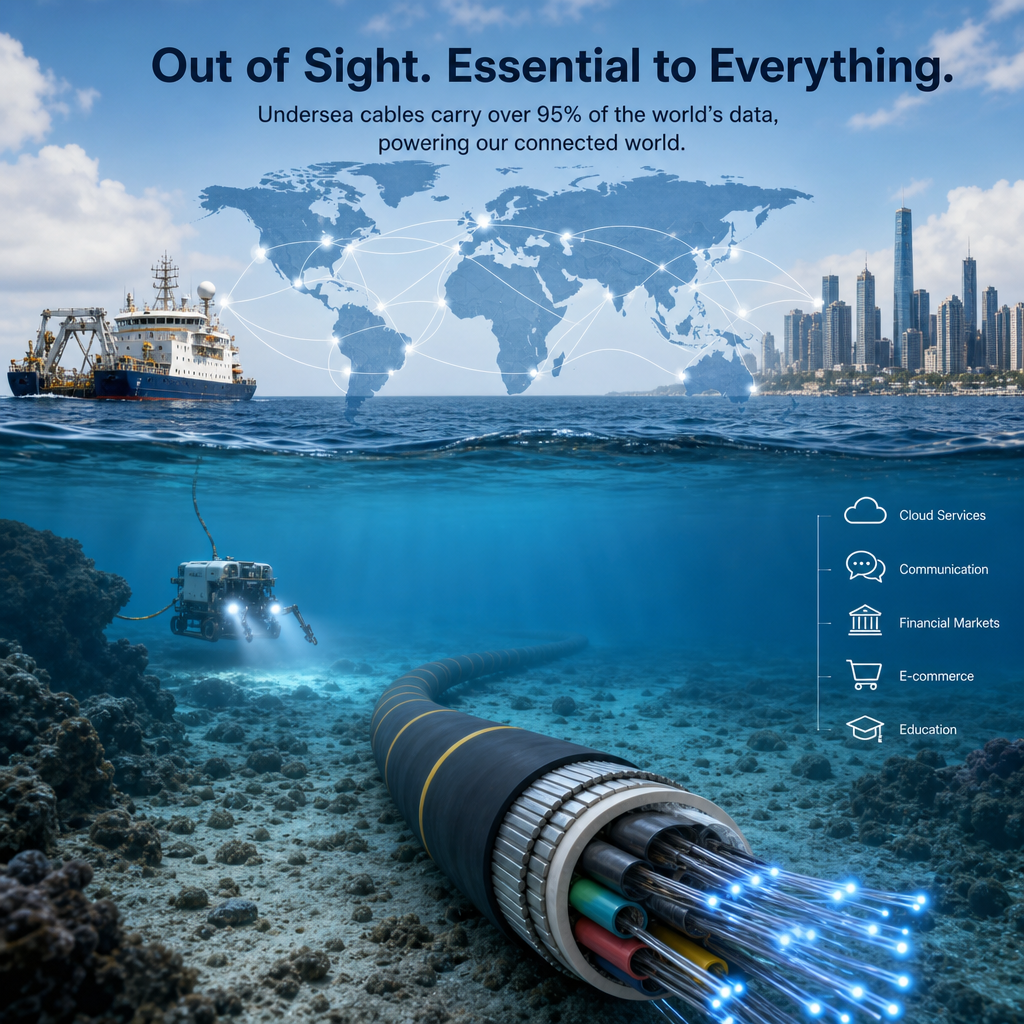
Undersea internet cables, also called submarine cables, are fiber-optic lines laid on the ocean floor to transmit data between land-based networks. They are not the giant thick cables many people imagine. Most are relatively small in diameter, built with layers of protection to survive harsh marine conditions.
They carry massive amounts of global internet traffic because fiber optics can send data as pulses of light at extremely high speed. Compared with satellites, cables offer:
Lower latency
Higher capacity
Greater reliability for large-scale traffic
Better support for real-time services like streaming, trading, and video conferencing
How They Fit Into the Internet
The internet is not one single network controlled from one place. It is a web of connected systems. Undersea internet cables form the international links between those systems. For example:
A message sent from New York to London often travels under the Atlantic Ocean.
A cloud backup from Singapore to California may cross the Pacific.
A financial trade between two global markets may depend on a cable route spanning multiple countries.
In other words, undersea internet cables make the internet global instead of local.
Why Undersea Internet Cables Are Critical Global Infrastructure
Undersea internet cables are critical global infrastructure because they support essential services that modern societies depend on every day. Their role goes far beyond streaming movies or sending emails.
They Power the Global Economy
International commerce depends on fast, stable digital communication. Businesses use undersea internet cables for:
Cross-border banking and payments
Supply chain coordination
Cloud software and remote work tools
E-commerce transactions
Digital advertising and analytics
When a company has offices in multiple countries, its teams often rely on cable-based connections for secure, fast access to shared systems. Even brief outages can disrupt operations and delay transactions.
They Support Essential Public Services
Governments and public institutions also rely on undersea internet cables. These cables help carry data for:
Diplomatic communications
Disaster response coordination
Public health systems
International research collaboration
Military and security networks
During emergencies, communication matters. A stable international network can help agencies share information quickly and coordinate response efforts across borders.
They Enable the Cloud and Modern Software
Much of today’s digital life depends on cloud services. If you store files in the cloud, use online collaboration tools, or stream content from platforms with global audiences, your data likely travels through undersea internet cables at some point.
This matters because cloud computing works best when users can reach data centers quickly and reliably. Low-latency cable routes help make:
Video meetings smoother
Online apps more responsive
Multiplayer gaming more stable
Data synchronization faster
They Carry More Traffic Than Most People Realize
Many people assume satellites handle most international data. In reality, undersea internet cables carry the overwhelming majority of cross-border internet traffic. Satellites are useful in remote areas and for specialized applications, but they cannot match the capacity and speed of fiber-optic submarine cables.
That’s why undersea internet cables are often described as the hidden highways of the digital world.
How Undersea Internet Cables Are Built
Building a submarine cable is a major engineering project. It requires careful planning, environmental review, route surveys, and international coordination.
The Cable Structure
A modern undersea cable typically includes:
Optical fibers at the core
Protective layers of steel wire
Waterproof insulation
Copper or aluminum components for powering repeaters
Outer protective coatings
The exact design depends on water depth, seabed conditions, and the risk of damage from anchors, fishing gear, or underwater movement.
Repeaters Keep the Signal Alive
Light signals weaken over long distances. To solve this, cables use repeaters, which are devices placed along the route to amplify the signal. These repeaters sit inside sealed housings and can operate for many years on the seafloor.
Landing Stations Connect Ocean Routes to Land Networks
A cable does not connect directly to the public internet by itself. It lands at special facilities called cable landing stations. These sites connect the submarine line to terrestrial fiber networks, data centers, and internet exchange points.
Because landing stations are so important, they are often treated as high-security infrastructure.
Why Cable Routes Matter
The path of an undersea internet cable is not random. Engineers and planners choose routes based on a mix of geography, safety, cost, and political considerations.
Distance and Latency
A shorter route usually means lower latency, which is valuable for financial trading, gaming, and real-time communications. But the shortest route is not always the best if it crosses dangerous terrain or politically unstable areas.
Geopolitics and Redundancy
Countries and companies prefer multiple cable routes so that traffic can shift if one cable is damaged. This redundancy improves resilience. It also gives network operators more flexibility if a route becomes congested or if political tensions affect access.
Environmental and Seafloor Conditions
Planners study:
Deep ocean trenches
Underwater mountains
Earthquake zones
Fishing areas
Shipping lanes
These factors affect both safety and installation costs. A cable route must be practical for decades, not just weeks.
The Risks Facing Undersea Internet Cables
Even though they are built to last, undersea internet cables face real risks. That is one reason they are considered critical global infrastructure.
Physical Damage
The most common causes of cable damage include:
Fishing gear
Anchors from ships
Seabed shifts
Natural wear over time
Rare geological events such as undersea landslides or earthquakes
In shallow waters, human activity is often the biggest threat. In deeper waters, natural hazards become more relevant.
Cyber and Security Concerns
Undersea internet cables are physical systems, but the networks they support are part of the wider digital security landscape. Concerns include:
Unauthorized access to landing stations
Sabotage or surveillance risks
Disruption of international communications
Dependence on a small number of routes
This is why governments and operators invest in monitoring, access controls, and backup routes.
Concentration of Ownership
A relatively small number of companies and consortia own and operate many submarine cables. While this is normal for such expensive infrastructure, it also means outages or policy changes can have wide effects. Diversity in ownership and routing helps reduce risk.
What Happens When a Cable Fails?
A cable failure does not usually “break the internet,” but it can slow or reroute traffic in noticeable ways.
Network Operators Reroute Traffic
Internet service providers and large network operators build redundancy into their systems. If one undersea internet cable fails, traffic can often be shifted to other routes. This is one reason users may not notice an outage immediately.
Performance Can Still Decline
Even when traffic is rerouted, the remaining paths may become crowded. That can lead to:
Higher latency
Slower downloads
Reduced video quality
Delays in financial or business systems
In regions with few alternative routes, the impact can be much more serious.
Repairs Take Time
Repairing a submarine cable is a specialized process. A cable repair ship must locate the break, recover the damaged section, splice in a replacement, and lower the repaired line back to the seabed. Weather, depth, and permitting can all affect the timeline.
Why the World Needs More Cable Resilience
As global internet demand grows, resilience becomes more important. More people are online, more businesses depend on cloud services, and more critical systems are connected across borders.
Building Redundancy Into the Network
A resilient global network often includes:
Multiple cable landing points
Diverse routes between regions
Backup links for emergencies
Stronger protections in shallow coastal waters
Better coordination between governments and private operators
This kind of redundancy reduces the chance that one failure will cause major disruption.
Planning for Future Demand
New technologies continue to increase data traffic, including:
Video streaming in higher resolution
Artificial intelligence workloads
Remote work and collaboration tools
Internet of Things devices
International research and education networks
Undersea internet cables remain the most practical way to move this much data across oceans at scale.
The Hidden Importance of a Quiet Industry
Submarine cable projects rarely make headlines unless something goes wrong. Yet the industry plays a foundational role in how the world communicates, trades, learns, and collaborates.
Why It Often Goes Unnoticed
Undersea cables are hidden beneath the ocean, so most people never see them. Their work is invisible when everything functions normally. But invisibility does not mean insignificance.
A power grid is only noticed when the lights go out. The same is true of undersea internet cables. Their value becomes obvious when a route fails, slows, or is unavailable.
Why Businesses and Governments Pay Attention
For telecom carriers, cloud providers, and national governments, cable resilience is a strategic issue. Connectivity affects:
Competitiveness
National security
Economic continuity
Emergency response
Innovation
That is why undersea internet cables are more than a technical asset. They are part of the core infrastructure that keeps the modern world functioning.
How Businesses Can Think About Cable Dependency
Most companies do not manage submarine cables directly, but they still depend on them. Understanding that dependency can improve planning and risk management.
Practical Steps for Organizations
Businesses with international operations should consider:
Mapping critical network routes
Know where your traffic goes and which regions depend on which cables.
Building redundancy
Use multiple cloud regions, carriers, or internet paths when possible.
Testing failover plans
Make sure critical systems can continue if one route becomes unavailable.
Reviewing latency-sensitive services
Applications like trading systems, customer support tools, and live collaboration need special attention.
Coordinating with providers
Ask telecom and cloud vendors about resilience, landing station diversity, and outage response procedures.
These steps can reduce business disruption during a cable incident.
Frequently Asked Questions
1. What are undersea internet cables used for?
Undersea internet cables carry most international internet traffic between countries and continents. They support cloud computing, video calls, financial transactions, streaming, government communications, and many other digital services.
2. Are undersea internet cables more important than satellites?
For most international data, yes. Satellites are helpful for remote locations and certain specialized uses, but submarine fiber-optic cables provide much higher capacity, lower latency, and better reliability for large-scale traffic.
3. How long do undersea internet cables last?
The lifespan varies by cable type, location, and maintenance, but many submarine cables are designed to operate for years and can remain functional for decades with proper care and repairs. Damage, technology upgrades, and demand changes can also lead to replacement before the physical cable fully wears out.
4. What happens if an undersea internet cable breaks?
Traffic is usually rerouted through other cables if available. Users may notice slower speeds or higher latency, especially in regions with limited backup routes. Repair ships and specialized crews then work to locate and fix the damaged section.
5. Can countries or companies protect undersea internet cables?
Yes. Protection strategies include route diversity, landing station security, monitoring systems, coordination with shipping and fishing industries, and strong backup network planning. No system is risk-free, but redundancy and planning greatly improve resilience.
Undersea internet cables are one of the most important forms of infrastructure in the modern world, even though most people rarely see them. They connect continents, power international commerce, support cloud services, and make global communication possible at the speed businesses and governments now expect. Their value lies not only in capacity and speed, but also in resilience, redundancy, and reach.
As internet demand continues to grow, the importance of these cables will only increase. That makes investment in route diversity, landing station security, repair readiness, and long-term planning more than a technical concern—it is an economic and strategic necessity. Whether you run a business, work in policy, or simply rely on digital tools every day, understanding undersea internet cables helps explain how the global internet really works.
The next time a video call connects instantly across oceans or a cross-border payment clears in seconds, remember the hidden network beneath the waves. It is one of the quiet systems holding the digital world together.
Peter B holds a degree in Journalism and has 5 years
of experience covering U.S. economic policy, labor markets, and
financial news. He writes data-driven news content on topics
like inflation, interest rates, and employment trends.