How the World Bank Measures Poverty Across Countries
Global poverty measurement is more complex than comparing incomes because prices, currencies, and living costs vary widely from country to country. The World Bank uses standardized poverty lines and purchasing power adjustments to create a clearer picture of who is living in poverty worldwide.
By: Peter B on July 24, 2026
Poverty is one of the most important challenges in global development, but comparing it across countries is not as simple as looking at income in local currency. The World Bank measures poverty across countries using standardized methods that make it possible to compare living conditions in very different economies. That process helps governments, researchers, and international organizations track progress and target support where it is needed most.
Understanding how the World Bank measures poverty across countries also helps readers interpret headlines, poverty reports, and development statistics more accurately. A country may have a lower poverty rate by one measure and a higher one by another, depending on the line used, the data available, and the cost of living. In this article, we’ll break down how the World Bank defines poverty, why different poverty lines exist, and what those measurements can and cannot tell us.
Why Measuring Poverty Across Countries Is So Difficult
Poverty is not just about money. It also includes access to food, housing, healthcare, education, safety, and basic services. Still, income remains a practical starting point because it can be measured more consistently than many other dimensions of well-being.
When comparing poverty across countries, several challenges appear:
Currencies differ, so incomes must be converted into a common standard.
Prices differ, meaning the same amount of money buys different things in different places.
Household sizes vary, so one person’s income does not tell the whole story.
Data quality differs from one country to another.
Living costs change over time, so comparisons need regular updates.
Because of these issues, the World Bank uses carefully designed poverty lines and purchasing power parity adjustments to make cross-country comparisons more meaningful.
How the World Bank Measures Poverty Across Countries
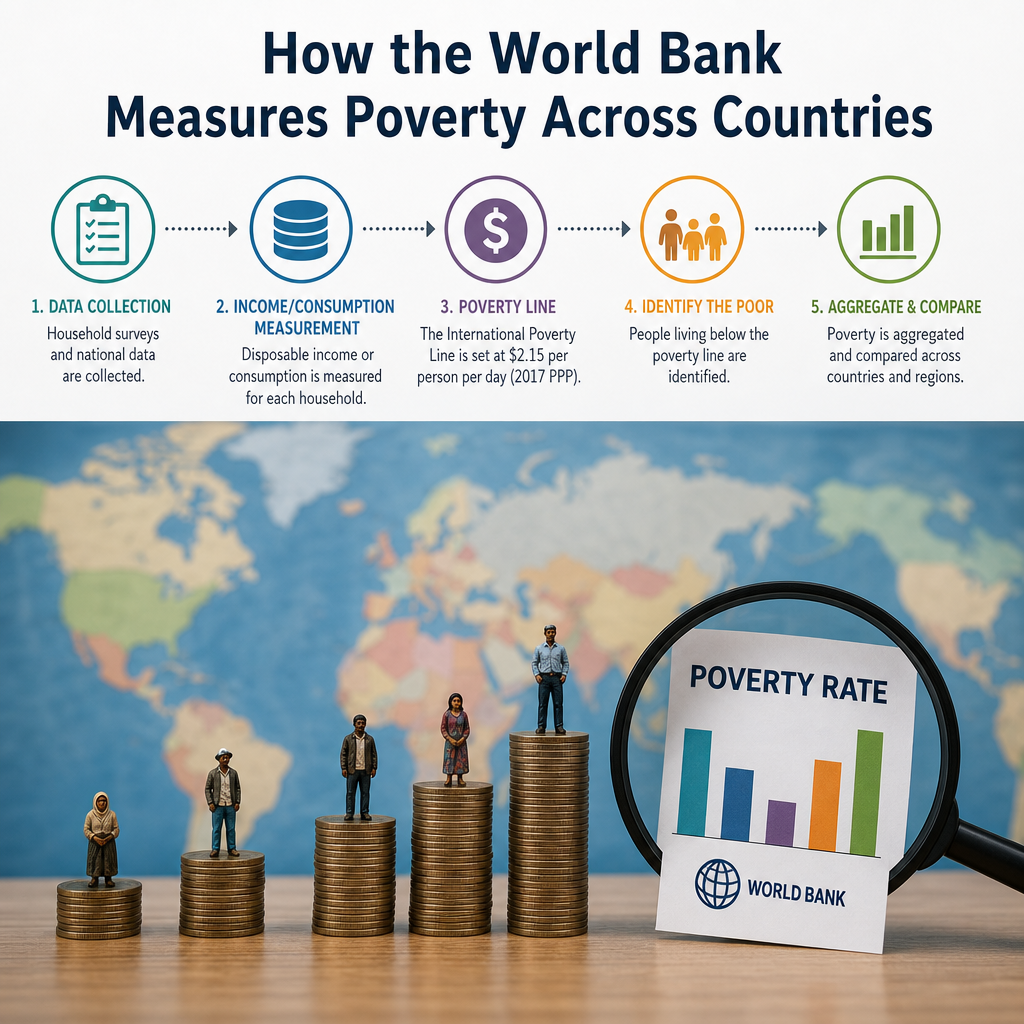
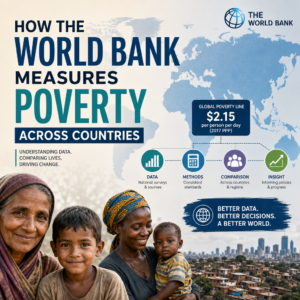
The World Bank measures poverty across countries by using international poverty lines that represent minimum thresholds for basic needs, adjusted for differences in price levels between countries. These lines are expressed in purchasing power parity (PPP) dollars, not local currency.
In simple terms, PPP helps answer this question: How much money does a person need in one country to buy the same basic goods and services that a person in another country could buy with a given amount?
The World Bank’s global poverty estimates typically use three international poverty lines:
$2.15 per day for extreme poverty
$3.65 per day for lower-middle-income countries
$6.85 per day for upper-middle-income countries
These are not arbitrary numbers. They are based on national poverty lines from a group of countries and updated periodically to reflect changes in global prices and data methods.
The role of purchasing power parity
PPP is essential because exchange rates alone do not reflect local costs. For example, converting a salary into U.S. dollars using market exchange rates can make a low-income country look much poorer or richer than it really is in terms of local buying power.
PPP adjustments aim to make income comparisons fairer by accounting for what people can actually purchase where they live.
Why the poverty lines differ
The World Bank uses more than one line because a single global threshold does not capture all income contexts. A family living just above the extreme poverty line may still struggle to afford adequate food, shelter, or transportation. The higher thresholds help show broader patterns of vulnerability.
The Main Poverty Lines Used by the World Bank
The World Bank’s poverty measurement framework is often described in tiers.
1. The international extreme poverty line
The $2.15 per day line is used to estimate extreme poverty. It aims to capture the minimum resources needed to meet basic survival needs in the world’s poorest countries.
This line is especially useful for:
Tracking progress against severe deprivation
Comparing the poorest populations across countries
Monitoring global development goals
2. The lower-middle-income poverty line
The $3.65 per day line is more appropriate for lower-middle-income countries, where the cost of a basic life package is often higher than in the poorest economies. People above the extreme poverty line may still be unable to meet essential needs reliably.
3. The upper-middle-income poverty line
The $6.85 per day line is used to evaluate poverty in upper-middle-income countries. At this level, poverty often includes more than survival needs. It may also involve exclusion from normal social participation, transport, education opportunities, or stable housing.
National poverty lines
The World Bank also works with national poverty lines, which governments set based on local definitions of minimum living standards. These are often better for understanding poverty within a specific country because they reflect national conditions, social expectations, and policy goals.
However, national poverty lines are not always directly comparable across countries, which is why the World Bank also uses international lines.
Where the Data Comes From
The World Bank does not simply estimate poverty from a single global model. It draws on many country-level household surveys and statistical systems.
Household surveys
The primary source is usually a household income or consumption survey. These surveys collect detailed information on how much households earn or spend, which helps estimate whether they fall below a given poverty line.
Consumption data is often preferred in lower-income settings because income can be irregular or difficult to measure. For example, a farmer may have seasonal income but still consume food from their own production throughout the year.
Price data and PPP updates
The World Bank uses global price comparison data, including information from the International Comparison Program (ICP), to convert local incomes into PPP dollars. This ensures that poverty estimates reflect real purchasing power rather than nominal exchange rates.
Population estimates
Poverty rates are combined with population data to estimate the number of people living in poverty. That means a country with a lower poverty rate can still have a very large number of poor people if its population is large.
What the World Bank Poverty Measure Can Tell Us
The World Bank’s poverty measures are valuable because they provide a common framework for comparing countries and tracking change over time.
They can help answer questions like:
How many people live in extreme poverty globally?
Which regions have seen the biggest improvements?
Are poverty reduction efforts reaching rural households?
How do poverty patterns differ between countries at similar income levels?
These measures are especially helpful for policy planning. Governments and development agencies can use them to identify where aid, social protection, job creation, or education investments may have the biggest impact.
What the Measure Cannot Tell Us
Even though the World Bank’s approach is widely used, it has important limits. A poverty line is useful, but it cannot capture the full complexity of human hardship.
It does not measure inequality
Two countries can have the same poverty rate but very different income distributions. One may be far more unequal than the other. Poverty measurement alone does not show that difference.
It does not capture all dimensions of poverty
Income poverty does not fully reflect:
Access to clean water
School quality
Healthcare access
Safe housing
Discrimination
Political instability
Environmental risk
That is why many analysts pair income poverty data with multidimensional poverty measures.
It may miss short-term hardship
Some households move in and out of poverty over time. A survey taken during a good month may miss families that struggle during lean seasons, after job loss, or during a crisis.
It depends on survey quality
If a country’s data is outdated, incomplete, or inconsistent, the poverty estimate may be less reliable. This is one reason official poverty figures are often revised when better data becomes available.
A Simple Example of Cross-Country Poverty Measurement
Imagine two households, one in Country A and one in Country B, each earning the equivalent of $4 per day.
At first glance, they seem identical. But if Country A has lower prices for food, rent, and transport than Country B, that same income may stretch much further in Country A. The World Bank’s PPP-based poverty line helps adjust for this difference.
Now imagine a country where many households earn slightly above $2.15 per day but below $6.85. That country may have relatively low extreme poverty but still face widespread economic insecurity. This is why different thresholds matter: they show different layers of deprivation.
Why These Poverty Measures Matter for Policy
Poverty measurements are not just academic. They shape real-world decisions.
Governments and development organizations use them to:
Target cash transfer programs
Prioritize rural development
Allocate education and health spending
Monitor social safety nets
Evaluate whether economic growth is reducing hardship
A well-designed poverty measure helps identify who is being left behind. It also helps assess whether growth is inclusive or concentrated among better-off groups.
The Shift Toward Broader Poverty Analysis
In recent years, global development experts have increasingly emphasized that income alone is not enough. That is why poverty analysis often now includes:
Multidimensional poverty indices
Food insecurity measures
Human development indicators
Access-to-services metrics
These tools do not replace income poverty lines, but they add context. Together, they paint a more complete picture of well-being.
Practical Tips for Reading World Bank Poverty Data
If you are using World Bank poverty data in research, journalism, or policy work, keep these tips in mind:
Check which poverty line is being used.
Extreme poverty and broader poverty are not the same thing.
Look at PPP, not just exchange rates.
PPP gives a more realistic picture of purchasing power.
Compare like with like.
A lower-middle-income country and an upper-middle-income country should not always be judged using the same line.
Pay attention to the survey year.
Poverty data can be several years old depending on country reporting cycles.
Use poverty rates and poverty counts together.
Rates show prevalence; counts show scale.
Frequently Asked Questions
1. What is the World Bank’s main poverty line?
The World Bank’s most widely cited global poverty line for extreme poverty is $2.15 per day in PPP terms. It is used to estimate how many people lack enough resources to cover basic needs.
2. Why does the World Bank use PPP instead of exchange rates?
PPP is used because exchange rates do not reflect the actual cost of goods and services within a country. PPP better measures how much people can buy with their income in local markets.
3. Does the World Bank use only one poverty line?
No. The World Bank uses multiple poverty lines, including $2.15, $3.65, and $6.85 per day, depending on a country’s income level and the type of comparison being made.
4. Are World Bank poverty estimates the same as national poverty rates?
Not always. National poverty lines are set by individual governments and reflect local standards. World Bank poverty estimates use international lines to make cross-country comparisons possible.
5. Can poverty be measured without income?
Yes. Many experts also use multidimensional poverty measures that look at education, health, housing, sanitation, and other non-income factors. These measures provide a broader picture of deprivation.
The way the World Bank measures poverty across countries is designed to solve a difficult problem: how to compare living standards fairly in places with different prices, currencies, and economic conditions. By using international poverty lines, purchasing power parity, and household survey data, the World Bank creates a common framework for understanding extreme poverty and broader economic vulnerability.
Still, no single measure can capture the full reality of poverty. Income thresholds are useful for comparison, but they work best when paired with national poverty lines and multidimensional indicators. Together, these tools help governments, researchers, and readers see both the scale of the problem and the lived experience behind the numbers.
If you want to understand global development more clearly, learning how poverty is measured is a strong place to start. It helps you read data more critically, follow policy debates more accurately, and appreciate why reducing poverty requires more than economic growth alone. The next step is to look beyond the headline figures and examine how poverty affects people’s daily lives, opportunities, and long-term well-being.
Peter B
Peter B holds a degree in Journalism and has 5 years
of experience covering U.S. economic policy, labor markets, and
financial news. He writes data-driven news content on topics
like inflation, interest rates, and employment trends.