The ocean climate plays a powerful role in shaping temperatures, weather, and even long-term climate patterns around the world. By absorbing heat and moving it across the planet, the oceans help keep Earth livable and constantly changing.
By: Peter B on July 24, 2026
The oceans shape Earth’s climate in ways that are easy to overlook but impossible to ignore. They absorb heat, move energy around the planet, store carbon, and influence weather patterns on every continent. Without the oceans, Earth would be a much hotter, drier, and less stable place.
For anyone trying to understand climate change, seasonal weather, or long-term environmental shifts, the oceans are not just part of the story—they are central to it. In this article, we’ll explore how the oceans shape Earth’s climate, why they matter so much, and what changes in the oceans mean for the future.
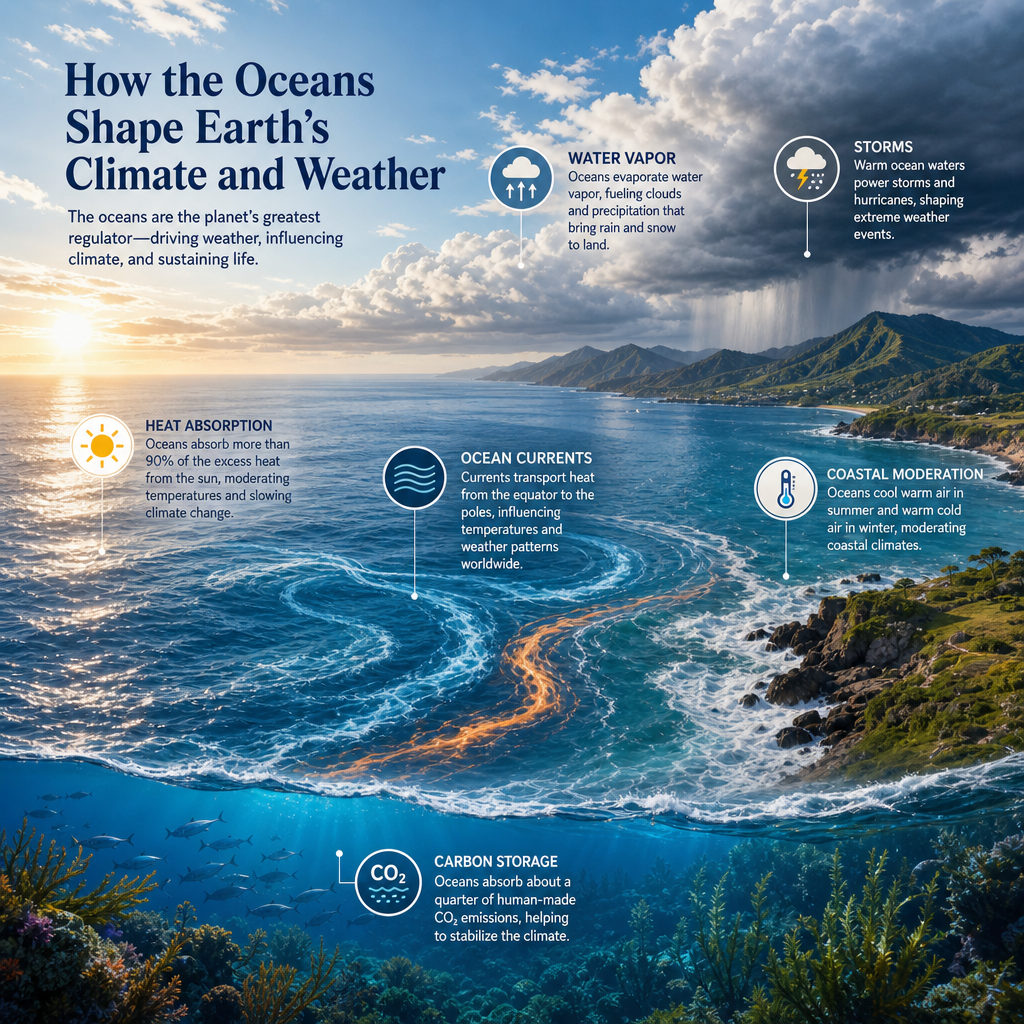
The oceans shape Earth’s climate by acting as a giant heat and carbon reservoir. They cover more than two-thirds of the planet’s surface, so they have enormous influence over atmospheric conditions. Water also responds to heat more slowly than land, which helps the oceans moderate temperature swings across the globe.
Oceans absorb and store heat
One of the most important ways the oceans shape Earth’s climate is by absorbing solar energy. The surface of the ocean takes in a large share of the heat that reaches Earth. Unlike land, which heats and cools quickly, water distributes that heat more gradually.
This matters because:
Coastal regions tend to have milder temperatures than inland areas.
The oceans reduce extreme temperature changes between day and night.
Stored heat can be released back into the atmosphere later, affecting seasons and storms.
In practical terms, this is why places near the ocean often have cooler summers and warmer winters than inland locations at similar latitudes.
Ocean currents move heat around the planet
Ocean currents act like a global conveyor belt. They transport warm water from the tropics toward the poles and bring colder water back toward the equator. This circulation helps regulate Earth’s climate and creates regional climate patterns.
A few well-known examples include:
The Gulf Stream, which carries warm water across the Atlantic and helps keep parts of Western Europe relatively mild.
The California Current, which brings cooler water down the western coast of North America.
The Antarctic Circumpolar Current, which helps isolate Antarctica’s climate from warmer waters.
These currents do more than move water. They move heat, nutrients, and carbon, all of which affect weather, marine ecosystems, and long-term climate stability.
The oceans drive weather patterns
The oceans shape Earth’s climate by influencing the atmosphere above them. Warm ocean surfaces add moisture and heat to the air, which can fuel storms and rainfall. Cooler ocean areas can suppress cloud formation and reduce precipitation.
This ocean-atmosphere relationship is especially important in tropical regions. Sea surface temperatures help determine:
Where hurricanes form
How intense storms may become
How much rain falls in nearby regions
Whether seasonal weather patterns shift
For example, warm waters in the Atlantic can support stronger tropical storms, while changes in Pacific temperatures can influence rainfall, drought, and flooding far beyond the ocean itself.
The Role of the Oceans in Carbon Storage
The oceans are also one of Earth’s biggest carbon sinks. They absorb carbon dioxide from the atmosphere through physical and biological processes. This slows the buildup of greenhouse gases in the air, helping to moderate global warming.
How the ocean takes in carbon
Carbon enters the ocean in several ways:
Direct gas exchange at the ocean surface.
Photosynthesis by marine organisms, such as phytoplankton.
Movement of water masses that carry dissolved carbon into deeper layers.
Phytoplankton play a particularly important role. These tiny organisms use sunlight and carbon dioxide to grow, and they form the base of the marine food web. When they die or are eaten, some of that carbon sinks deeper into the ocean.
Why ocean carbon storage matters
Without the oceans absorbing so much carbon, atmospheric warming would likely be much more severe. But this buffering effect has limits. As ocean temperatures rise, the water becomes less efficient at absorbing carbon dioxide. That means warming can reduce the ocean’s ability to help stabilize the climate.
A second concern is ocean acidification. When the ocean absorbs carbon dioxide, it becomes more acidic. That can make it harder for shell-forming organisms and coral reefs to survive, which can disrupt marine ecosystems and reduce biodiversity.
How the Oceans Influence Rainfall and Drought
The oceans shape Earth’s climate by controlling where water evaporates and where that moisture later falls as rain or snow. Since much of the atmosphere’s moisture comes from ocean evaporation, sea surface temperatures play a major role in hydrology.
Evaporation fuels the water cycle
Warm ocean water evaporates into the atmosphere. As that vapor rises, cools, and condenses, it can form clouds and precipitation. Areas with warm, moist ocean air often experience heavier rainfall.
This is why ocean conditions can affect:
Monsoon systems
Coastal storms
Regional wet and dry seasons
Snowfall patterns in some areas
Climate patterns like El Niño and La Niña
Two of the clearest examples of how the oceans shape Earth’s climate are El Niño and La Niña. These are opposite phases of a recurring climate pattern in the tropical Pacific Ocean.
El Niño usually involves warmer-than-average ocean waters in the central and eastern Pacific.
La Niña usually involves cooler-than-average waters in the same region.
These shifts can influence weather across the globe, affecting agriculture, wildfire risk, storm tracks, and rainfall. In some years, El Niño brings wetter conditions to certain areas and drought to others; La Niña often produces the opposite effects.
Even though these events happen in the ocean, their impacts are felt on land by farmers, city planners, emergency responders, and everyday households.
Oceans and Climate Regulation Over Time
The oceans shape Earth’s climate not only day to day, but also over decades and centuries. Because they store so much heat, they help smooth out short-term fluctuations in climate. This makes Earth’s climate more stable than it would be otherwise.
Oceans delay some effects of warming
When greenhouse gases trap more heat in the atmosphere, the oceans absorb much of that excess energy. This slows the rate at which the surface warms, but it also means the oceans are taking on a growing amount of heat.
That stored heat can later contribute to:
Rising sea levels through thermal expansion
Warmer storm systems
Marine heatwaves
Coral bleaching events
In other words, the oceans don’t just react to climate change; they also help shape how climate change unfolds.
Sea level rise is part of the climate story
As ocean temperatures rise, seawater expands. At the same time, melting glaciers and ice sheets add more water to the oceans. Both processes contribute to sea level rise, which affects coastal climate and weather-related risks.
Sea level rise can increase the impact of:
Storm surge
Coastal flooding
Saltwater intrusion into freshwater systems
Erosion along shorelines
This creates a feedback loop in which changes in the ocean affect land-based communities, infrastructure, and ecosystems.
Marine Life and Climate Feedbacks
Marine ecosystems also play a part in how the oceans shape Earth’s climate. Coral reefs, kelp forests, mangroves, seagrass beds, and plankton communities all interact with carbon, oxygen, and heat.
Healthy ecosystems support climate balance
Some marine habitats help store carbon and protect coastlines. For example:
Mangroves trap carbon in their soils and reduce storm damage.
Seagrass beds store carbon and provide habitat for marine life.
Phytoplankton help regulate carbon exchange between the ocean and atmosphere.
These ecosystems are sometimes called “blue carbon” systems because of their ability to store carbon in coastal and marine environments.
Warming oceans disrupt ecosystems
As oceans become warmer and more acidic, marine ecosystems can be stressed or damaged. Coral bleaching is one visible result of rising ocean temperatures. When corals lose the algae they depend on, reef systems become less resilient and less able to support marine biodiversity.
These changes can also affect climate in indirect ways by altering carbon cycling, food webs, and the ocean’s ability to absorb heat and gases.
Why the Oceans Matter for Forecasting and Climate Science
Scientists study the oceans to improve weather forecasts and climate models. Because the oceans shape Earth’s climate on so many levels, understanding them is essential for predicting future conditions.
Ocean data improves predictions
Researchers use tools like satellites, buoys, ships, and underwater sensors to measure:
Sea surface temperature
Ocean salinity
Current speed and direction
Heat content
Carbon levels
This information helps meteorologists and climate scientists anticipate storm development, seasonal shifts, and longer-term climate trends.
Climate models depend on ocean behavior
Modern climate models must account for the oceans because they influence heat transfer, cloud formation, rainfall, and carbon storage. If a model gets ocean behavior wrong, it may also get climate projections wrong.
That is why ocean observation is a major part of climate research. Better measurements lead to better forecasts, which can help communities prepare for extreme weather, drought, flooding, and sea level rise.
What This Means for the Future
The oceans shape Earth’s climate today, but their role is becoming even more important as the planet warms. The more heat and carbon the oceans absorb, the more stress they face. That can affect marine life, global weather, and coastal communities.
Key challenges ahead
Some of the biggest concerns include:
Warmer ocean temperatures
More intense marine heatwaves
Stronger or more unpredictable storms
Sea level rise
Ocean acidification
Ecosystem disruption
These issues are interconnected. A change in ocean temperature can alter currents, which can affect rainfall, which can influence agriculture and water supplies. That is why ocean health is a climate issue, not just an environmental one.
What people can do
While individual actions won’t solve ocean-related climate problems alone, they do matter as part of broader solutions. Support for renewable energy, coastal resilience, sustainable fishing, and ocean conservation all helps reduce pressure on marine systems.
You can also stay informed by following trusted scientific sources, learning about local climate risks, and supporting policies that reduce greenhouse gas emissions.
Frequently Asked Questions
1. Why are the oceans so important to Earth’s climate?
The oceans store and move heat, absorb carbon dioxide, and influence rainfall and storms. Because they cover so much of Earth’s surface, they strongly affect temperature patterns and weather around the world.
2. How do ocean currents affect climate?
Ocean currents transport warm and cold water across the planet. This redistributes heat and can make some regions warmer or cooler than they would be otherwise. Currents also influence storm tracks and precipitation patterns.
3. What is the connection between the oceans and climate change?
The oceans absorb much of the excess heat and carbon dioxide caused by human activity. This helps slow warming, but it also leads to ocean warming, sea level rise, and acidification. In that sense, the oceans both buffer and reveal climate change.
4. How do El Niño and La Niña influence weather?
El Niño and La Niña are Pacific Ocean climate patterns that shift sea surface temperatures. These changes can alter rainfall, drought, flooding, storms, and temperature patterns in many parts of the world.
5. Can healthy oceans help fight climate change?
Yes. Healthy oceans and coastal ecosystems like mangroves, seagrass beds, and phytoplankton play a role in carbon storage and climate regulation. Protecting these systems can support climate resilience and reduce environmental damage.
The oceans shape Earth’s climate in ways that are both immediate and long-lasting. They absorb heat, move it across the globe, store carbon, and influence rainfall, storms, and sea level. They also help stabilize the planet’s climate system, even as they face increasing pressure from warming, acidification, and ecosystem loss.
Understanding the oceans is essential for understanding climate itself. Whether you are interested in weather patterns, coastal impacts, marine life, or long-term environmental change, the ocean is a key part of the answer. Its currents, temperatures, and chemistry affect life far beyond the shoreline.
As climate science continues to evolve, one message remains clear: protecting the oceans is not separate from protecting the climate. The two are deeply connected. Learning more about that connection is one of the best ways to make sense of the world we live in and prepare for the changes ahead.
Peter B holds a degree in Journalism and has 5 years
of experience covering U.S. economic policy, labor markets, and
financial news. He writes data-driven news content on topics
like inflation, interest rates, and employment trends.