Why Global Migration Rises During Conflicts and Climate Disasters
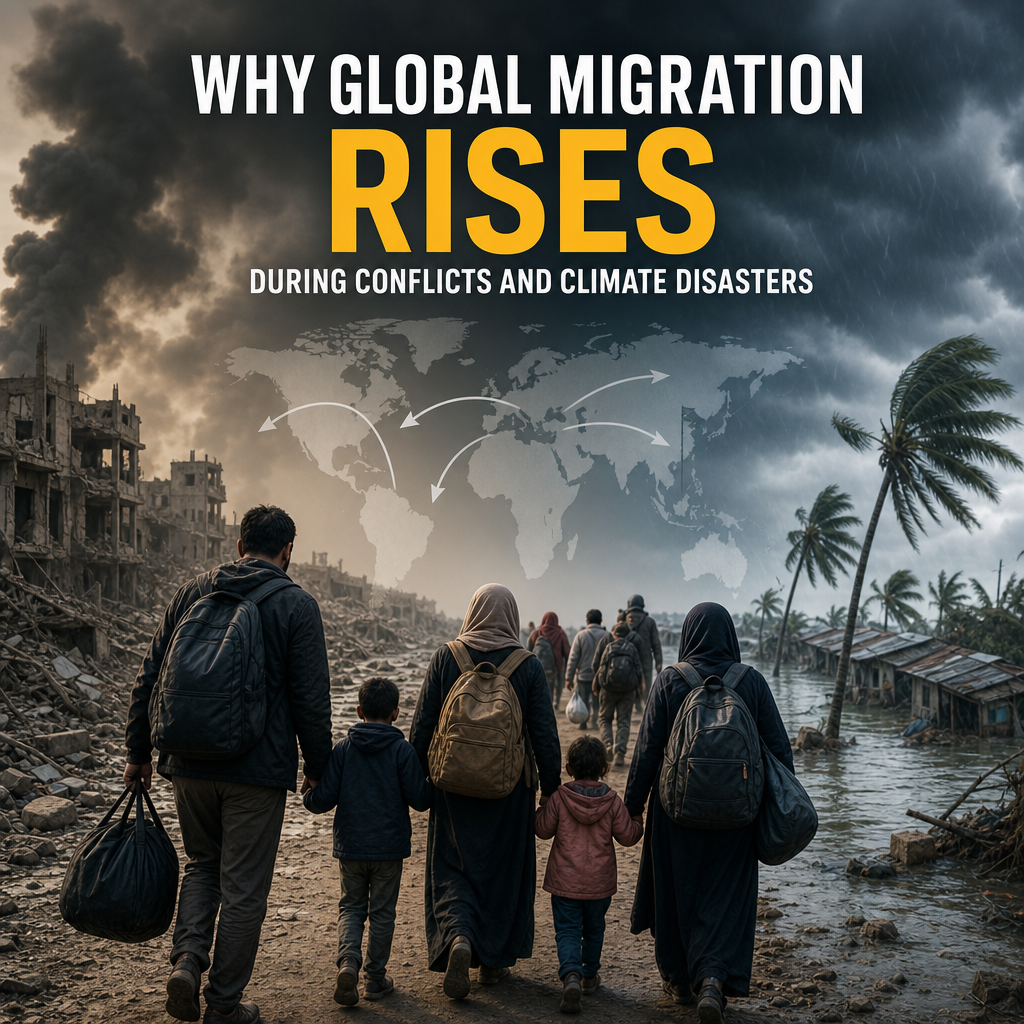
Global migration often surges when conflict or climate disasters make daily life unsafe, unstable, or impossible to predict. From war zones to flooded coastlines, people are forced to move to protect their families, livelihoods, and future.
By: Peter B on July 24, 2026
Global migration rises during conflicts and climate disasters because people move when staying put becomes too dangerous, too unstable, or too uncertain. War, political violence, drought, floods, hurricanes, and rising seas can all disrupt daily life so severely that families have little choice but to leave home. In many cases, migration is not a long-planned decision. It is a response to urgent survival needs.
Understanding why global migration increases during these crises matters for policymakers, aid organizations, journalists, and everyday readers. It helps explain why refugee flows, internal displacement, and cross-border movement often spike after major emergencies. It also shows how conflict and climate stress can overlap, creating compounding pressures that force more people to move.
What Drives Global Migration During Crises?
Migration during crises usually comes from a mix of “push factors” that force people out and “pull factors” that attract them somewhere safer. When war destroys neighborhoods or a flood wipes out farmland, people may leave to protect their safety, income, and family stability.
The main drivers include:
Physical danger from attacks, violence, or severe weather
Loss of housing after destruction or evacuation
Food and water insecurity caused by disrupted supply chains or drought
Economic collapse when jobs, markets, or farms can no longer function
Breakdown of public services like schools, clinics, electricity, and transport
Long-term uncertainty about whether recovery is possible
In other words, people migrate when normal life stops working.
Why Conflict Causes Migration
Conflict is one of the strongest forces behind global migration. Armed violence can spread quickly, making whole communities unsafe in a matter of days or even hours. Once homes, roads, hospitals, and businesses are damaged, many residents have no realistic way to stay.
Direct threats to life and safety
The most obvious reason people flee conflict is the immediate risk of injury or death. Airstrikes, shelling, armed checkpoints, kidnapping, and street violence can make entire areas unlivable.
Families often leave because they fear:
Being caught in active fighting
Recruitment or persecution by armed groups
Ethnic, religious, or political targeting
Sexual violence or other forms of abuse
Being trapped without access to help
Even when a conflict does not affect every neighborhood equally, rumors of violence can spread quickly and trigger precautionary movement.
Destruction of homes and livelihoods
Conflict rarely damages only people; it destroys the systems people depend on. A farmer may lose fields to landmines. A shop owner may lose inventory after looting. A teacher may no longer be able to reach a school that has closed.
Once livelihoods disappear, migration becomes a practical survival strategy. People move to find:
Safer neighborhoods
Temporary shelter
Informal work
Family support
Better access to food and medicine
Collapse of services and governance
When conflict weakens government institutions, basic services often break down. Hospitals run low on supplies. Schools close. Water systems fail. Courts and local officials may disappear or lose authority.
This matters because migration is not only about escaping bullets. It is also about escaping conditions where daily life no longer feels sustainable. For many families, the decision is based on whether they can still raise children, earn a living, and access care.
Why Climate Disasters Increase Migration
Climate disasters also raise global migration because they can make places temporarily unsafe or permanently harder to live in. A single event, such as a cyclone or wildfire, may force immediate evacuation. Repeated events, such as seasonal floods or prolonged drought, can slowly erode a community’s ability to remain in place.
Sudden-onset disasters
Sudden disasters often trigger rapid displacement. These include:
Hurricanes and tropical storms
Floods and flash floods
Wildfires
Landslides
Heatwaves in areas with limited infrastructure
People may leave because their homes are destroyed, roads are cut off, or emergency services cannot reach them. Some return after repairs. Others never fully recover and relocate permanently.
Slow-onset climate stress
Not all climate-related migration starts with one dramatic event. Some of the most important patterns come from gradual environmental decline.
Examples include:
Drought that reduces crop yields year after year
Saltwater intrusion into drinking water and farmland
Desertification and soil degradation
Rising temperatures that strain labor and health
Sea-level rise that threatens coastal communities
When these changes build up, families may move to protect their income, food security, and future prospects. In rural areas, young adults often leave first in search of work, followed by other family members if conditions worsen.
Climate disasters and housing loss
Housing is often the tipping point. If a flood destroys a village or a wildfire levels an entire neighborhood, the immediate need for shelter can lead to displacement across towns, regions, or borders. Even when homes can be rebuilt, insurance gaps, debt, and repeated damage can push families to move elsewhere permanently.
How Conflict and Climate Disasters Interact
One reason global migration rises so sharply during crises is that conflict and climate disasters often reinforce each other. They do not always happen separately.
Climate stress can worsen conflict
When drought or crop failure reduces access to water, food, and jobs, tensions can rise. Competition over scarce resources may intensify local disputes and increase the risk of violence. This does not mean climate change automatically causes war, but it can deepen existing fragility.
Conflict makes climate impacts harder to manage
At the same time, conflict weakens a society’s ability to respond to environmental shocks. A region already facing violence may have damaged infrastructure, weak health systems, and limited emergency planning. When floods or droughts hit that same area, the result can be massive displacement.
The compounding effect
When people face both conflict and climate stress, they often have fewer options:
Farmers cannot rely on crops
Aid delivery becomes difficult
Governments cannot coordinate recovery
Displaced families may have nowhere safe to return
This compounding effect is one of the clearest reasons migration rises during overlapping crises.
Who Is Most Likely to Move?
Not everyone moves in the same way during conflict and climate disasters. Migration patterns depend on resources, age, gender, location, and access to social networks.
People with fewer resources are often hit first
Lower-income households usually have fewer savings, weaker housing, and less ability to absorb loss. They may be more likely to move after a disaster because they cannot afford repeated rebuilding.
Rural communities face unique pressures
Rural residents often depend directly on land, water, and livestock. If drought, flood, or conflict destroys those assets, the local economy may collapse. In these cases, migration may become the only viable option.
Children, older adults, and vulnerable groups
Some people leave because they are especially vulnerable to harm if they stay:
Children may be unable to attend school or access food
Older adults may need medical care that is no longer available
Pregnant people may face serious health risks
People with disabilities may struggle during evacuation
At the same time, not everyone can move. Some families become trapped because they lack money, transport, or legal pathways. This is an important but often overlooked part of global migration during crises.
Internal Displacement vs. Cross-Border Migration
When people are forced to move, they do not always cross an international border. In fact, many displaced people move within their own country first.
Internal displacement
Internal displacement happens when people flee to another city, region, or province but remain inside their country. This is common after floods, armed clashes, or sudden disasters. It can place enormous pressure on host communities, schools, hospitals, and housing markets.
Cross-border migration
Some people cross into neighboring countries when danger is severe or prolonged. They may seek asylum, temporary protection, or family reunification. Cross-border movement often rises when conflict is widespread or when repeated disasters make return impossible.
Why the distinction matters
The legal and humanitarian response depends on whether a person is internally displaced, a refugee, or another type of migrant. But from a human perspective, both groups are often trying to solve the same problem: finding safety and stability.
The Human Costs of Crisis Migration
Global migration during conflicts and climate disasters is rarely simple or voluntary in the ordinary sense. It often involves trauma, uncertainty, and difficult trade-offs.
Common challenges after displacement
Displaced people may face:
Separation from family members
Loss of identity documents
Interrupted schooling
Unstable work and income
Overcrowded shelters
Limited healthcare
Legal barriers to protection or residency
These challenges can last for months or years. Even when emergency aid arrives, rebuilding a stable life takes much longer.
Long-term effects on communities
Migration can also reshape the places people leave behind. Skilled workers may depart. Elderly residents may remain. Local institutions may weaken. In some cases, entire villages or neighborhoods are abandoned, especially where recurring flooding or conflict makes return too risky.
What Helps Reduce Forced Migration?
It is not possible to stop all crisis migration, and not every movement is negative. Migration can be a survival strategy and a path to recovery. But there are practical steps that can reduce forced displacement and make movement safer.
Conflict prevention and peacebuilding
Reducing violence is one of the most effective ways to lower forced migration. That includes:
Supporting diplomatic efforts
Protecting civilians
Investing in local conflict resolution
Strengthening rule of law and public trust
Climate adaptation and resilience
Communities can reduce displacement risk by preparing for climate impacts:
Flood defenses and drainage systems
Drought-resistant agriculture
Early warning systems
Heat action plans
Safer housing and land-use planning
Stronger social safety nets
Cash assistance, food support, healthcare access, and emergency shelters can help families remain safe without being forced to leave prematurely. When people know support is available, they are better able to make informed decisions.
Pathways for legal and orderly migration
When movement becomes unavoidable, legal pathways matter. Humanitarian visas, temporary protection, work permits, and family reunification policies can reduce danger and exploitation.
Why This Topic Matters Now
As climate risks grow and conflicts continue in many parts of the world, global migration is likely to remain a major issue. But migration should not be viewed only as a crisis problem. It is also a sign of uneven vulnerability. People move when their environment, economy, or security situation can no longer support everyday life.
Seeing migration through that lens leads to better responses. It shifts the question from “Why are people leaving?” to “What conditions made staying impossible?” That is a more useful and humane way to understand displacement and design effective policy.
Frequently Asked Questions
1. Why does global migration rise during conflicts and climate disasters?
Global migration rises during conflicts and climate disasters because people need safety, shelter, food, and stability. When violence destroys homes or disasters wipe out livelihoods, families often have little choice but to move.
2. What is the difference between displacement and migration?
Displacement usually refers to forced movement, often within a country or across a border, caused by danger or disaster. Migration is a broader term for movement from one place to another and can be voluntary or forced. In crisis situations, displacement is often a form of migration.
3. Do climate disasters always cause permanent migration?
No. Some people return after rebuilding, while others move permanently because repeated disasters make recovery too difficult. Whether migration becomes permanent depends on damage, resources, government support, and future risk.
4. How do conflict and climate change work together?
Conflict and climate change can reinforce one another. Climate stress may increase competition over scarce resources, while conflict damages infrastructure and weakens a community’s ability to respond to droughts, floods, or heatwaves. This combination often increases migration.
5. Who is most affected by crisis-driven migration?
People with fewer financial resources, rural households, children, older adults, people with disabilities, and those in fragile or war-affected areas are often most affected. They may be more likely to move, but some are also unable to leave safely.
Global migration rises during conflicts and climate disasters because people move when safety, stability, and basic survival are no longer guaranteed. War can destroy homes, interrupt services, and threaten lives directly. Climate disasters can do the same, whether through sudden events like floods and wildfires or slower pressures like drought and sea-level rise. When these crises overlap, the pressure to move becomes even stronger.
The key takeaway is that migration is often a response to conditions people did not choose. Understanding that reality leads to better policy, more effective humanitarian aid, and greater empathy for displaced families. It also highlights the value of prevention: peacebuilding, climate adaptation, stronger infrastructure, and legal migration pathways can all reduce harm.
If you want to understand global migration clearly, start by looking at the forces behind it. The more we understand those forces, the better prepared we are to respond with practical solutions, humane policies, and support for the people most affected.
Peter B holds a degree in Journalism and has 5 years
of experience covering U.S. economic policy, labor markets, and
financial news. He writes data-driven news content on topics
like inflation, interest rates, and employment trends.