How the UN Security Council Responds to Global Crises
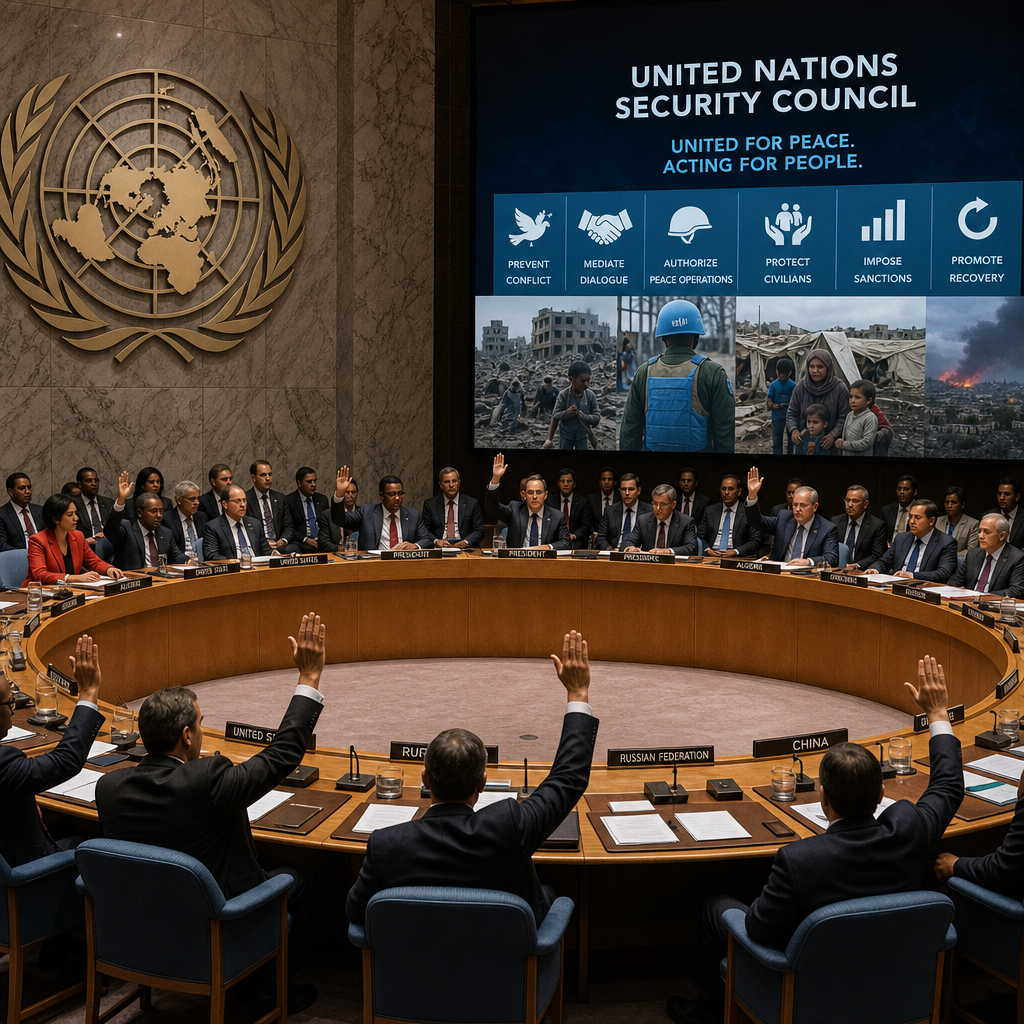
When global crises erupt, the UN Security Council becomes a key stage for urgent diplomacy, sanctions, peacekeeping, and decisions meant to protect civilians. But its response is shaped as much by international politics as by the crisis itself, which is why some emergencies move quickly while others stall.
By: Peter B on July 24, 2026
When a crisis threatens international peace and security, the UN Security Council is often the most visible forum in the world responding to it. From armed conflict and civilian protection to sanctions and peacekeeping, the Council plays a central role in shaping the global response. Understanding how the UN Security Council responds to global crises helps explain why some emergencies prompt quick action, why others stall, and how international law and diplomacy intersect during the most urgent moments.
The Security Council is not a world government, and it cannot solve every conflict. But it does have unique authority under the UN Charter to make decisions that member states are expected to carry out. That makes it one of the most important institutions for crisis management in today’s international system.
What the UN Security Council Does During a Crisis
The UN Security Council is responsible for maintaining international peace and security. When a crisis escalates, the Council can meet at any time and adopt measures ranging from political statements to binding resolutions.
Its response usually depends on the nature of the crisis. A civil war, a cross-border invasion, a terrorism threat, or a humanitarian emergency may each require a different approach. The Council’s tools include:
Debates and emergency meetings
Presidential statements
Press statements
Sanctions
Arms embargoes
Authorization of peacekeeping missions
Support for ceasefires or peace talks
Referral of situations to international justice mechanisms
These actions are designed to reduce violence, protect civilians, and encourage diplomatic solutions.
How the UN Security Council Responds to Global Crises
The Council’s response usually follows a familiar pattern, although each case is shaped by politics, urgency, and the interests of member states.
1. It gathers information and holds emergency consultations
When a crisis breaks out or worsens, the Council often convenes quickly. Member states, the Secretary-General, and relevant UN officials brief the Council on what is happening on the ground.
This first stage matters because it helps members assess:
Whether the situation threatens international peace and security
Which populations are at immediate risk
What actions may be politically possible
Whether regional organizations are already involved
Sometimes the Council meets publicly. In other cases, members negotiate in private before any formal statement is issued.
2. It issues political signals
Not every crisis leads to an immediate resolution. Sometimes the Council begins with a presidential statement or press statement to show concern and urge restraint.
These messages may:
Call for an immediate ceasefire
Condemn attacks on civilians
Demand humanitarian access
Support negotiations or mediation
Warn against escalation
Even when not legally binding, these statements can shape international expectations and signal that the crisis has global attention.
3. It negotiates a resolution
If members can agree on a shared response, the Council may adopt a resolution. A resolution can be binding and is often the most powerful tool available to the Council.
A resolution may:
Authorize sanctions
Deploy peacekeepers
Create a monitoring mechanism
Set deadlines for compliance
Request reports from the Secretary-General
Establish an arms embargo or travel ban
Because the Council includes five permanent members with veto power—China, France, Russia, the United Kingdom, and the United States—resolutions often require careful negotiation. If one permanent member opposes a draft, it can block action.
4. It uses pressure and incentives
The Council often relies on a mix of coercion and diplomacy. Sanctions are meant to pressure actors who are contributing to violence or instability. At the same time, the Council may support political talks, mediation, or ceasefire agreements to create a path toward de-escalation.
This combination reflects a basic reality: the Security Council works best when it can encourage a negotiated solution, not simply impose punishment.
5. It follows up on implementation
A resolution is only as effective as its implementation. The Council often creates committees, panels of experts, or reporting requirements to track compliance.
Follow-up may include:
Reviewing sanctions designations
Receiving regular briefings from UN missions
Evaluating ceasefire violations
Adjusting mandates for peacekeeping operations
In long-running crises, follow-up is essential. Without monitoring, even the strongest resolution can lose impact.
Key Tools the Security Council Uses
The Council’s authority comes from the UN Charter, especially Chapters VI and VII. In practice, this gives it a range of crisis response tools.
Sanctions
Sanctions are one of the Council’s most common responses. They can target individuals, groups, companies, or governments.
Examples include:
Asset freezes
Travel bans
Arms embargoes
Commodity restrictions
The goal is to change behavior without resorting to military force. In modern practice, the Council often prefers targeted sanctions over broad measures that can harm civilians.
Peacekeeping operations
The Council can authorize peacekeeping missions to help stabilize conflict zones. These missions may monitor ceasefires, protect civilians, support elections, or assist with disarmament.
Peacekeeping is not the same as peace enforcement. Peacekeepers usually operate with the consent of the host state and are meant to support political solutions rather than impose them by force.
Humanitarian access and civilian protection
In many crises, the Council focuses on people trapped by conflict. It may call for humanitarian corridors, protection of medical workers, or safe delivery of aid.
This is especially important when civilians face:
Siege conditions
Mass displacement
Famine
Attacks on hospitals or schools
Sexual and gender-based violence
The Council has increasingly recognized that civilian protection must be part of any effective response.
Referrals to international justice
The Security Council can also refer situations to the International Criminal Court when crimes such as genocide, war crimes, or crimes against humanity are alleged. This does not happen often, but it is one of the Council’s strongest accountability tools.
Why the Security Council Sometimes Moves Slowly
Many people expect the UN Security Council to respond instantly to emergencies. In reality, the Council often moves slowly because it is a political body made up of sovereign states with different interests.
The veto power of permanent members
The veto is the biggest reason the Council may deadlock. If a permanent member views a draft resolution as harmful to its interests or allies, it can block action.
This means the Council can struggle when:
Major powers disagree
A crisis involves a close partner of a permanent member
The response would require strong enforcement measures
Language on accountability or sanctions becomes controversial
Competing national interests
Council members may broadly agree that a crisis is serious while disagreeing on the best solution. Some favor sanctions; others prefer diplomacy first. Some want stronger language on human rights; others worry about state sovereignty.
These tensions can delay action or lead to weaker resolutions.
Limited enforcement capacity
Even after adopting a resolution, the Council depends on member states to carry it out. It has no standing army of its own. Its influence comes from legitimacy, coordination, and the willingness of states to act.
How the Council Responds to Different Types of Crises
The Security Council’s response varies depending on the crisis.
Armed conflict and civil war
In wars, the Council may focus on ceasefires, peacekeeping, sanctions on armed groups, and humanitarian relief. It may also support political transition or negotiations between combatants.
Cross-border aggression
If one state attacks another, the Council may condemn the aggression, call for withdrawal, and demand respect for sovereignty and territorial integrity. These cases can be highly politicized, especially if a permanent member is involved.
Terrorism and extremist violence
The Council often responds to terrorism through sanctions, intelligence coordination, and support for international cooperation. It may also assist states in strengthening border security and criminal justice systems.
Humanitarian crises
When war or political collapse creates famine, displacement, or mass suffering, the Council may focus on civilian access, aid delivery, and protection of vulnerable groups. It often works alongside humanitarian agencies and regional organizations.
Nuclear and weapons-related threats
The Council may address proliferation concerns by imposing sanctions, demanding inspections, or supporting diplomatic negotiations. These cases often involve intense negotiation because they touch on national security and regional balance.
The Role of Regional Organizations and UN Agencies
The Security Council does not act alone. It often coordinates with regional organizations such as the African Union, European Union, Arab League, or NATO, depending on the situation.
It also relies on:
The UN Secretary-General
Special envoys and mediators
Peacekeeping departments
Humanitarian agencies
Human rights investigators
This broader network allows the Council to combine political pressure with practical on-the-ground support.
Real-World Lessons About Council Effectiveness
The Security Council can be influential, but its success is uneven. In some cases, it helps create space for peace talks or deters further violence. In others, division among members limits its response.
A few lessons stand out:
Unity among major powers improves results
Clear mandates help peacekeeping missions
Targeted sanctions are more likely to avoid civilian harm
Sustained follow-up matters as much as the first resolution
Diplomacy works better when backed by credible international pressure
The Council is most effective when members share a common political goal and are willing to enforce the decisions they make.
Why the Security Council Still Matters
Despite criticism, the UN Security Council remains central to international crisis response because no other body has the same combination of legitimacy, authority, and global reach.
It matters because it can:
Bring urgent attention to a crisis
Create legal obligations for member states
Mobilize peacekeeping and sanctions
Support ceasefires and diplomacy
Link humanitarian concerns to political action
Even when the Council cannot act decisively, debate in the chamber can shape global diplomacy and influence what states do next.
Frequently Asked Questions
What is the main role of the UN Security Council in a global crisis?
The main role of the UN Security Council is to maintain international peace and security. During a crisis, it can call emergency meetings, adopt resolutions, impose sanctions, authorize peacekeeping missions, and support diplomatic efforts to reduce violence.
Can the UN Security Council stop a war?
The Council can help reduce violence, pressure parties to negotiate, and authorize peacekeeping or sanctions, but it cannot guarantee that a war will stop. Its effectiveness depends on member state cooperation, political unity, and whether the parties involved are willing to comply.
Why does the UN Security Council sometimes fail to act?
The Council may fail to act because permanent members disagree and use the veto, or because members cannot agree on how strong the response should be. Political rivalries and national interests often slow or block action.
Are UN Security Council resolutions legally binding?
Some Security Council resolutions are legally binding under the UN Charter, especially those adopted under Chapter VII. Others are political statements or recommendations. The exact effect depends on the language and authority used in the resolution.
How do sanctions from the Security Council work?
Security Council sanctions can freeze assets, restrict travel, embargo weapons, or target specific individuals and entities. They are intended to pressure those responsible for destabilizing behavior while minimizing harm to civilians.
The UN Security Council remains one of the most important institutions in global crisis management. When conflicts escalate, civilians are threatened, or international peace is at risk, the Council can bring urgent attention, shape diplomatic pressure, and authorize meaningful action. Its tools include resolutions, sanctions, peacekeeping, humanitarian support, and accountability mechanisms, all designed to encourage stability and protect people caught in the middle.
At the same time, the Council’s limitations are impossible to ignore. The veto power of permanent members, conflicting political interests, and weak enforcement can slow or block responses when action is most needed. That tension is built into the system. Still, the Council matters because it gives the international community a structured way to respond collectively rather than leaving each crisis to be handled in isolation.
If you want to understand global affairs, international law, or peace and security, learning how the UN Security Council responds to global crises is a strong place to start. It reveals both the promise and the challenge of trying to manage conflict in a world of sovereign states.
Peter B holds a degree in Journalism and has 5 years
of experience covering U.S. economic policy, labor markets, and
financial news. He writes data-driven news content on topics
like inflation, interest rates, and employment trends.